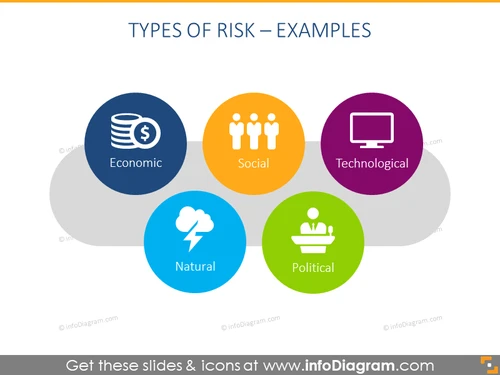
In an age where uncertainty is ubiquitous, understanding risk is paramount for individuals and organizations alike. Risk, often perceived as a daunting specter, can actually serve as the crucible for transformative opportunities. This article delves into various dimensions of risk, extends an invitation to reconsider its implications, and offers an illustrative example that highlights the five distinct types of risk.
First, let us examine the essence of risk itself. At its core, risk represents the potential for loss or the chance that an adverse event will occur. Yet, it simultaneously embodies the prospect for gains, providing a double-edged sword that can lead to either detriment or prosperity. The critical task lies in deciphering the fabric of risk, allowing us to navigate the complexities of our decisions.
The types of risk can often be categorized into five primary categories: financial risk, operational risk, strategic risk, compliance risk, and reputational risk. Each category bears its own nuances and challenges, influencing countless decisions in personal finance, corporate governance, and beyond.
1. Financial Risk
Financial risk pervades every aspect of fiscal management, representing potential losses due to market fluctuations, credit extensions, and other monetary factors. This risk can manifest through investments that downturn unexpectedly, or when market conditions shift, rendering previously viable strategies obsolete. Investors and corporate leaders alike grapple with the intricate web of assets and liabilities; they must make strategic decisions that balance risk tolerance with the desire for return on investment.
Imagine a startup aiming to disrupt an industry with a groundbreaking product. The initial financial investment may soar, supported by ambitious projections. However, financial risk looms large if the projected revenues fail to materialize. This dynamic emphasizes the need for robust financial modeling and risk assessment techniques that enable entities to forecast not only potential profits but also the likely consequences of adverse scenarios.
2. Operational Risk
Operational risk relates to the inherent dangers faced in the day-to-day functioning of an entity. This includes breakdowns in internal processes, systems failures, and human error. Take, for instance, a manufacturing company that relies on a complex supply chain. If a key supplier encounters a disruption due to geopolitical unrest or natural disasters, the ripple effects could halt production, affecting revenue streams and customer relationships.
The latent potential for such disruptions necessitates the implementation of strategic operational protocols, including contingency plans and diversified supplier networks. Just as flexibility is key in financial risk management, adaptive operational strategies are essential in averting catastrophic failures and ensuring business continuity.
3. Strategic Risk
Strategic risk is perhaps the most nebulous of all risk types, standing at the crossroads of ambition and caution. It arises from the long-term business strategies and decisions made by leaders. A glaring example is the decline of once-prominent retail giants who failed to pivot in an evolving market. Companies that fail to adapt may relinquish market share to more agile competitors who capitalize on innovative business models.
To mitigate such risks, organizations should conduct thorough market analyses, consumer trend observations, and constant evaluation of their positioning in relation to competitors. The realization that seizing new opportunities can often entail stepping into the unknown is crucial—a delicate dance of ambition and prudence.
4. Compliance Risk
In an increasingly regulatory landscape, compliance risk has gained prominence as organizations strive to align with laws and regulations governing their industries. Non-compliance can lead to severe consequences, including hefty fines and damage to reputation. A vivid example surfaces in the financial sector, where banks continually navigate stringent regulatory requirements to safeguard against fraud and ensure customer protection.
Adoption of diligent compliance measures not only acts as a safeguard but also instills consumer confidence. Embracing this as an opportunity for elevated standards can redefine a firm’s engagement with its customer base, highlighting the duality of risk as both a challenge and a path to excellence.
5. Reputational Risk
Perhaps the most intangible yet consequential form of risk is reputational risk, which can flourish through social media and rapid communication. A single misstep can spiral into a public relations crisis, causing irreparable damage. The actions of certain brands, whether tied to corporate social responsibility initiatives or perceived ethical dilemmas, can fall under scrutiny, leading to significant backlash. Consider major brands that have faced public outcry due to questionable manufacturing practices or poor customer service.
In a world where an event can trend on social media in mere moments, investing in a strong, positive reputation becomes vital. Herein lies the challenge: organizations must constantly foster relationships with stakeholders and the public to build resilience against the capricious nature of reputational risk.
By recognizing and understanding these five distinct types of risk, individuals and organizations can reshape their perspectives. The potential for negative outcomes can be daunting. However, it can also be reframed as a fertile orb for opportunity. Embracing risk empowers decision-makers to create more adaptive, resilient frameworks that navigate challenges while simultaneously fostering growth.
As one contemplates the myriad possibilities that risk introduces, the invitation to reimagine our relationship with uncertainty unfurls. Rather than viewing risk solely as a harbinger of potential calamity, recognizing its multifaceted nature allows for a more nuanced embrace of the complexity of life and business. We can then move forward with boldness and astuteness, fully aware of the uncertainties, yet ready to seize the opportunities they may conceal.