
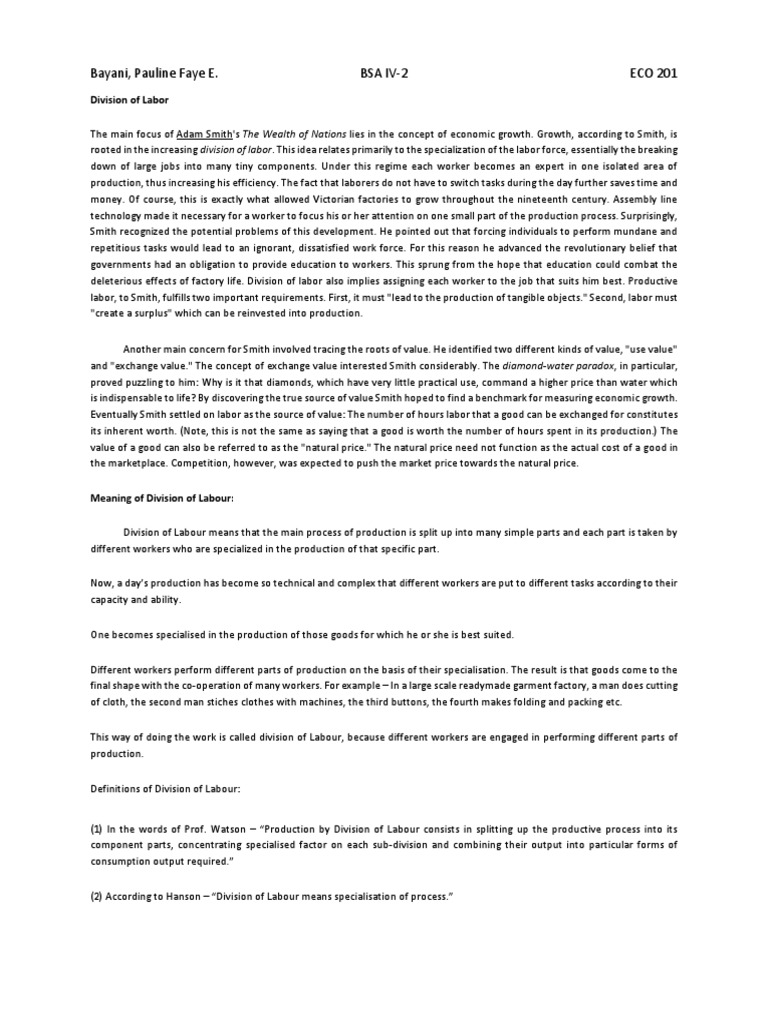
The concept of division of labor is akin to a finely tuned orchestra, with each musician playing a distinct role to create a harmonious symphony. Just as a conductor positions each instrumentalist to bring out the best in the collective sound, division of labor arranges individuals within an economic or organizational framework to enhance productivity and efficiency. This intricate arrangement allows tasks to be broken down into specialized functions, enabling workers to hone their skills and increase overall output.
The genesis of division of labor can be traced back to the seminal works of economists like Adam Smith, who illustrated this phenomenon with the famous example of a pin factory. In this scenario, a single worker attempting to make a pin would struggle to create even a few in a day. However, when the task is subdivided—one person drawing the wire, another cutting it, a third sharpening it, and so forth—the factory could produce thousands of pins efficiently. This systematic approach underscores the transformation of labor into a sophisticated and nuanced dance, where each individual contributes unique expertise.
Delving deeper, the intricacies of division of labor manifest in various domains, from industrial production lines to modern corporations. In essence, the principle remains the same: by allocating specific tasks to individuals, organizations capitalize on individual strengths, allowing for greater efficiency and higher quality outcomes. For example, consider a thriving automobile manufacturing plant. Here, the assembly line epitomizes the division of labor. Each worker is assigned a specific task, such as installing the engine, attaching the doors, or painting the chassis. This finely-detailed division yields accelerated production rates and a reduction in errors, ultimately delivering superior vehicles to consumers.
Notably, division of labor transcends mere efficiency; it is also a catalyst for innovation. As workers become adept in their designated roles, they may uncover new methods or tools to streamline processes, thus enhancing productivity even further. This self-reinforcing cycle not only optimizes efficiency but also fosters a culture of continuous improvement. Take, for example, software development teams. Traditionally, these teams comprised individuals with broad skill sets; however, the evolution of agile methodologies has paved the way for highly specialized roles such as ‘frontend developer,’ ‘backend developer,’ and ‘UX designer.’ Each role thrives on its niche expertise, propelling innovative solutions and expediting project delivery.
Nevertheless, the division of labor is not without its challenges. While specialization can lead to greater efficiency, it can also engender monotony. Workers engaged in repetitive tasks may experience diminished job satisfaction and a sense of alienation. This disparity highlights the delicate balance of the division of labor: while it drives efficiency, it can at times stifle creativity and personal fulfillment. To mitigate these risks, organizations can advocate for job rotation and continuous learning, allowing individuals to expand their skills and diversify their contributions.
Moreover, the impact of division of labor extends beyond the workforce to encompass broader economic and societal dimensions. It generates opportunities for trade and interdependence among various sectors. When one industry specializes in a particular capability, it can exchange its surplus with another, fostering a network of collaboration and mutual benefit. A vivid example can be found in agricultural practices, where farmers might specialize in different crops—one growing wheat, while another focuses on corn. This specialization creates a dynamic marketplace where goods are exchanged, fueling regional economies and enhancing community resilience.
In the grand tapestry of economic systems, division of labor is akin to the vibrant threads that interweave to create a compelling narrative. Without it, the efficiency, productivity, and innovation that characterize modern economies would falter. The phenomenon exemplifies the essence of specialization—where the whole becomes greater than the sum of its parts. Each worker, adept in their role, contributes to a flourishing ecosystem bolstered by shared knowledge, collaboration, and mutual objectives.
As society continues to evolve, the implications of division of labor are becoming increasingly pertinent. In the age of automation and artificial intelligence, new dimensions of specialization and collaboration emerge. Jobs may shift and transform, but the core principle remains unchanged: the division of labor will continue to be a cornerstone of economic advancement and a catalyst for societal progress. This dynamic landscape challenges us to rethink the interplay between specialization and creativity, calling for a future where individual expertise harmonizes with innovative collaboration.
In conclusion, the division of labor is a multifaceted paradigm that has historically shaped economic structures and continues to redefine modern workplaces. It fosters efficiency and innovation while presenting challenges that require thoughtful navigation. Understanding its nuances is essential as we move forward into a world where specialization will inevitably play a pivotal role in determining the trajectory of economic and social development. Just as an orchestra thrives through the unity of diverse instruments, so too does an economy flourish through the intricate interplay of specialized labor—a compelling testament to the power of collaboration in the human experience.













