
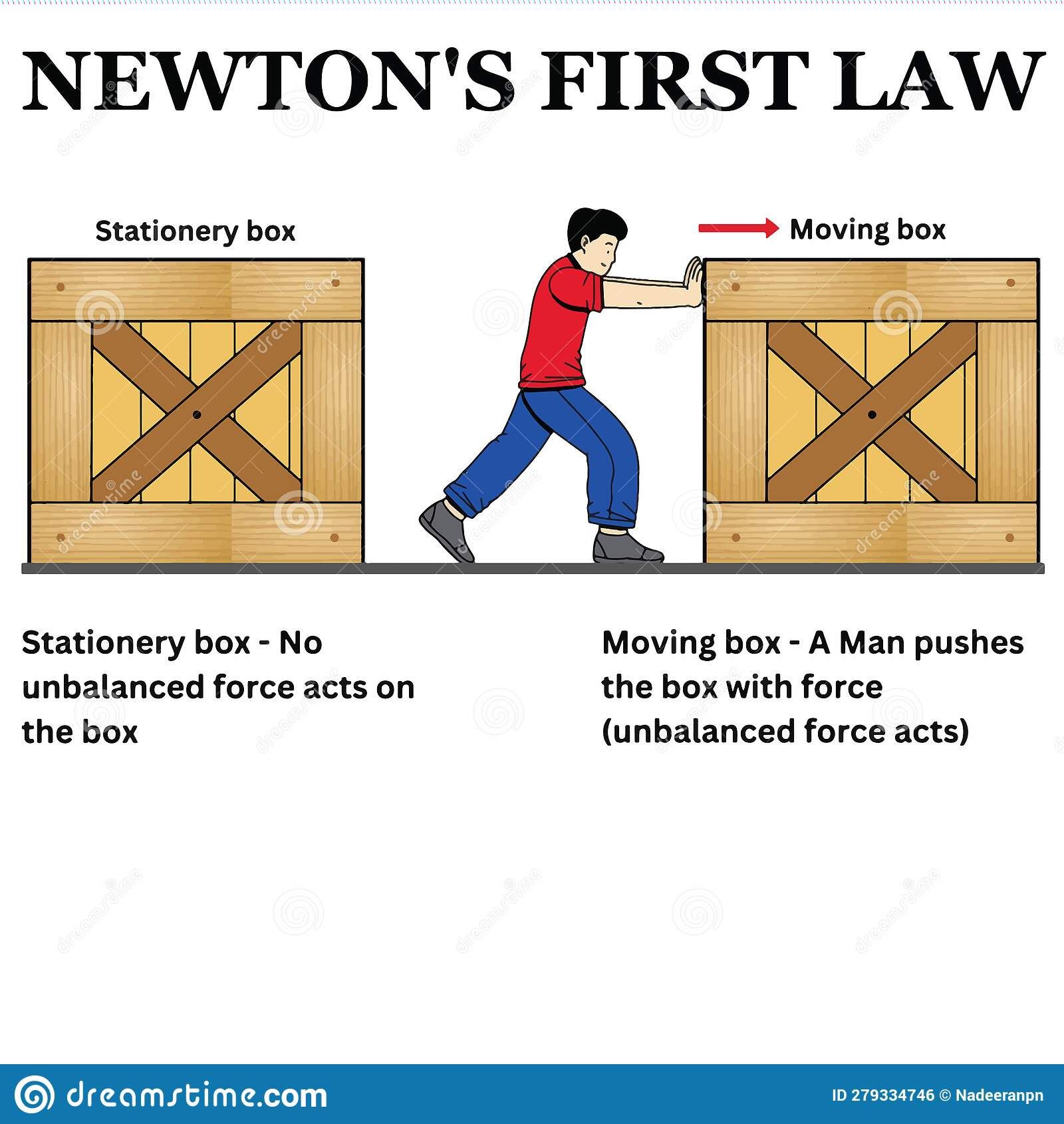
Newton’s First Law of Motion, often articulated as the law of inertia, presents a fascinating lens through which to observe the universe. This principle posits that an object will remain at rest or in uniform motion in a straight line unless acted upon by an external force. It may seem straightforward at first glance, but a deeper exploration reveals intricate implications that challenge our everyday experiences and perceptions of motion and rest.
To fully appreciate the profundity of this law, consider the simplicity of a stationary soccer ball on a field. The ball embodies a state of equilibrium, highlighting that in the absence of any external influences—be it a gust of wind, a foot striking it, or an incline of the ground—it will stubbornly remain in place. This quiet defiance against change beckons us to reconsider our assumptions about motion in our daily lives. The notion that an object, whether stationary or moving, has a natural propensity to maintain its state of inertia invites curiosity about the dynamics of our surroundings.
As we venture further into practical illustrations of Newton’s First Law, the scenario of a book resting on a table becomes compelling. Much like the soccer ball, the book experiences no net external forces when undisturbed. It is only when a deliberate action—an abrupt push or a gentle nudge—is applied that it transitions into motion. This transition elegantly underscores the interplay between inertia and external forces, prompting one to ponder the multitude of forces subtly governing our environments, often unnoticed.
Moreover, consider the example of a passenger in a car. As the vehicle accelerates, the passenger is compelled to lean back against the seat. This sensation encapsulates Newton’s First Law in action. The passenger’s body, which naturally prefers a state of rest, resists the sudden motion imparted by the car’s acceleration. This instinctual resistance underscores the inherent inertia of human bodies and objects alike, drawing a vivid connection between physics and our lived experiences.
This principle extends beyond mere inertia, illustrating both the predictability and unpredictability of physical behavior. Let’s transition to examining a more dynamic situation: a skateboarder gliding smoothly down a hill. When the skateboarder ceases to pedal, the board continues to roll along the slopes until friction or an obstacle necessitates a cessation of movement. The exhilarating feeling of wind tousling hair, coupled with the realization that forces such as friction and gravity were poised to counteract the skateboarder’s motion, embodies not only the essence of Newton’s First Law but also the exhilarating unpredictability of real-world experiences.
In a broader context, Newton’s First Law serves as a philosophical mirror reflecting countless life situations. Think about shifting paradigms in personal life. When one faces resistance in making a change—whether it’s adopting a healthier lifestyle or pursuing novel endeavors—the inertia of old habits can be palpable. This law invites introspection, encouraging individuals to recognize that just like an object at rest, often it requires an external influence, be it motivation, inspiration, or sometimes an upheaval, to overcome inertia.
Pivotal to understanding this law is recognizing the significance of external forces. Take, for example, the case of a dart thrown at a dartboard. The dart, propelled by the force of the throw, travels through the air until it strikes the board. In this scenario, several forces interact—the initial force from the throw, gravitational pull, and air resistance—all orchestrating the dart’s pathway. Each force contributes to the dart’s eventual resting place, offering a tantalizing perspective on how external variables shape outcomes in seemingly straightforward events.
Moreover, it is critical to examine scenarios where Newton’s First Law brings forth the phenomenon of collisions. In a car crash, for instance, we see inertia at its most dramatic. A car traveling at a high velocity suddenly collides with a stationary object, and both the car and its occupants experience a jarring force that changes their state of motion. This scenario poignantly illustrates the devastating potential of inertia when an external force is suddenly imposed, offering essential insights into safety protocols and the engineering of vehicles designed to mitigate such forces.
Thus, the nuances of Newton’s First Law resonate not just within the realm of physics, but also extend to societal structures and individual psyche. In our quest for progress, emancipation from conventionalities often requires an external catalyzing force to motivate action and change. Just as in physics, where an object’s inertia can be disrupted by a force, human inertia can similarly be harnessed and redirected through inspiration, mentorship, or even life-altering events.
In summary, Newton’s First Law proffers more than a simplistic perspective on motion; it invites a multi-faceted inquiry into the fabric of our existence. By examining the law through diverse lenses—ranging from childhood games to high-velocity collisions—we unearth the universal constants of inertia that transcend mere physics and permeate into the very essence of human experience. It challenges us to embrace curiosity and urges us to awaken to the myriad forces at play within our lives, encouraging a profound exploration of change, resistance, and the inexorable drive towards motion.













