
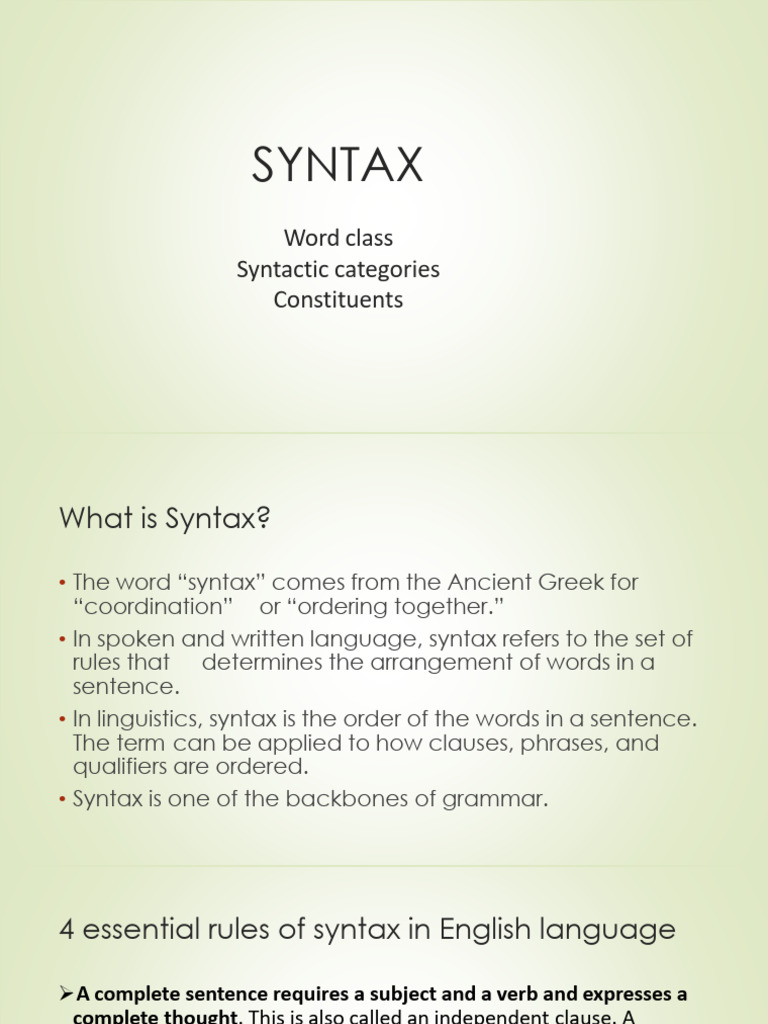
Syntax, often regarded as the backbone of language, serves as an intricate system governing how words combine to form coherent sentences. Though seemingly abstract, syntax plays a crucial role in communication, affecting not only meaning but also emotional resonance and clarity. This exploration into the realm of syntax will unravel its complexities, providing ample examples and illuminating its significance in everyday language.
At its essence, syntax involves the arrangement of words and phrases to create well-formed sentences. Consider the simple sentence, “The cat chased the mouse.” This straightforward construction illustrates fundamental syntactic rules. Here, the subject (“The cat”) precedes the verb (“chased”), which subsequently leads to the object (“the mouse”). This ordered sequence ensures that the sentence conveys a clear meaning, demonstrating the functional importance of syntax.
Delving deeper, syntax can transform mundane sentences into eloquent expressions. For instance, altering the original sentence to “Chased by the cat, the mouse fled in panic” shifts the focus and formality while retaining the core idea. It employs a different syntactic structure, showcasing how varied arrangements can enrich expression. Such manipulation of syntax is not merely a creative endeavor but serves to enhance clarity and emphasis, allowing speakers and writers to convey nuanced meanings.
One notable aspect of syntax is its capacity to evoke specific feelings through word order. Consider the emotional weight of “I love you” compared to “You are loved by me.” The first phrase is direct and passionate, utilizing active voice and straightforward syntax. In contrast, the latter: passive voice and a more complex structure subtly detracts from the intimacy. This distinction underscores how syntactical choices influence perception, showcasing the art of wordcraft in revealing deeper emotional undercurrents.
Syntax also varies significantly across languages, each possessing its own unique rules and structures. In English, a predominately Subject-Verb-Object (SVO) language, word order dictates meaning. However, in languages such as Latin or Russian, the inflection of words often indicates grammatical relationships, allowing for greater flexibility in sentence construction. These syntactic variations serve as a testament to cultural and linguistic diversity, emphasizing how language is a living reflection of human thought and interaction.
Furthermore, syntax underpins the concept of phrases and clauses, both of which contribute to the richness of language. A phrase, such as “under the old oak tree,” adds descriptive detail without containing a subject-verb pairing. Clauses, on the other hand, can be independent or dependent, enabling complex ideas to unfold. For example, in the sentence “Although it was raining, the picnic continued,” the dependent clause “Although it was raining” sets the stage for the independent clause, creating a more sophisticated sentence that captures contrasting ideas.
The fascination with syntax extends beyond its structural function; it delves into cognitive processes. Psycholinguistics studies illustrate how individuals process syntactical structures when reading or listening, revealing that the brain is adept at parsing sentences swiftly, drawing on contextual clues and inherent rules. Neuroimaging studies have shown that specific brain regions activate when encountering complex or unconventional syntax, suggesting a profound relationship between syntax and cognitive function.
Moreover, the evolution of syntax reflects broader shifts in society and culture. As language evolves, so too do syntactic norms. The rise of digital communication has birthed a new syntax characterized by brevity and immediacy, often seen in text messaging and social media. The sentence “LOL, can’t believe it!” exemplifies this trend, demonstrating how syntactical conventions can adapt to the demands of contemporary expression. This evolution invites reflection on how syntax serves not only as a grammatical framework but as a living entity that changes in tandem with human interaction.
Syntax also plays a pivotal role in literature. Authors manipulate sentence structure to create rhythm, pace, and mood. For example, the prose of Ernest Hemingway is known for its stark simplicity, often employing short, declarative sentences that deliver powerful impact. In contrast, the intricate, multilayered sentences of Virginia Woolf showcase a shift in syntax that mirrors the tumultuous inner thoughts of characters. Such masterful syntactical choices highlight the writer’s intent and enhance the reader’s experience, revealing the profound connection between syntax and stylistic expression.
As we continue to unravel the layers of syntax, it becomes evident that it is more than a mere set of rules; it is a lens through which we understand language and, consequently, the world around us. By examining syntax, we engage with the fundamental ways in which humans communicate. It invites us to appreciate the interplay between structure and meaning, the elegance of simplicity, and the complexities that arise when words are woven into sentences. This linguistic tapestry illustrates not only the fundamental characteristics of language but also the broader narratives that shape human thought and interaction.
In conclusion, syntax is an intricate system that transcends mere grammatical structure. Its influence permeates communication, literature, and cognition, offering a fascinating glimpse into the interplay between language, thought, and culture. Through careful examination and appreciation of syntax, we not only understand the mechanics of language but also unlock deeper insights into the ways that humanity engages, expresses, and evolves. Whether in informal conversations, literary masterpieces, or the evolving terrain of digital communication, the essence of syntax continues to captivate and define our linguistic journey.













