
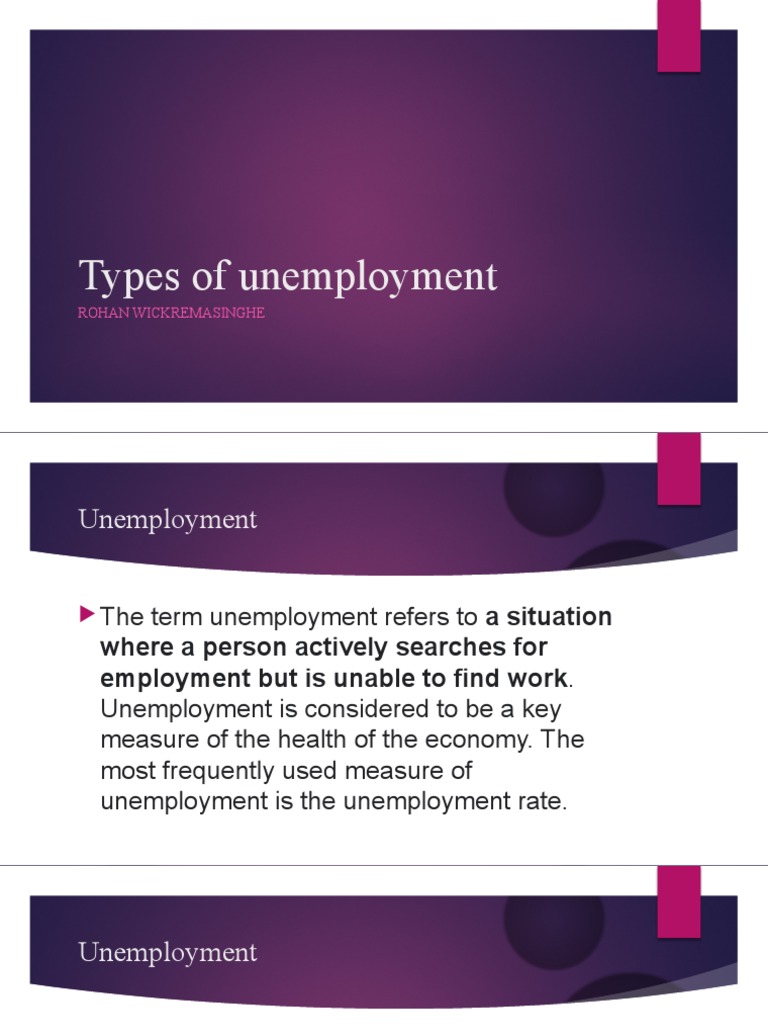
Unemployment is a critical phenomenon that impacts economies, communities, and individuals alike, revealing the subtle intricacies of the labor market. Often relegated to mere statistics, the various types of unemployment offer a lens into the multifaceted nature of joblessness, prompting us to rethink conventional perceptions. In this exploration, we will delve into the distinctions among the principal types of unemployment, enhancing our understanding through vivid examples and insightful analysis.
Unemployment can broadly be categorized into several types, each dittoed by its unique underlying causes and societal implications. The most prominent classifications include frictional, structural, cyclical, seasonal, and long-term unemployment. Navigating these waters reveals not only the economic consequences but also the human stories woven into the fabric of joblessness. Let us dive into each type.
1. Frictional Unemployment
Frictional unemployment occupies an intriguing space within the job market. This form occurs when individuals voluntarily leave their jobs to seek new opportunities, often driven by a desire for better wages, career advancement, or improved working conditions. It reflects a natural transition phase that everyone experiences at some point in their professional lives.
Consider the example of Sarah, a recent college graduate. After landing her first job at a corporate firm, she realizes that the corporate lifestyle does not align with her personal values or aspirations. Choosing to quit, she embarks on a quest for a role in environmental advocacy, a field that resonates with her passions. Sarah’s journey typifies frictional unemployment — a transient state that underscores the importance of personal choice in career progression.
2. Structural Unemployment
In contrast to frictional unemployment, structural unemployment arises from fundamental shifts in the economy that alter the demand for certain skills. As industries evolve due to technological advancements or changes in consumer preferences, some jobs become obsolete while new ones emerge. This misalignment can leave workers stranded, lacking the requisite skills to thrive in the changing market landscape.
For example, consider the impact of automation on manufacturing jobs. As robots and artificial intelligence become more prevalent in production lines, workers like John, a long-time factory employee, may find themselves displaced. Lacking technical skills to operate new machinery, John’s struggle exemplifies structural unemployment. It illuminates a vital societal challenge: the need for robust vocational training to prepare the workforce for an ever-evolving job market.
3. Cyclical Unemployment
Cyclical unemployment is intricately tied to the fluctuations of the economic cycle, linked with periods of economic downturns or recessions. As consumer demand wanes, businesses may curtail operations, leading to job losses. This form of unemployment serves as a barometer for economic health, illustrating how vulnerability within the job market can arise from larger macroeconomic forces.
To illustrate, let’s consider the 2008 financial crisis. During this turbulent period, widespread failures among financial institutions triggered an avalanche of job losses across various sectors. Emma, who worked in the housing market, suddenly found herself unemployed as mortgage companies shuttered their doors. Her experience encapsulates the core essence of cyclical unemployment, reminding us that economic stability is intricately linked to workforce vitality.
4. Seasonal Unemployment
Seasonal unemployment ebbs and flows in accordance with seasonal demand, affecting industries like agriculture, tourism, and retail. Workers in these sectors often face joblessness during off-peak seasons, which can result in a precarious financial situation for many families. The cyclical rhythm of the calendar thus dictates their livelihood.
Take the case of Tom, a ski instructor. Each winter, he thrives on the slopes, teaching eager learners. However, as spring arrives and snow melts, Tom finds himself unemployed until the next ski season. His fluctuating employment epitomizes seasonal unemployment, underscoring the disconnect between work availability and seasonal demands that many face.
5. Long-term Unemployment
Long-term unemployment is perhaps the most debilitating form, defined as individuals who remain unemployed for an extended period, often six months or longer. This condition can erode skills, leading to a diminishing self-esteem and reduced employability. The psychological toll, compounded by economic strains, can create a vicious cycle of despair and disengagement.
Consider Patricia, a professional who has faced repeated job searches without success due to her protracted unemployment. Over time, her skills have dulled, and she struggles with the evolving trends in her field. As the months stretch into years, her confidence wanes. Patricia’s experience is a poignant reminder of the profound effects long-term unemployment can have, necessitating targeted support and re-skilling initiatives to aid reintegration into the workforce.
In synthesis, understanding the varied strands of unemployment enriches our perspective on this pressing societal issue. Frictional, structural, cyclical, seasonal, and long-term unemployment each present distinct challenges that require tailored solutions. They remind us that behind every statistic lies a narrative shaped by personal journeys, economic landscapes, and the relentless pursuit of meaningful work. The next time we consider unemployment, let us not simply view it as a number, but rather as a tapestry of human experiences reflecting our evolving world.












