When we delve into the world of literature, we often find ourselves enamored by the rhythm and patterns that words create. But have you ever asked yourself, what is it that makes poetry resonate so deeply? Could the secret lie within something as understated as meter? This invites an intriguing challenge: can you decode the magic of meter in literature and uncover its transformative power? Let us embark on a journey through the intricacies of poetic meter, exploring its significance, various forms, and how it shapes our understanding of poetry.
Meter can be defined as the structured rhythm of a poem, determined by the arrangement of stressed and unstressed syllables. It serves as a foundational element, crafting the musicality that can evoke emotions and conjure vivid imagery. One might consider meter as the backbone of verse—without it, poetry may flounder in the murky waters of prose. The challenge, of course, is mastering its complexities while maintaining creativity and personal voice.
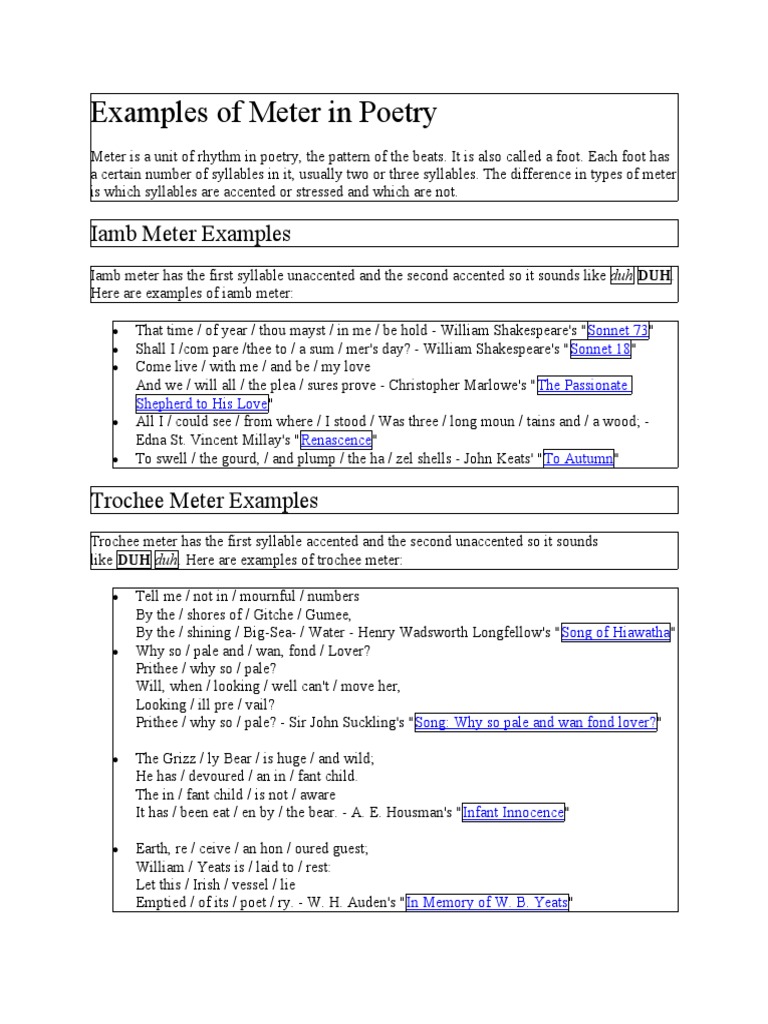
To better understand meter, let’s examine some prevalent types that have shaped literature through the ages. The most celebrated form is iambic pentameter, a structure that consists of five iambs per line. An iamb is a metrical foot containing an unstressed syllable followed by a stressed syllable. This rhythmality is famously utilized by Shakespeare, who imbues his works with a captivating flow. In “Shall I compare thee to a summer’s day?” the cadence encapsulated within this structure draws readers into the poem’s embrace, complementing its themes of beauty and desire.
Conversely, anapestic meter—characterized by two unstressed syllables followed by a stressed syllable—provides a more playful and lively tone. This meter can be found in works like “The Night Before Christmas” by Clement Clarke Moore, where the rhythm tends to bounce along with a buoyancy that mirrors the whimsical imagery. Can you feel the exhilaration in the fluttering verses? Such metrical choices encourage a deeper exploration of the text, inviting readers to dance alongside the words.
Yet another intriguing form is trochaic meter, which flips the structure of the iamb. A trochee consists of a stressed syllable followed by an unstressed one, bestowing a more emphatic and spirited quality to the verse. Consider Longfellow’s use of trochaic meter in “The Song of Hiawatha.” The robust rhythmic pattern, along with the meter’s drum-like pulsation, allows the reader to vividly picture the journey of its titular character, drawing them deeper into native mythology and folklore. Herein lies the challenge: can you wield these metrical forms to elicit specific moods and imagery? The answer beckons exploration.
Moreover, the effects of meter extend well beyond mere aesthetic appeal. It becomes an integral component in shaping meaning and highlighting themes within a poem. For instance, a shift from one meter to another can indicate a turning point in the narrative or a transformation in the speaker’s perspective. This deft manipulation can further immerse readers in the emotional landscape of the piece. The modern poet might employ free verse to highlight the discontinuities in their experience, while traditional forms allow a sense of stability and control. In both instances, meter operates as a guiding force, one that anchors ideas while simultaneously allowing for movement and innovation.
Many poets have experimented with meter, interweaving various forms to create a symphony of sounds and rhythms. In T.S. Eliot’s “The Love Song of J. Alfred Prufrock,” the sporadic meter mirrors the character’s fragmented psyche, unraveling layers of introspection and indecision. The fluctuating rhythm invites readers to engage with Prufrock’s introspective challenges. Here, one might ask: how does the interplay of meter inform our understanding of the character’s emotional state? This is where the true essence of meter lies—it’s a gateway into the mind of the poet and their creations.
The contemporary landscape of poetry has seen revolutionary alterations to traditional meter, with poets embracing unconventional structures that often break the rules. Slam poetry, for example, utilizes rhythm in ways that reflect urban speech patterns and cultural dynamics. In this arena, meter becomes an electrifying force, melding sound and message into explosive performances that resonate with authenticity. This invites another inquiry: how can we innovate within metrical forms while honoring the established traditions of poetic rhythm? This quest for innovation is ongoing and is where modern poets are forging their own paths.
As our exploration into meter concludes, it becomes evident that its presence enriches literary works in ways that go beyond the superficial. The challenge now resides with you. How will you engage with meter—will you embrace traditional forms, or will you push the boundaries of what poetry can achieve? The delicate dance between structure and creativity is a personal undertaking, one that each budding poet must navigate in their quest for expression.
Ultimately, meter in literature is not merely a collection of rules but a living, breathing component of poetic artistry. Whether through iambic rhythms that evoke a sense of timelessness or the playful bounce of anapestic forms, meter invites us to experience the depth and complexity of human emotion. So, take up the challenge and explore the world of meter—who knows what transformative pathways may unfold before you?