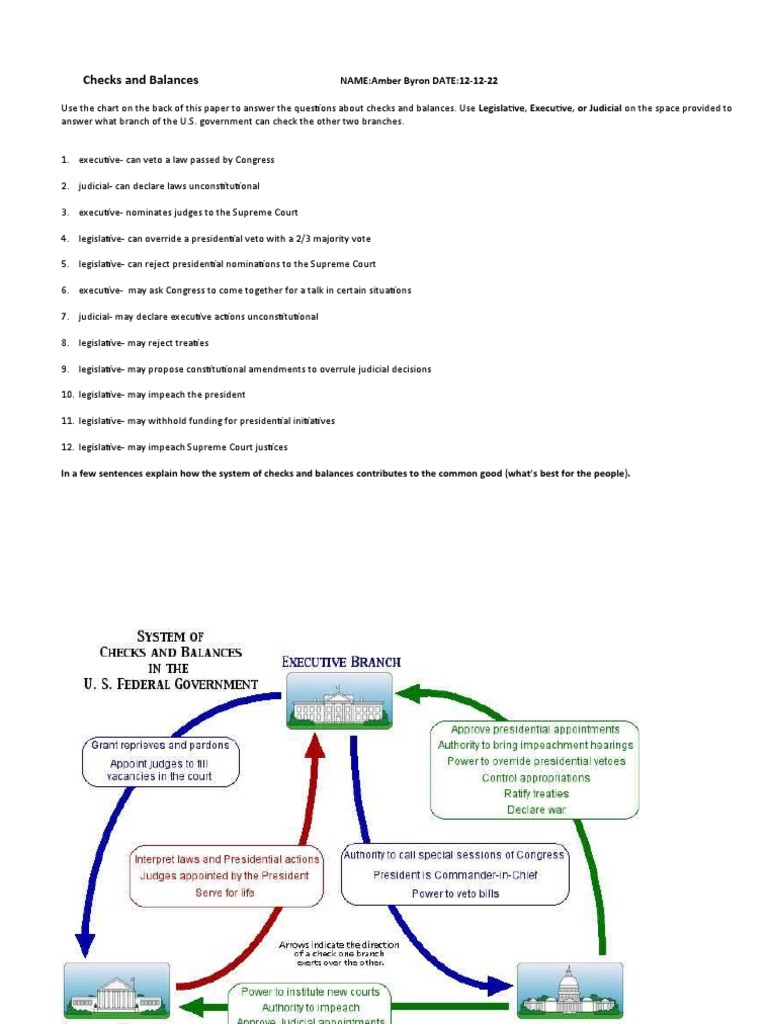
The concept of checks and balances is a fundamental principle in political theory, primarily aimed at preventing any one branch of government from becoming overly powerful. This system is intricately woven into the fabric of modern democracies, particularly in the United States. It dictates that the powers of government are divided among various entities, each with its own responsibilities and the ability to govern others. The following listicle delves into vivid examples of this critical mechanism, illustrating how it operates within various spheres of governance.
1. The Three Branches of Government
At the core of the checks and balances system in the U.S. lie three branches of government: the Executive, the Legislative, and the Judicial. Each of these branches possesses distinct powers and functions while simultaneously maintaining the ability to oversee and limit the actions of the others.
Executive Branch: Enforcement of Laws
The Executive branch, led by the President, is responsible for enforcing laws. However, its power is limited by the Legislative branch, which wields the authority to create laws. For instance, the President may veto legislation; yet, Congress can override this veto with a two-thirds majority. This tension exemplifies the interplay between branches, ensuring that no single entity can wield unchecked authority over law-making processes.
Legislative Branch: Creating Laws
Conversely, the Legislative branch, comprised of the Senate and House of Representatives, is tasked with drafting legislation. However, the Judicial branch can review laws to assess their constitutionality. A prominent case underscoring this was Brown v. Board of Education (1954), wherein the Supreme Court ruled that state laws establishing separate public schools for black and white students were unconstitutional, thereby dismantling legal barriers to equality.
Judicial Branch: Interpreting Laws
The Judicial branch interprets laws and adjudicates disputes, acting as a guardian of the Constitution. Notably, it can declare legislation unconstitutional, as demonstrated in the landmark case of Marbury v. Madison (1803), which affirmed the principle of judicial review. Thus, while the Legislative branch can create laws, the Judicial branch ensures their alignment with the Constitution.
2. Federal vs. State Powers
Checks and balances also manifest at the federal and state levels of governance. Federalism, the division of power between national and state governments, creates a dynamic environment where both levels must work collaboratively, yet remain vigilant against overreach.
The Tenth Amendment is pivotal in this respect, as it stipulates that powers not delegated to the federal government are reserved for the states. This arrangement allows states to enact laws that reflect their specific needs while ensuring that the federal government cannot usurp state authority arbitrarily. A noteworthy instance is the legalization of marijuana. Some states have chosen to legalize it for recreational use, challenging federal law, which still classifies it as illegal.
3. Separation of Powers: The Essence of Liberty
The separation of powers entrenched in checks and balances fosters a culture of accountability and transparency. This principle’s importance extends beyond government and penetrates various sectors, such as the corporate world, where internal checks within a company are essential for ethical governance.
For instance, a board of directors may authorize major decisions, but oversight is contributed by a company’s audit committee, ensuring that all financial practices align with regulations and ethical standards. Such structural delineation within corporations reflects the same vigilance inherent in governmental frameworks.
4. Media as a Watchdog
The role of media in a democracy cannot be understated; it acts as a fourth estate, maintaining a watchful eye on the actions of those in power. Investigative journalism serves as an essential check, exposing corruption, abuse of power, and other malfeasance in government.
Consider the Watergate scandal, which ultimately led to the resignation of President Richard Nixon. Investigative articles published by the Washington Post revealed the extent of wrongful actions, showcasing how a vigilant press can serve as a mechanism for checks and balances, holding leaders accountable to the populace.
5. Civil Society and Grassroots Movements
The engagement of civil society organizations and grassroots movements exemplifies another layer of checks and balances. When citizens mobilize to advocate for their rights or to challenge governmental actions, they become a vital force that can counterbalance the powers of the state.
Modern movements such as Black Lives Matter and environmental activism reflect how organized citizen engagement can influence legislative agendas. Such movements compel lawmakers to address the concerns of the people, demonstrating that democracy thrives not solely on institutional frameworks but also on active citizen participation.
6. International Checks and Balances
Finally, the concept stretches beyond national boundaries as international organizations and treaties provide additional avenues for oversight and cooperation between nations. The United Nations, for example, is an international body that promotes global peace and security, often acting as a mediator in conflicts that could disrupt the balance of power.
Furthermore, treaties like the Paris Agreement on climate change require countries to hold each other accountable regarding environmental practices, ensuring that no single nation can act unilaterally without facing international repercussions.
In conclusion, the principle of checks and balances is embodied in various mechanisms within and beyond government. By segregating powers among branches, levels, and societal actors, this intricate framework fosters a culture of accountability. From the interplay among the Executive, Legislative, and Judicial branches to the role of civil society and the influence of international law, the examples of checks and balances serve as a testament to the resilience of democratic ideals. The ongoing evolution of these mechanisms ensures that the principles of justice, accountability, and liberty remain at the forefront of governance, empowering citizens and protecting their rights against the encroachment of power.