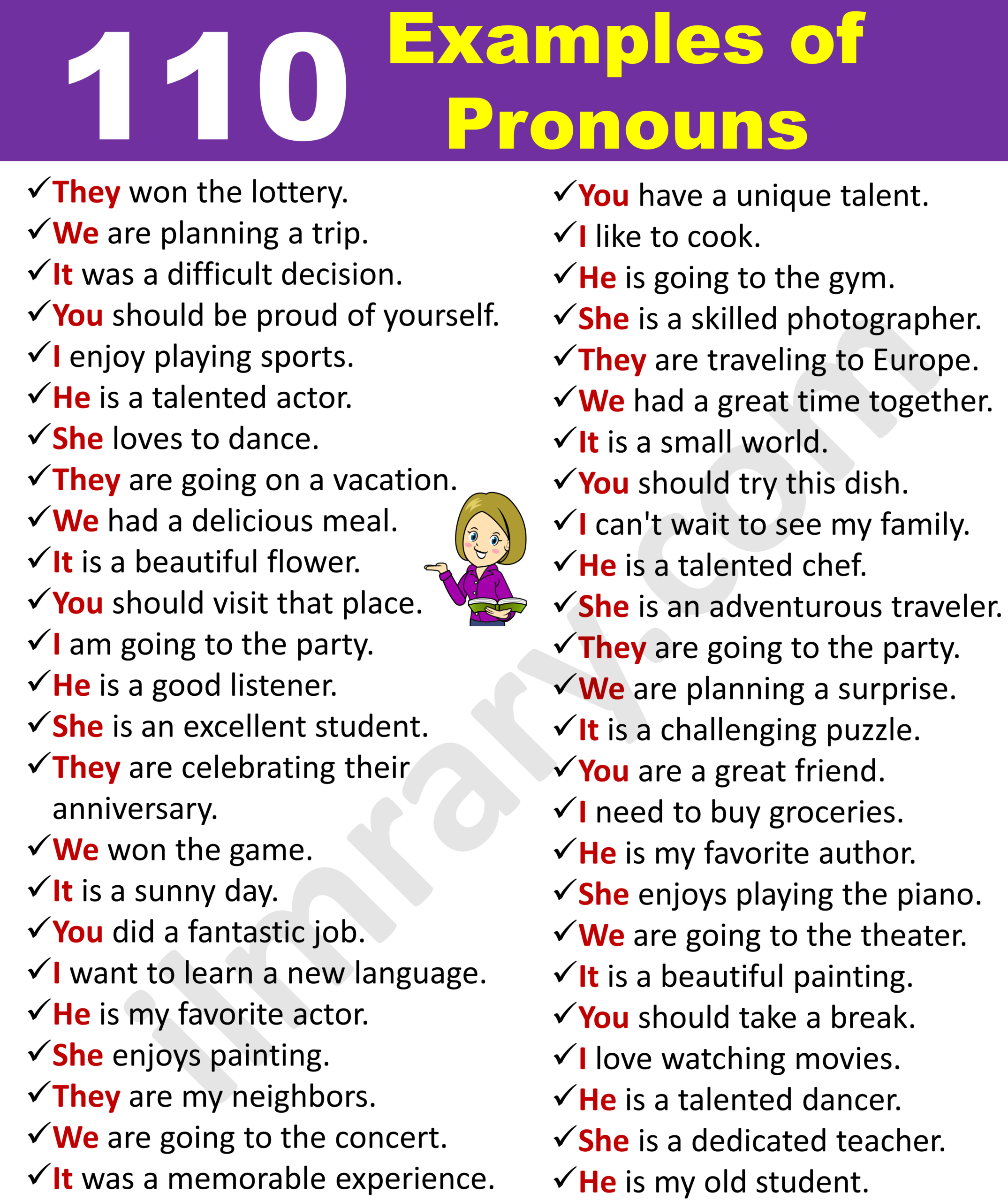
Pronouns are like the unsung heroes of language—subtle yet powerful, often lurking in the shadows of sentences, waiting to create coherence and clarity. They stand in for nouns and help us avoid redundancy, breathing life into our communication without overwhelming our listeners or readers with repetition. Understanding pronouns and their usage is fundamental to mastering the English language.
At its core, a pronoun is a word that replaces a noun or noun phrase. Consider them as the chameleons of grammar; they adapt based on context, taking on various roles. Whether we are discussing individuals, objects, or abstract concepts, pronouns allow us to express ourselves effectively while maintaining a fluid narrative. Let’s delve deeper into the fascinating world of pronouns through a variety of examples.
To start, personal pronouns are perhaps the most straightforward. They refer directly to specific people or things. For instance, “I,” “you,” “he,” “she,” “it,” “we,” and “they” are personal pronouns that represent individuals or groups. “I” denotes the speaker, while “you” engages the listener. The third-person pronouns “he,” “she,” and “it” introduce others to the conversation. “We” and “they” include or refer to groups of individuals. The elegance of personal pronouns lies in their ability to simplify complex ideas into singular expressions. For example:
- I
- You
- He
- She
- It
- We
- They
- You
Next, we encounter possessive pronouns, which convey ownership—like a crown that signifies rule. These pronouns—“my,” “your,” “his,” “her,” “its,” “our,” and “their”—indicate to whom something belongs. For example:
- My
- Your
- His
- Her
- Its
- Our
- Their
- Your
Reflexive pronouns add another layer of intrigue to our narratives. They are those remarkable words—“myself,” “yourself,” “himself,” “herself,” “itself,” “ourselves,” and “themselves”—that act upon the subject of the sentence. Reflexive pronouns emphasize the subject’s agency and can imbue a sentence with a sense of intimacy or self-reflection. As seen in these examples:
- Myself
- Yourself
- Himself
- Herself
- Itself
- Ourselves
- Themselves
- Yourself
As we explore indefinite pronouns, we step into a realm of ambiguity, where specificity gives way to generalization. Indefinite pronouns—“anyone,” “everyone,” “somebody,” “no one,” “many,” and “few”—allow us to speak of individuals and groups without pinpointing exact identities. They evoke a sense of universality and connection, making our language relatable. For instance:
- Anyone
- Everyone
- Somebody
- No one
- Many
- Few
- Everyone
Then, we have relative pronouns—”who,” “whom,” “whose,” “which,” and “that”—which connect clauses, creating a tapestry of information woven into a coherent thought. These pronouns introduce relative clauses, lending specificity and depth to our observations. Consider these examples:
- Who
- Whom
- Whose
- Which
- That
- Whom
In conclusion, pronouns are indispensable tools in the arsenal of language, acting as both concise substitutes and connectors, allowing us to express complex thoughts with elegance and clarity. They transform the mundane into the extraordinary, making our communications resonate on multiple levels. Understanding the nuances of pronouns not only enhances our grammatical prowess but also enriches our engagement with the world around us, like a master artist skillfully blending colors on a canvas to create a masterpiece.