Imagine a bustling market, the air thick with the aroma of spices and the cacophony of vendors eagerly beckoning passersby to taste their wares. Each stall glows with a bounty of colors, textures, and flavors. In this vibrant tableau, one encounters a powerful analogy for understanding combinations: it is like selecting an assortment of delightful delicacies from the myriad choices before you. In the world of mathematics, combinations represent the art of selection, where the order of the chosen items is inconsequential. This intriguing concept finds resonance in various real-life scenarios, weaving itself into the fabric of decision-making and problem-solving.
To elucidate the concept of combinations, let us break down this mathematical jewel, exploring its essence and illuminating examples that carve its importance in multiple contexts. Consider this as a treasure hunt; its hidden gems lie within the principle of combinations, inviting you to uncover their significance.
The Definition of Combinations
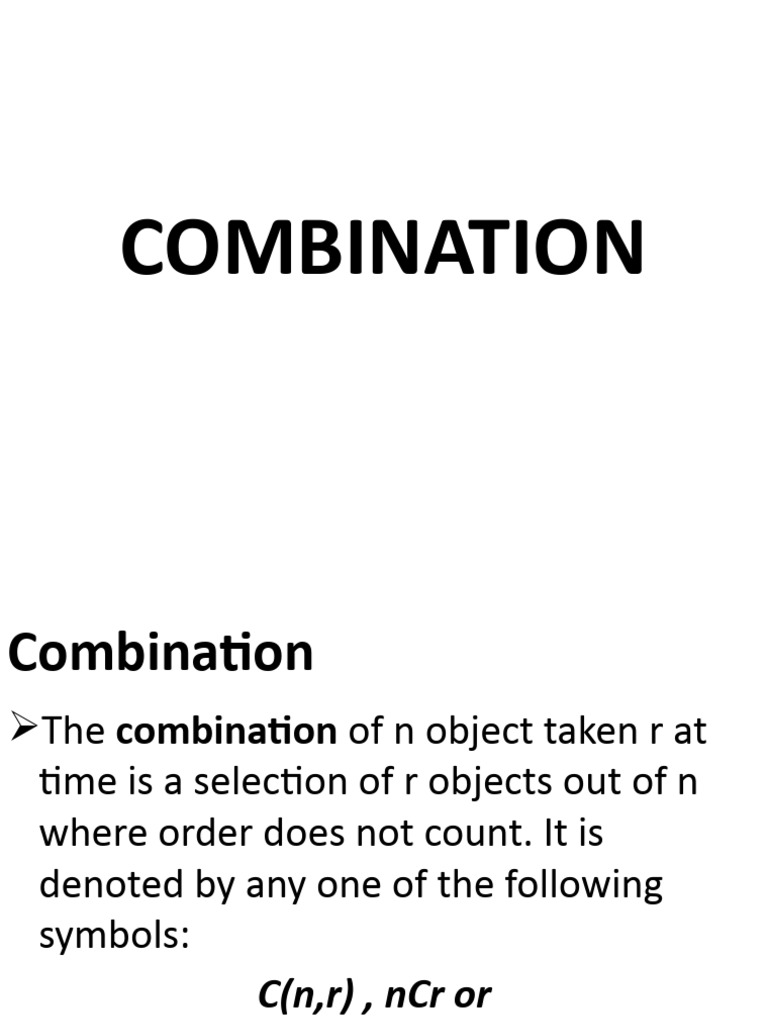
At its core, a combination is a selection of items without regard to the sequence in which they are chosen. This is not merely an academic definition; it’s an entryway into an expansive realm of possibilities. When you choose 3 fruits from a basket of 5—be it an apple, an orange, a banana, a grape, and a pear—how many ways can those fruits combine? Unlike permutations, which focus on the intricate arrangements of selections (think of arranging fruits in an eye-catching display), combinations allow the fruits to coexist peacefully, without concern for their order.
The Formula: C(n, r)
The mystique of combinations is often encapsulated in the formula C(n, r) = n! / (r! * (n – r)!), where n represents the total number of items, and r symbolizes the number of selected items. The exclamation mark denotes factorial, a mathematical function that multiplies a number by all positive integers less than itself. For instance, if you’re selecting 3 fruits from a choice of 5, the calculation becomes quite telling. This formula serves as the compass guiding the curious through the labyrinthine world of combinations.
Applications of Combinations
Combinations extend their tendrils into various disciplines, each time revealing a new facet of their allure. Let us embark on a journey through several applications:
1. Scientific Research
In the realm of scientific exploration, researchers often find themselves in a cornucopia of variables. When conducting experiments, choosing different combinations of compounds can yield unpredictable results. For instance, a biochemist studying the effects of drug combinations on a specific ailment must evaluate several permutations of active ingredients to ascertain the ideal mix. Understanding combinations helps streamline this process, enhancing the efficiency and effectiveness of groundbreaking discoveries.
2. Culinary Arts
In the culinary world, the phrase “the perfect recipe” is often tossed around, though the true art lies in the combination of ingredients. A master chef’s ability to blend flavors, textures, and colors creates a symphony that delights the palate. When crafting a salad, the combination of lettuce, tomatoes, cucumbers, and avocados allows you to deviate from traditional patterns, crafting a magnificent dish tailored to your liking. Every culinary creation, at its heart, is an exquisite dance of combinations.
3. Fashion and Design
The world of fashion flourishes on the notion of combinations. Designers curate collections that juxtapose diverse elements—prints, fabrics, and styles—to create striking ensembles. The selection of accessories plays a crucial role in this interplay of combinations. Whether mixing and matching jewelry or pairing shoes with outfits, the art of combination imbues personal style with individuality, allowing self-expression to flourish.
4. Sports Teams
Sports teams embody the principle of combinations, as coaches must strategically select players to form a cohesive unit. The amalgamation of skills, strengths, and personalities often determines a team’s success. Just like assembling a colorful bouquet, the harmonious blend of athletes can create formidable synergy, resulting in a championship-worthy squad.
5. Event Planning
In the realm of event planning, combinations shine in their full glory. From wedding seating arrangements to curated guest lists, the essence of each event lies in the thoughtful selection of attendees and activities. Combinations help organizers ensure that every gathering is a balanced blend of personalities, fostering an atmosphere of camaraderie and joy.
Conclusion: The Art of Selection
The concept of combinations intertwines itself into the myriad threads of our lives, much like the vivid tapestries adorning the walls of a grand museum. Each example illuminated in this exploration reveals the artistry inherent in selection; whether in scientific inquiry, culinary masterpieces, or the creation of memorable events, combinations offer a framework for understanding complexity. By embracing this mathematical principle, one can navigate myriad choices to unveil the best possible outcomes. In essence, combinations are more than just numbers—they represent the beautiful art of selection that pervades our everyday existences.