
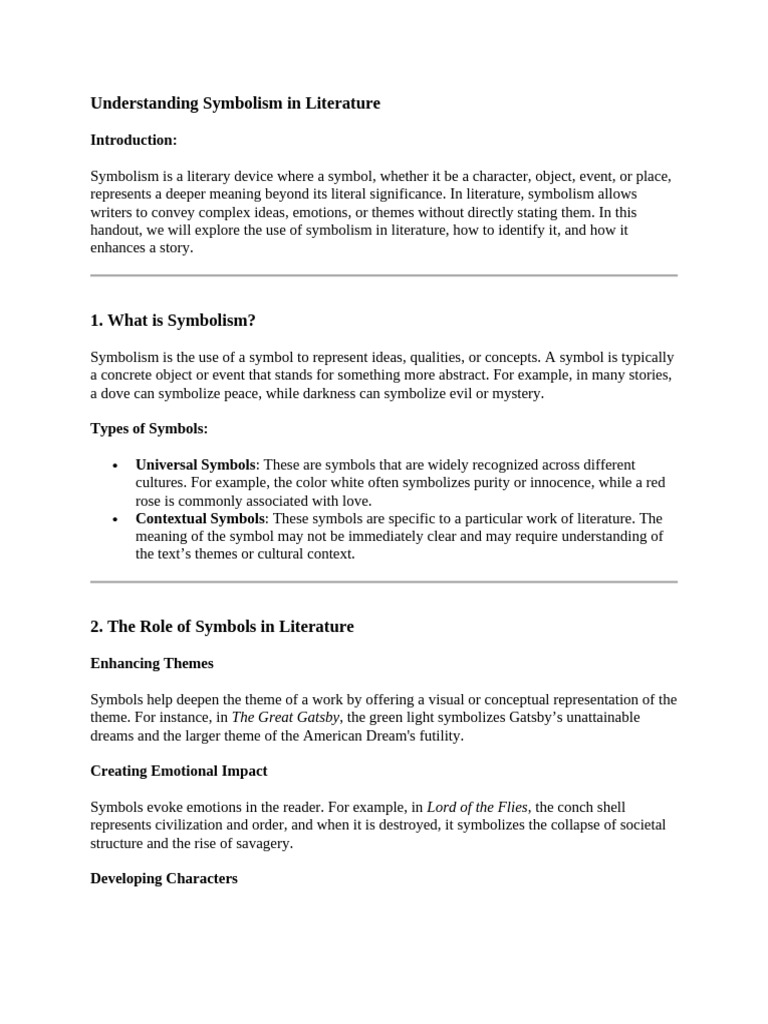
Literature often serves as a nexus where the tangible and the abstract collide, creating a rich tableau of meanings that can resonate across eras. One of the most potent devices employed by authors to convey deeper significance is symbolism. By employing symbols, writers invite readers to pierce the veneer of surface narratives, pushing them to contemplate a wider array of interpretations. This exploration dives into an emblematic example of symbolism in literature, particularly focusing on Nathaniel Hawthorne’s magnum opus, “The Scarlet Letter.” Here, we explore the multifaceted implications of the letter itself, “A,” and its reverberations throughout the narrative.
To comprehend the profundity of Hawthorne’s use of symbolism, one must first understand the societal tapestry of Puritan New England. The stark moral landscape paints a vivid backdrop against which the protagonist, Hester Prynne, lives and suffers. She bears the punitive mark of her transgression—a scarlet letter stitched onto her breast, a tangible symbol of sin, shame, and societal ostracization. But as the narrative unfolds, this singular letter metamorphoses into a complex symbol laden with evolving meanings.
Initially, the letter “A” unequivocally signifies adulteress. It is a badge of dishonor thrust upon Hester, representing her failure in the eyes of the community and serving as a constant reminder of her fall from grace. The harshness with which she is treated is emblematic of a punitive society that prioritizes rigid moral codes over individual nuance. Yet, within this insular bubble of judgment, Hester’s resilience begins to subvert the very nature of the letter itself.
As Hester endures her punishment, the letter transforms in perception. It becomes a symbol of her strength and resilience. She adorns the “A” with embellishments, allowing it to morph from a mark of disgrace into a representation of her personal dignity. Such an ambivalence in meaning challenges the reader to reconsider preconceived notions of morality and justice. The character’s evolution invites readers to explore how personal identity can emerge from societal condemnation.
The scarlet letter further symbolizes the tension between individual desire and social conformity. The dichotomy between Hester’s need for authenticity and Puritanical values presents a poignant commentary on the struggles of self-expression against a backdrop of strict moralism. Hester’s affair with Arthur Dimmesdale juxtaposes the constraints of their society with their visceral human desires. The letter, thus, embodies not just the consequences of sin, but the yearning for connection, love, and redemption—emotions that thrive even within a repressive environment.
Moreover, the symbolism of the letter amplifies through the character of Dimmesdale, who grapples with his complicity in the sin that Hester openly bears. His inability to publicly acknowledge his wrongdoing contrasts starkly with Hester’s acceptance of her punishment. The internal conflict he experiences can be seen as a microcosm of the larger struggle between individual conscience and societal expectation. In this light, the letter becomes a broader commentary on guilt and the psychological burdens it imposes.
Further enriching the symbolism of the letter is the contrast between Hester and Pearl, Hester’s daughter. Pearl, conceived from the act that the letter marks, is herself a living embodiment of both the sin and the love that birthed her. She dances between innocence and the societal implications of her origin. In her wild spirit and whimsical nature, she often becomes a symbol of Hester’s unquenchable spirit, signifying a connection to both the sacred and the profane. As Hester navigates a world that seeks to define her, Pearl serves as a reminder that life—and by extension, identity—cannot be wholly contained within social constructs.
As the narrative progresses, the once-stigmatized “A” begins to take on new dimensions, eventually evolving into a symbol of “Able.” This transition encapsulates the overarching theme of transformation—how one can reclaim narratives and redefine meanings through personal experience. What was initially a label of shame becomes an emblem of capability and strength, illustrating the power of personal agency in defiance of societal constraints.
The discussion of symbolism in “The Scarlet Letter” goes beyond mere character analysis. It encapsulates an exploration of the human condition—our complexities, contradictions, and the often multifarious nature of truth and error. Hawthorne’s deft manipulation of symbols prompts readers to confront their interpretations of morality, courage, and redemption.
In conclusion, Hawthorne’s use of the scarlet letter as a symbol is a profound commentary on the intricate dance between sin and salvation, individual identity and societal norms. It is a testament to the capacity of literature to reflect and question the human experience. This singular emblem, while initially representing disgrace, unveils a narrative rich in possibility and reformation, transforming our understanding of self and society. As readers engage with the layers of symbolism, they are beckoned to reflect upon their own perceptions of morality, identity, and the possibility of redemption in an imperfect world. Such explorations remind us that amid judgments and labels, the essence of our humanity transcends the limits of societal definitions.













