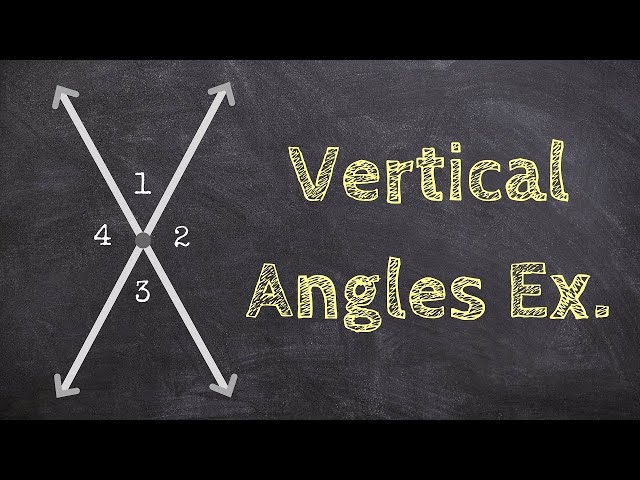
Understanding vertical angles presents an engaging opportunity to reevaluate geometric principles and their real-world applications. Vertical angles, formed when two lines intersect, are positioned opposite each other, creating congruent pairs. As one delves into this geometrical phenomenon, one cannot help but be enchanted by the elegance of these angles and the intricate dance they perform on the canvas of mathematics.
Visualize two lines that cross at a single point. These intersecting lines give rise to four angles. The vertical angles, the ones that face each other across the intersection, hold a unique relationship—they are equal. This fundamental property serves as the bedrock of numerous geometric applications, enriching our understanding of the spatial realm. Engaging with this concept draws one into a profound narrative of symmetry and balance, making it all the more enticing to investigate further.
To illustrate this concept, consider a classic example: Two roads converging at a bustling intersection. You may find two cars, one turning left and another turning right, their paths crossing and forming pairs of vertical angles. The left turn and the right turn are members of distinct sets of vertical angles, illustrating that although the vehicles diverge, the angles created at their intersection remain equal. Each angle thus serves not only as a geometric representation but also as a metaphor for choices and paths taken in life.
The implications of vertical angles extend far beyond theoretical discussions. They naturally surface in architectural designs, structural engineering, and even in artistic endeavors. When designing a building, engineers meticulously calculate angles to ensure structural integrity. Vertical angles in such contexts are paramount; they guarantee that forces are evenly distributed, thereby bolstering the framework of the entire structure. The significance of these angles illustrates how geometry permeates the physical world, often unnoticed yet invaluable.
In the realm of art, vertical angles can be seen reflected in perspective drawings. Artists often utilize these angles to achieve depth and realism within their works. When viewing a piece of art, the vertical angles help guide the viewer’s gaze, creating an immersive experience. The artist’s ability to manipulate these angles draws viewers into a three-dimensional illusion on a two-dimensional plane, enhancing the artwork’s visual narrative and allure.
Another fascinating application of vertical angles can be found in surveying. Surveyors employ the principles of vertical angles to measure land and create maps. When determining plots or elevations, understanding the relationship between vertical angles allows for more accurate representations of geographical features. The upward and downward angles create a comprehensive understanding of terrain that would otherwise remain obscured. This practical usage transforms vertical angles from simple concepts into essential tools that shape our understanding of the world.
Through the lens of physics, the importance of vertical angles is equally pronounced. Consider the trajectory of an object in motion. When one analyzes the forces acting upon it—especially during collision scenarios—vertical angles become vital. For instance, when two billiard balls collide, the angles formed upon impact dictate the direction and speed of their trajectories post-collision. This interplay of angles reveals the intricacies of motion and inertia, showcasing vertical angles as paramount to predicting outcomes in kinetic studies.
Furthermore, vertical angles can play a role in navigation. Pilots, for instance, must constantly account for vertical angles concerning their flight paths and the approach to landing. Elevation changes, as another facet of navigation, hinge on understanding these angles, particularly in mountainous terrain or urban landscapes. The interplay of angles contributes immensely to ensuring safe and efficient travel, emphasizing the relevance of geometric principles in everyday life.
Beyond practical applications, vertical angles also entice our curiosity by encouraging a contemplative approach to geometry. Engaging with vertical angles invites participants to explore deeper layers of mathematical thought. Why do these angles hold their properties? What philosophical implications can be drawn from their existence? Questions like these may invigorate a learner’s curiosity and foster a deeper appreciation for mathematics as both an art form and a science.
Moreover, examining vertical angles encourages a broadening of one’s perspective—both literally and figuratively. Just as two intersecting lines create pathways leading in divergent directions, the study of vertical angles symbolizes the myriad perspectives we can adopt in our exploration of knowledge. Life, much like geometry, is often defined by intersecting paths, choices, and angles. Appreciating the succinct elegance of vertical angles beckons thinkers to ponder the interconnectedness of ideas that manifest in various disciplines.
In summary, delving into the world of vertical angles is not merely an academic pursuit but a voyage through understanding the intersections that define our lives and surroundings. From architecture to art, surveying to physics, and even metaphorical reflections on decision-making, vertical angles offer a mosaic of interconnected applications and concepts that beg further exploration. As one contemplates these angles, they serve as a reminder of the beauty inherent in mathematics, ever-present yet often unnoticed, urging a shift in perspective—a gentle nudge to look closer and appreciate the harmonious balance that governs both abstract thought and concrete reality.