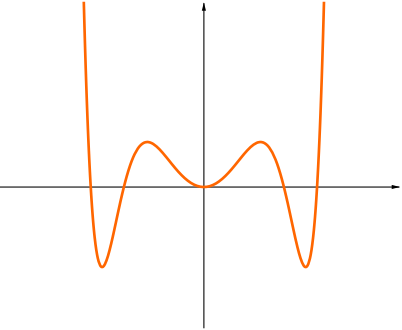
When delving into the world of mathematics, one encounters various classifications of functions, with even and odd functions standing out due to their unique properties and applications. An even function is defined by the symmetry it possesses around the y-axis. This intrinsic characteristic is formalized through the mathematical condition: if ( f(x) = f(-x) ) for all values of ( x ) in the function’s domain, then ( f ) is categorized as an even function. Understanding even functions provides insight into broader mathematical concepts, including graphing variations, application in real-world problems, and implications in calculus. Herein, we explore several examples and manifestations of even functions over various contexts.
One of the quintessential examples of an even function is the quadratic function ( f(x) = x^2 ). The graph of this function is parabolic, with its vertex positioned at the origin (0,0). Its symmetry about the y-axis is visually evident, as the left and right sides mirror each other perfectly. Evaluating the function at positive and negative values of ( x ) leads to identical results: ( f(2) = 4 ) and ( f(-2) = 4 ). This property makes quadratic functions not only easy to manipulate algebraically but also essential in physics, particularly when modeling projectile motions where the trajectory forms a parabolic path.
Another compelling instance of even functions includes trigonometric functions, with the cosine function exemplifying this category splendidly. The cosine function is represented as ( f(x) = cos(x) ). It displays periodic behavior, with a periodicity of ( 2pi ) radians. The property of evenness is observed as ( cos(-x) = cos(x) ) for any angle ( x ). This phenomenon underscores the matching values for both positive and negative angles, which can be visually confirmed through its graph. Cosine functions have vast applications in various fields, ranging from engineering to signal processing, where the modulation and periodicity characteristics are paramount.
Moving beyond the standard polynomial and trigonometric functions, consider the function ( f(x) = x^4 ). This function, part of the family of even-degree polynomial functions, holds a remarkable similarity to the quadratic function. While the steeper rise manifests for large absolute values of ( x ), it too possesses the even characteristic: ( f(3) = 81 ) and ( f(-3) = 81 ). Moreover, the interplay of even functions with calculus reveals intriguing integrations. The antiderivative of ( x^4 ), calculated via integration techniques, is beneficial in solving complex problems involving area under the curve.
In the realm of absolute value functions, ( f(x) = |x| ) emerges as another evocative example of even functions. Defined by its non-negative output, the absolute value function graphically emphasizes its symmetry about the y-axis. Consequently, ( |x| ) demonstrates the property of evenness, as demonstrated by ( |3| = 3 ) and ( |-3| = 3 ). Such functions often play a crucial role in optimization problems, wherein distances are concerned and expressions involving radical terms arise.
Even functions also find a significant presence in higher dimensions. For instance, the function defined as ( f(x, y) = x^2 + y^2 ) embodies characteristics of even functions in a two-dimensional context. The graph of this function creates a circular paraboloid centered at the origin. For any point ((x, y)), reflecting the point to ((-x, -y)) yields the same output; thus, affirming that ( f(x, y) = f(-x, -y) ). Such functions facilitate the exploration of multivariable calculus and vector fields, amplifying their relevance in physics and engineering.
Exploring further, one can encounter compositions of even functions, such as ( f(x) = cos^2(x) ). Here, the product of even functions remains even. Such compositions extend the intrinsic properties of even functions into more complex frameworks, useful in advanced studies such as Fourier analysis. The sine function is peculiar due to its odd nature; however, utilizing it in even function compositions often yields engaging insights, exemplifying the collaborative interplay between function types.
Transitioning from mathematics to physics, we find that even functions also inhabit essential roles in mechanics, particularly in harmonic motion. Systems characterized by potential energy, such as springs and pendulums, often result in equations that can be described using even functions. The restoration force in such systems typically correlates to displacement squared, embodying an even function structure. Analyzing the dynamics through this lens assists in understanding equilibrium and oscillation behaviors that govern these systems.
In summation, even functions represent a distinctive segment of mathematical functions, marked by their symmetrical nature. Functions such as ( f(x) = x^2 ), ( f(x) = cos(x) ), and ( f(x) = |x| ) illustrate the essence of evenness in one-dimensional spaces, reaffirmed by similar constructs in higher dimensions. These functions support a myriad of applications across calculus, physics, and engineering, solidifying their importance within both theoretical and applied mathematics. The exploration of even functions not only enhances mathematical understanding but provides a toolset for addressing real-world problems, thereby enriching the intellectual landscape for students, researchers, and practitioners alike.