
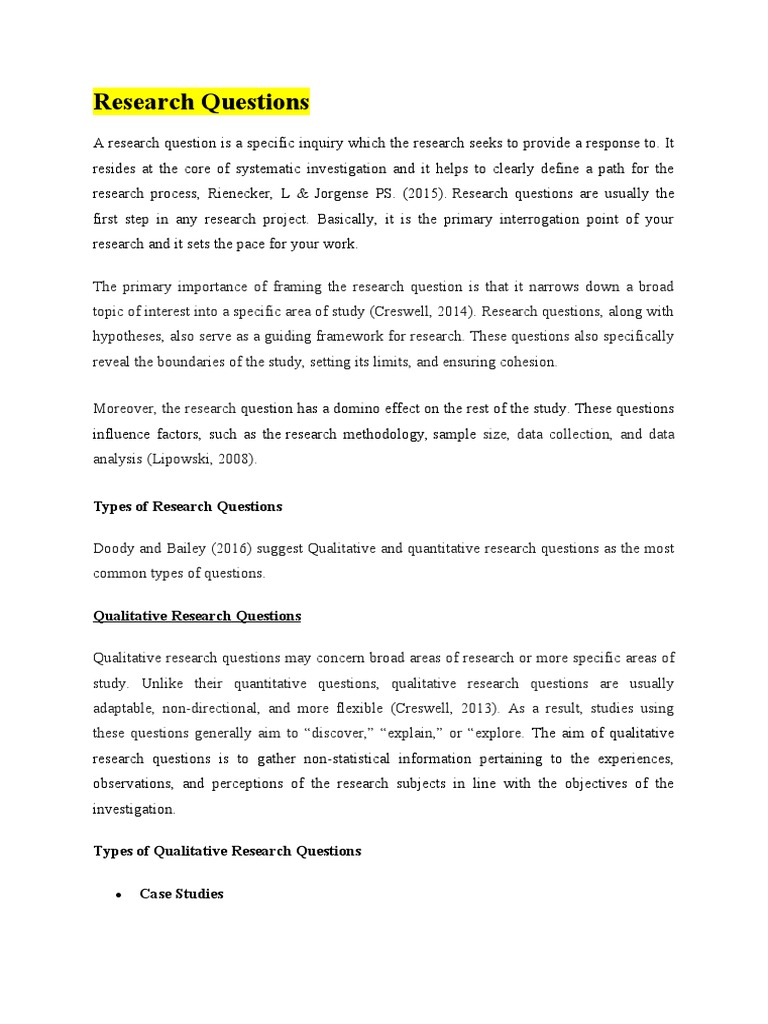
Research serves as a beacon of enlightenment, guiding us through the murky waters of uncertainty and ignorance. One of the cornerstones of effective research is the formulation of incisive questions. The nature of these questions can substantially impact the trajectory of a research study. Indeed, the questions posed can promise a fundamental shift in perspective, often revealing intricacies that were previously overlooked.
To embark on a comprehensive exploration of research questions, it is essential to categorize them based on the objectives they aim to achieve. Generally, research questions fall into two broad categories: qualitative and quantitative. Each type serves a distinct purpose and employs different methodologies, ultimately shaping how knowledge is constructed within the respective fields.
1. Qualitative Research Questions
Qualitative research focuses on understanding human behavior, experiences, and social phenomena. The questions crafted in this domain are often open-ended and exploratory. They seek to uncover the “why” and “how” behind specific issues, thus opening up a world of narrative inquiry.
Examples of qualitative research questions include:
- What are the lived experiences of individuals navigating life after a major medical diagnosis? This question invites a deep dive into personal narratives, encouraging participants to share their profound encounters and the emotional ramifications of their experiences.
- How do cultural beliefs influence parenting styles in immigrant families? Here, the researcher aims to unravel the complex interplay between culture and upbringing, probing into the diverse frameworks that shape parenting practices.
- What factors contribute to the sense of belonging among students in a multicultural educational environment? This question fosters an exploration into community dynamics, inviting insights into how students perceive inclusion and identity in an increasingly diverse setting.
By employing such exploratory inquiries, researchers can decipher multifaceted human experiences, shedding light on the subtle nuances that quantitative metrics might fail to capture.
2. Quantitative Research Questions
In contrast to qualitative questions, quantitative research questions are often numeric in nature, seeking to test hypotheses and establish correlations. These inquiries frequently employ statistical analysis to draw conclusions from collected data.
Consider the following examples of quantitative research questions:
- Is there a significant correlation between the hours spent studying and the academic performance of high school students? This question sets the stage for a statistical inquiry, as the researcher would collect data to ascertain the relationship between two measurable variables.
- What impact does regular exercise have on the mental well-being of adults aged 30-50? Here, the emphasis is on quantifying the effects of physical activity, inviting participants to report on their mental health status before and after adopting a workout regimen.
- How does socio-economic status influence access to healthcare services in urban environments? This question indicates an exploration of systemic disparities, aiming to furnish statistical evidence regarding healthcare accessibility among different socio-economic groups.
Quantitative questions assert empirical rigor, proving vital for establishing patterns, testing theories, and generating generalizable insights that can be replicated across various contexts.
3. Mixed-Methods Research Questions
In the realm of research, the lines between qualitative and quantitative paradigms can blur, giving rise to mixed-methods research. This approach synthesizes both qualitative and quantitative inquiries, providing a holistic view of the research problem.
Examples of mixed-methods research questions might include:
- How do online learning environments affect student motivation, and what statistical trends can be observed among students in different academic disciplines? This multifaceted question necessitates qualitative insights into student experiences, alongside quantitative assessments of motivation levels across various fields.
- What perceptions do healthcare professionals hold towards patient-centered care, and how do these perceptions correlate with patient satisfaction scores? By addressing both attitudes and measurable outcomes, researchers can foster a more comprehensive understanding of healthcare dynamics.
- To what extent do social media campaigns influence public health awareness, combined with numerical data on engagement rates? This inquiry draws from the qualitative aspect of campaign messaging and the quantitative aspect of engagement analytics, promising a fuller picture of contemporary health communication.
Through mixed-methods research questions, scholars can traverse the complexities of human behavior and societal patterns, yielding enriched insights that resonate on multiple levels.
4. Crafting Effective Research Questions
The art of crafting effective research questions requires finesse and a nuanced understanding of the research landscape. Key attributes of effective questions include:
- Clarity: A well-articulated question avoids ambiguity, ensuring that all stakeholders comprehend its implications.
- Feasibility: Questions should be grounded in reality, ensuring that researchers possess the necessary resources and access to data.
- Relevance: Effective questions should address significant issues or gaps in existing literature, promising contributions that align with scholarly discourse.
In conclusion, the manner in which questions are framed significantly influences the quality and scope of research outcomes. Whether qualitative, quantitative, or mixed-methods, the right questions promise a shift in perspective and ignite the curiosity of both researchers and stakeholders alike. These inquiries not only shape individual studies but echo through the broader academic landscape, continuously informing and transforming our understanding of the world.













