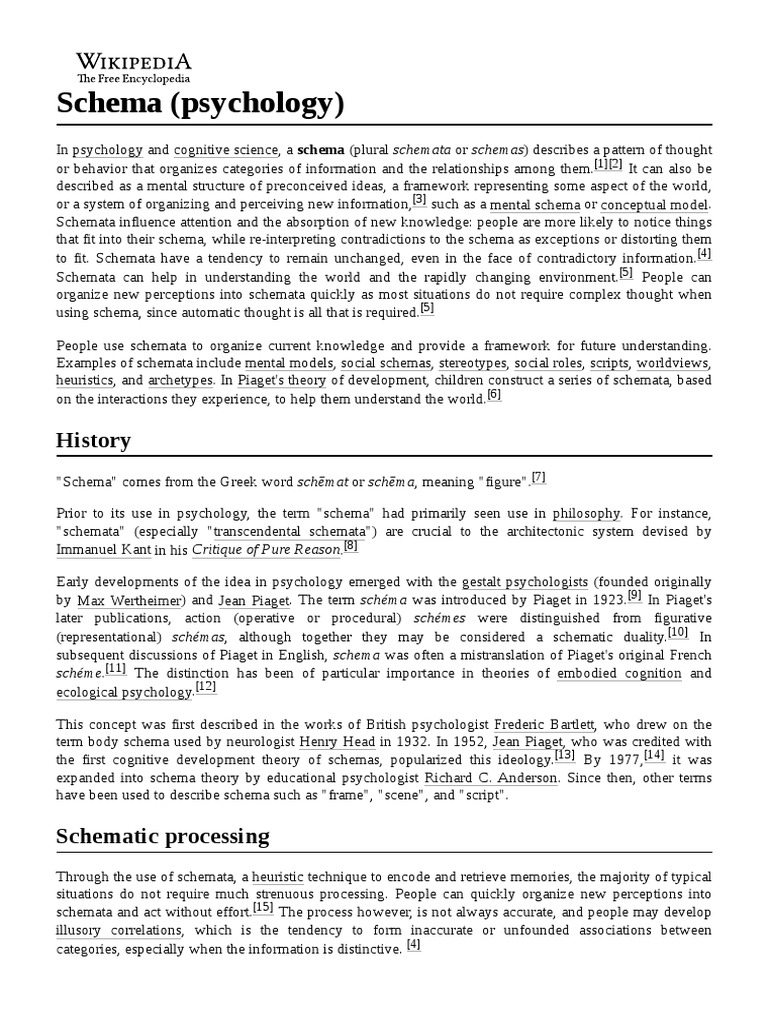
Schemas in psychology are cognitive frameworks that help individuals organize and interpret information. These mental structures enable us to categorize and make sense of the world around us, influencing our perceptions, memory, and expectations. The concept of schema was initially introduced by cognitive psychologist Jean Piaget in the context of child development but has since been expanded upon by various psychologists across different domains. This article explores the myriad examples of schemas in psychology, elucidating the distinctions between their types, functions, and implications for behavior and cognition.
To begin, it is essential to understand that schemas can be categorized into several types, each serving a unique purpose. The taxonomy of schemas can be broadly divided into two main categories: person schemas and event schemas.
Person Schemas
Person schemas pertain to our organized knowledge about specific individuals and their traits, behaviors, and relationships. This cognitive scaffolding allows us to form expectations about how people will act in given situations based on past experiences or generalized social roles. For instance, if someone has encountered a friendly teacher or a strict judge, they might form schemas that shape their perceptions and interactions with future teachers or judges. Such schemas can be incredibly potent; they often lead to the halo effect, where a single positive trait could influence evaluations of an individual’s other characteristics.
Another example of a person schema is the stereotypical representation of different social groups. These schemas can create biases and prejudices, leading to assumptions that do not necessarily hold true for every member of that group. For instance, if one holds a schema that characterizes all teenagers as rebellious, they may overlook the respectful behavior of a particular teenager who does not fit this stereotype.
Event Schemas (Scripts)
Event schemas, often referred to as scripts, are cognitive structures that dictate the expected sequence of events in particular contexts. They help shape our understanding of routine occurrences and provide guidance on how to navigate complex social situations. For instance, individuals have a well-developed script for going to a restaurant that typically includes the sequence of being seated, reviewing a menu, placing an order, eating, and settling the bill.
This cognitive blueprint allows individuals to anticipate events and perform tasks without excessive cognitive load. Changes or deviations from the anticipated script can lead to confusion or discomfort. Consider the scenario of a diner expecting to pay at the end of the meal but suddenly being asked to pay upfront; this unforeseen alteration may provoke feelings of unease or doubt.
Schema Development and Change
While schemas are predominantly stable, they are not static. Developmental psychologists emphasize the notion of schema modification, which occurs through two primary processes: assimilation and accommodation. Assimilation involves integrating new information into existing schemas, whereas accommodation refers to altering one’s schemas to incorporate new data. For example, a child who has always viewed dogs as friendly might initially assimilate a new experience with a growling dog within their existing schema. However, upon experiencing fear, they may be compelled to adapt their dog schema to encompass both friendly and aggressive canines.
This adaptability is crucial not only for personal growth but also for effective functioning within society. Particularly in times of change or trauma, the ability to revise schemas can foster resilience and facilitate recovery by allowing individuals to construct more balanced views of their experiences.
Implications of Schemas on Behavior and Cognition
Foregrounding the practical impacts of schemas allows us to examine their influence on reactions, decision-making, and interpersonal relationships. For example, someone operating under a negative schema regarding authority figures may experience heightened anxiety before interacting with their boss, leading to a self-fulfilling prophecy where this anxiety affects their performance at work. Conversely, an individual with a positive schema regarding authority might approach their boss with confidence, building a more fruitful professional relationship.
Furthermore, schemas can affect memory and information processing. Research indicates that individuals often remember information that fits their existing schemas more accurately while misremembering or overlooking details that conflict with these cognitive frameworks. This selective retrieval can perpetuate stereotypes and biases, as individuals may unconsciously prioritize information that confirms their pre-existing beliefs, sidelining alternative perspectives.
Conclusion
In summary, schemas are fundamental to understanding human cognition and behavior in psychology. The examples ranging from person and event schemas demonstrate how these cognitive structures shape our interpretations and interactions. The malleability of schemas highlights the importance of awareness and critical reflection, especially in a diverse and dynamic world. By recognizing the influence of schemas, individuals can strive for a more nuanced understanding of both themselves and others, ultimately fostering empathy and reducing harmful biases. Embracing this awareness is a crucial step toward personal growth and societal evolution.