Understanding the intricacies of language is a voyage laden with wonder. One enthralling facet of grammar is the compound sentence, which deftly intertwines independent clauses, forming a tapestry of ideas that not only informs but also resonates emotionally. The use of compound sentences is not merely a grammatical choice; it is a stylistic decision that can lend depth to both written and spoken communication. By exploring the essence of compound sentences, we can uncover the reasons behind their allure while simultaneously enhancing our command of language.
Defining Compound Sentences
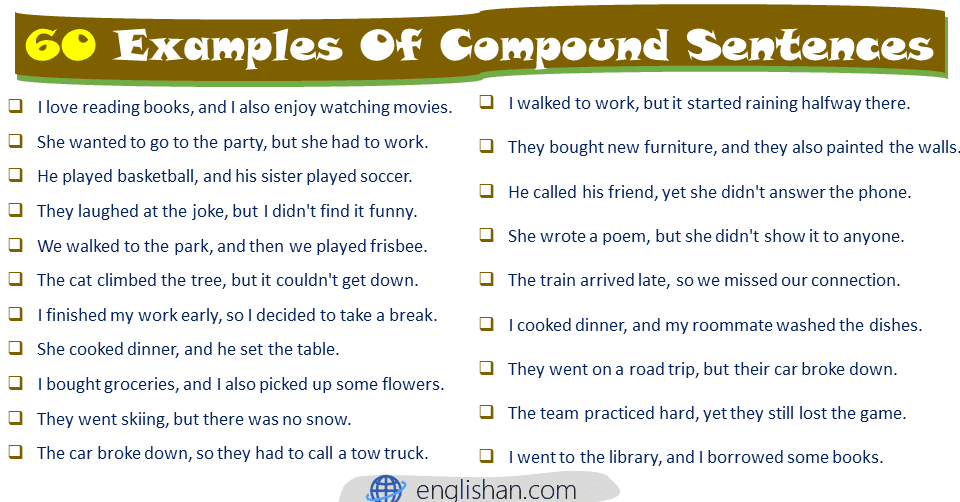
A compound sentence is characterized by the conjunction of two or more independent clauses, which are clauses that can stand alone as complete sentences. This syntactic structure is typically connected by coordinating conjunctions—such as “and,” “but,” “or,” “nor,” “for,” “so,” and “yet”—or by using a semicolon. The beauty of this construction lies in its ability to convey relationships and contrasts between ideas, inviting readers and listeners to engage with the material on multiple levels.
The Structure Explained
To effectively craft a compound sentence, it is beneficial to understand its structural components fully. Consider the two independent clauses:
- Clause 1: “I wanted to go for a walk.”
- Clause 2: “The rain was pouring down.”
When combined into a compound sentence, they can be articulated as follows: “I wanted to go for a walk, but the rain was pouring down.” This not only joins two complete thoughts but also juxtaposes opposing ideas, enhancing the emotional weight of the sentence.
Enhancing Clarity and Coherence
One of the most compelling reasons to use compound sentences is their ability to enhance clarity and coherence in writing. Through the juxtaposition of clauses, a compound sentence can illuminate how different ideas relate to one another. For instance:
“She enjoys reading mysteries, and her brother prefers science fiction.”
This sentence clearly delineates the preferences of two individuals while simultaneously highlighting their differences. Instead of resorting to two separate sentences that may fragment the reader’s attention, a compound sentence unifies thoughts into a coherent expression.
Invoking Emotion and Nuance
Furthermore, compound sentences wield the power to evoke emotion and nuance. The rhythm established by their structure can impart a lyrical quality to prose. Consider the following:
“He was elated about his promotion, yet he felt an undercurrent of anxiety about new responsibilities.”
Here, the use of “yet” connects two seemingly contradictory feelings. This not only conveys a more profound emotional landscape but also allows readers to empathize with the complexities of human experience. Such subtleties are often lost in simpler sentence constructions.
Building Complexity
The beauty of compound sentences also lies in their potential for complexity. Writers can craft intricate thoughts by linking several independent clauses: “The sun set behind the mountains, the sky turned a brilliant shade of orange, and the air grew cooler as night fell.”
This sentence paints a vivid picture by combining multiple sensory details into a single flowing statement, thereby enriching the reader’s visual experience. The complexity of ideas is presented in a seamless manner, allowing for a deeper understanding of the scene depicted.
Creative Expression through Compound Sentences
Moreover, compound sentences provide a canvas for creative expression. Writers, poets, and speakers often employ them to create rhythm and flow in their work. The juxtaposition of thoughts can lead to a delightful unexpectedness, prompting readers to contemplate relationships in new ways. For example:
“She danced with abandon, and the world outside faded away.”
In this instance, the compound structure conveys a sense of liberation, inviting readers to lose themselves alongside the dancer. This connection between structure and meaning illustrates the profound effect that linguistic choices can have on the reader’s imagination.
Common Mistakes to Avoid
While compound sentences offer myriad advantages, it is essential to tread carefully to avoid common pitfalls. A frequent mistake is creating a run-on sentence, which occurs when independent clauses are improperly joined without appropriate punctuation or conjunctions.
For instance, saying “I love to travel I enjoy exploring new cultures” fails to use a conjunction or proper punctuation. Instead, it can be corrected as: “I love to travel, and I enjoy exploring new cultures.” Taking care to punctuate correctly ensures that clarity is maintained and that compound sentences serve their intended purpose.
Conclusion
In summary, compound sentences represent a dynamic component of language that enriches communication. By weaving together independent clauses, they can enhance clarity, evoke emotion, build complexity, and allow for creative expression. As we delve into the world of compound sentences, we find not just a grammatical structure, but a powerful tool that can transform ordinary communication into extraordinary narratives. Embracing this complexity not only elevates writing but also fosters a deeper appreciation for the artistic possibilities inherent in language. Whether crafting prose, poetry, or persuasive arguments, the judicious use of compound sentences can open new avenues of expression, inviting readers to engage, reflect, and ultimately connect with the thoughts and emotions shared. Thus, the allure of the compound sentence continues to captivate the hearts and minds of language enthusiasts everywhere.