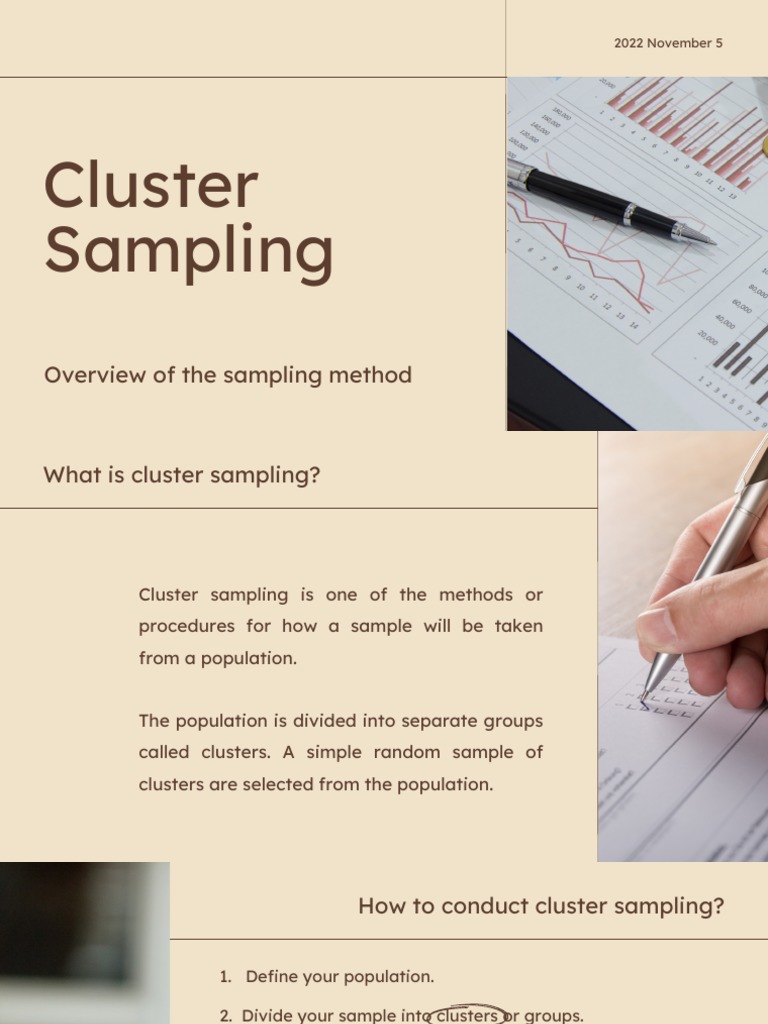
Cluster sampling is a pragmatic technique frequently employed in various fields such as sociology, education, and health sciences. The method carries with it a plethora of applications and reveals the nuanced layers of complexities inherent to the research process. This article elucidates the concept of cluster sampling through a series of examples, elucidating its principles, advantages, and potential challenges.
To commence, it is paramount to understand the essential framework of cluster sampling. This technique divides a population into distinct subgroups known as clusters. Rather than sampling individuals randomly from the entirety of the population, researchers select entire clusters at random. This approach simplifies the sampling process, particularly when dealing with large populations. Why might this method be chosen? Several scenarios elucidate its practical utility, offering insights into its deeper allure.
One prevalent example of cluster sampling can be observed in educational research. Suppose a researcher wishes to evaluate the academic performance of students in a particular school district. Instead of meticulously sampling students from each and every school in that district, the researcher could categorize schools into clusters, grouping them perhaps by geographical location or socio-economic characteristics. A handful of schools could then be randomly selected, and every student within those schools might be assessed. This not only reduces time and costs, but it also mitigates logistical complications associated with gathering data from multiple, widely dispersed locations.
Considering the intricacies of urban environments, another compelling instance can be gleaned from market research. A company aiming to launch a new product might be interested in consumer preferences across an entire city. Rather than conducting surveys across various neighborhoods, which could be labor-intensive and costly, the researchers could treat each neighborhood as a distinct cluster. By randomly selecting a few neighborhoods and surveying every household within them, the researchers can obtain valuable insights into the preferences and buying behaviors of the city’s citizens. This method also allows for a colorful tapestry of data, reflecting the diversity within the population with relative efficiency.
Furthermore, public health statistics often leverage cluster sampling to gauge the prevalence of diseases or health behaviors. Imagine a public health agency tasked with assessing vaccination rates in a country. Instead of attempting to survey every individual, which is obviated by the vastness of populations, the agency can segment the country into clusters based on regional health departments. Randomly choosing a few counties, the agency can then disseminate surveys or conduct field studies within those selected regions. This focused approach enables public health officials to extrapolate findings that might resonate across broader demographics while remaining manageable and systematic.
Cluster sampling is not without its challenges, however. One significant concern regarding this methodology is the potential for intracluster correlation. This phenomenon occurs when the individuals within a single cluster exhibit similarities, potentially skewing results and leading to biased conclusions if not adequately addressed. For instance, if a cluster consists of schools within a homogeneous affluent neighborhood, the data might inaccurately portray an inflated performance metric, as the social and economic factors shared by the cluster can influence outcomes. Researchers must remain astute, employing appropriate statistical techniques to adjust for these variances when reporting their findings.
Moreover, the effective implementation of cluster sampling necessitates meticulous planning in terms of cluster selection. The process requires a deep understanding of the population’s composition and careful consideration of how clusters are defined. Should they be created based on geography, socio-economic status, or some other characteristic? The nuances of defining clusters bear significant implications on the validity and generalizability of the findings derived from the cluster-sampled data.
In summary, the array of examples surrounding cluster sampling illuminates its pivotal role in facilitating valuable research while simultaneously magnifying the inherent complexities that accompany it. As we journey through the multifaceted landscape of data gathering, we come to appreciate not only the methodology itself but also the profound implications it carries. Each cluster holds a realm of untapped potential, and within those realms, researchers continue to unearth insights that inform policy, enhance education, and improve public health.
In scrutinizing the elegance of cluster sampling, we observe a method both intriguing and pragmatic. While it holds the promise of simplification and efficiency, it simultaneously poses intricate questions warranting scrutiny and consideration. The rich tapestry of human society demands that researchers remain vigilant, ensuring that the pursuit of knowledge does justice to the complexities of the populations they strive to understand. In this regard, cluster sampling serves as a unique window through which we can explore the often-overlooked intricacies of collective human behavior.