
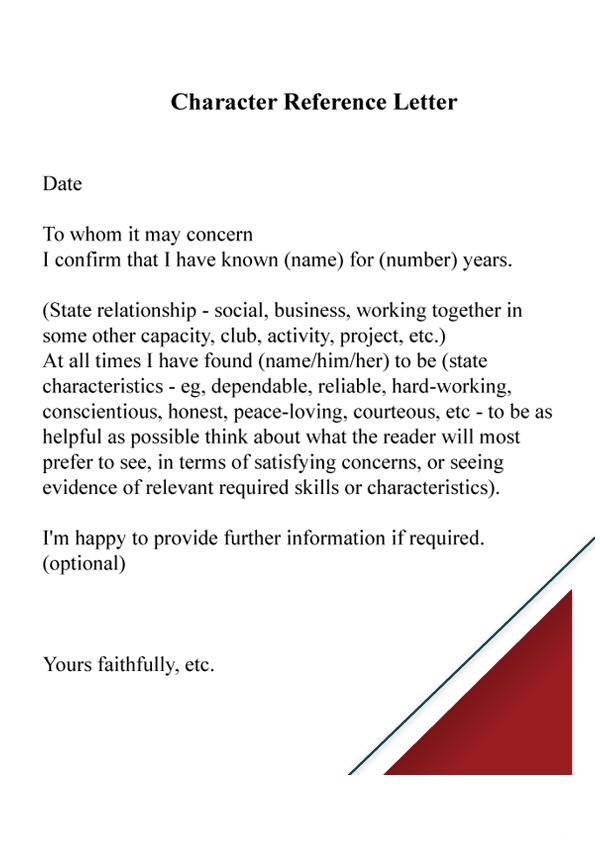
When navigating the labyrinth of life, we often find ourselves in need of a guiding hand or a trusted voice to speak on our behalf. A character reference letter serves precisely this function, echoing the sentiment of camaraderie and trust. Whether for employment opportunities, legal matters, or educational endeavors, character references are the lighthouses that illuminate our credentials, values, and the very essence of our being. Herein lies the exploration of what a character reference letter embodies, its multifaceted appeal, and detailed examples that serve as templates for aspiring authors of such important correspondence.
Understanding the Significance of Character Reference Letters
Character reference letters act as testimonials to an individual’s virtues, capabilities, and moral fiber. They are akin to sturdy scaffolding, providing support to the edifice of one’s professional or personal aspirations. Within these letters, the author paints a vivid picture, encapsulating the subject’s integrity, work ethic, and unique qualities that make them an asset in various scenarios.
In essence, a character reference is more than mere words on paper; it embodies the essence of trust and serves as a bridge between past experiences and future opportunities. These letters transmute personal anecdotes and observations into powerful endorsements, often influencing decisions made by employers, educational institutions, or judicial figures.
Components of an Effective Character Reference Letter
At the heart of every compelling character reference letter lies a structured approach, ensuring clarity and impact. The following elements coalesce to create an harmonious narrative:
- Introduction: A succinct introduction establishes the author’s relationship with the subject. For instance, “It is with great pleasure that I write this character reference for John Doe, who has been a close friend and colleague for over five years.”
- Context: This section elaborates on the context in which the author knows the individual, providing a backdrop for the ensuing praise. Highlighting shared experiences can strengthen the authenticity of the endorsement.
- Personal Attributes: Here lies the heart of the letter—a rich tapestry woven from personal anecdotes that highlight the applicant’s qualities. Words like ‘diligent,’ ‘empathetic,’ and ‘resilient’ can paint an alluring portrait of the individual.
- Professional Contributions: If applicable, this segment emphasizes the individual’s achievements, contributions, and potential within a professional context. Specific examples lend credibility and showcase the subject’s suitability for the intended opportunity.
- Conclusion and Recommendation: A powerful closing captures the essence of the recommendation, urging the reader to consider the subject’s merits. This can be as simple as, “I wholeheartedly recommend John Doe for any opportunity he pursues.”
Sample Character Reference Letter
To elucidate the aforementioned components, consider the following example:
[Your Name]
[Your Address]
[City, State, Zip Code]
[Email Address]
[Phone Number]
[Date]
[Recipient’s Name]
[Company/Institution Name]
[Company Address]
[City, State, Zip Code]
Dear [Recipient’s Name],
It is with great pleasure that I write this character reference for [Individual’s Name], who has been a close friend and colleague for over [duration]. My acquaintance with [Individual’s Name] has granted me a vantage point to observe firsthand the exceptional qualities that define them. In both personal and professional spectrums, [Individual’s Name] exhibits virtues such as integrity, compassion, and unwavering dedication.
The memory of our collaboration on [specific project or event] demonstrates [his/her/their] innate ability to lead and inspire others. [He/She/They] encountered numerous challenges, yet met each with resolute optimism and a problem-solving mindset, propelling the team toward success. It is this resilience that sets [Individual’s Name] apart from peers, rendering [him/her/them] a beacon of reliability and an asset to any organization.
Moreover, [he/she/they] possess an exceptional ability to connect with others. [His/Her/Their] empathetic nature ensures that colleagues feel heard and supported, fostering an environment of trust and collaboration.
Considering the breadth of [his/her/their] experiences and the depth of [his/her/their] character, I wholeheartedly endorse [Individual’s Name] for [specific opportunity]. I have no doubt that [he/she/they] will bring the same level of enthusiasm and excellence to your organization as [he/she/they] have consistently demonstrated in the past.
Thank you for considering this recommendation.
Sincerely,
[Your Name]
The Emotional Resonance of Character References
The emotional gravitas embedded in character reference letters transcends mere words. They forge connections, resonating deeply with those who read them. An effective character reference letter draws upon the tapestry of shared experiences, unrestricted by time or circumstance. They function not only as endorsements but as echoes of our shared humanity, fostering a culture of mutual respect and admiration.
In the end, the character reference letter stands as a testament to the individual it champions—not merely as a document, but as an embodiment of their potential, a canvas painted with strokes of authenticity, and a harbinger of future endeavors that await in the realm of possibility. When wielded adeptly, a character reference letter can be the key that unlocks doors to new horizons, transforming lives and weaving stories of success that resonate like a symphony in the hearts of those who dare to dream.













