
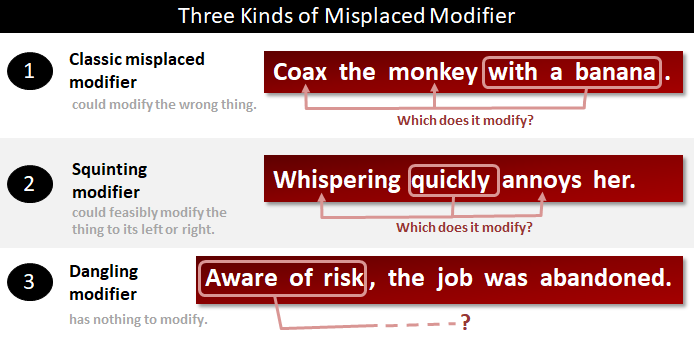
In the intricate tapestry of language, words hold the power to shape our understanding and perceptions. Among these linguistic wonders lies a phenomenon known as the misplaced modifier, an element that can skew meaning and lead to whimsical misunderstandings. Misplaced modifiers, when unleashed into sentences, can transform clarity into confusion. To embark on this exploration, we will dissect examples of misplaced modifiers and their ramifications on meaning, all the while enticing your curiosity and challenging your perspective on grammar.
First, let’s clarify what a modifier is. Modifiers are words, phrases, or clauses that provide additional information about another word in a sentence, often enhancing comprehension. However, a misplaced modifier occurs when it is positioned ambiguously, leaving readers to question which word it is intended to modify. This confusion can lead to comical and perplexing sentences that dance on the edge of absurdity.
Consider the sentence: “She almost drove her kids to school every day.” At first glance, it appears innocuous, yet the placement of “almost” raises eyebrows. Did she come close to driving them, or did she in fact not drive them at all? The modifier’s misalignment with the verb “drove” creates uncertainty about her actions. In a world where clarity is treasured, such ambiguity can sow seeds of perplexity.
Moreover, the thrill of mischief arises when modifiers take on unintended meanings in more complex constructions. Take, for instance, the sentence: “The dog barked at the man over the fence.” Who can resist the enticing image of a man precariously balanced on a fence? One could easily visualize a surreal scene of an acrobat engaging with a canine. In reality, the intended meaning is that the dog barked at a man who was standing on the opposite side of the fence. By reordering the elements, one can rectify the wayward modifier: “Over the fence, the dog barked at the man.”
The whimsicality of misplaced modifiers extends to humorous realms, provoking amusement in everyday life. Consider the phrase: “He watched her swim with a telescope.” Initially, one might envision the peculiar act of spectating a swimming event through a telescope. However, the intended meaning becomes clearer when the sentence shifts: “He, with a telescope, watched her swim.” Suddenly, the focus is restored, and clarity reigns supreme.
Such examples invite us to ponder: how often do we navigate through life, blissfully unaware of the nuances dancing just beneath the surface of our language? The reality is that misunderstandings stemming from misplaced modifiers are prevalent in everyday communication. They can slip into casual conversations, formal writings, and even witty advertisements.
Advertising often treads carefully through the treacherous terrain of modifiers. A clever yet misplaced phrase can inadvertently alter the entire perception of a brand. For instance, “We sell shoes for hardworking men and women” might suggest a focus on the shoes themselves rather than the individuals who wear them. Alternatively, if phrased as “For hardworking men and women, we sell shoes,” the emphasis shifts appropriately, engaging the target audience with more precision.
Yet, beyond humor and advertising, misplaced modifiers can significantly impact the clarity desired in academic and professional settings. Consider an academic paper asserting, “The study showed significant improvements in student performance for teachers using innovative methods.” Here, the placement of “for teachers” could lead readers to mistakenly attribute the performance gains directly to the teachers rather than recognizing their use of innovative methods as the catalyst for improvement. Therefore, refining to “The study showed significant improvements in student performance when innovative methods were used by teachers” mitigates misunderstanding and enhances precision.
In an era where communication spans across diverse platforms, the impact of misplaced modifiers can ripple throughout digital mediums. An email stating, “Thank you for your support, we will return your call shortly” might give the impression of appreciating ongoing support while inadvertently suggesting an immediate follow-up. A clear restructuring to “Thank you for your support. We will return your call shortly” allows for a distinct separation of thoughts, ensuring that your intentions resonate harmoniously with the recipient.
From a psychological perspective, the allure of misplaced modifiers also lies in the cognitive dissonance they create. When readers encounter a composition that defies their expectations, they are compelled to engage more critically with the text. This can foster a deeper understanding of language nuances and open pathways for learning. As curiosity burgeons, individuals may become more vigilant in their own writing, striving for linguistic excellence.
Ultimately, the exploration of misplaced modifiers serves as a powerful reminder of the intricate dance between language and meaning. By addressing these linguistic quirks, we not only enhance our ability to communicate effectively but also enrich our appreciation for the artistry of language itself. As we unravel the chaos of misplaced modifiers, we cultivate clarity, ensuring that our expressions resonate with intentionality and precision.
As you venture forth in your communication endeavors, remain vigilant against the mischief of misplaced modifiers. An awareness of their potential to enchant or perplex will empower you to wield language with grace, ensuring your thoughts are conveyed unambiguously and your audience remains captivated and informed.













