Understanding the concept of a physical change is essential for grasping the foundations of chemistry and the behavior of matter. A physical change refers to a transformation that does not alter the chemical composition of a substance, allowing the original materials to retain their inherent properties. This article delves into various examples of physical changes, exploring their characteristics, significance, and applications across different fields.
Defining Physical Change
To embark upon this exploration, it is imperative to first delineate what constitutes a physical change. In essence, it is any alteration in the form or appearance of a substance without a corresponding change in its chemical identity. Such transformations can occur through processes such as melting, freezing, evaporating, condensing, and dissolving. While the molecules may rearrange or experience changes in state, their fundamental structures remain intact.
Types of Physical Change
There are several notable types of physical changes to consider, each marked by distinct characteristics:
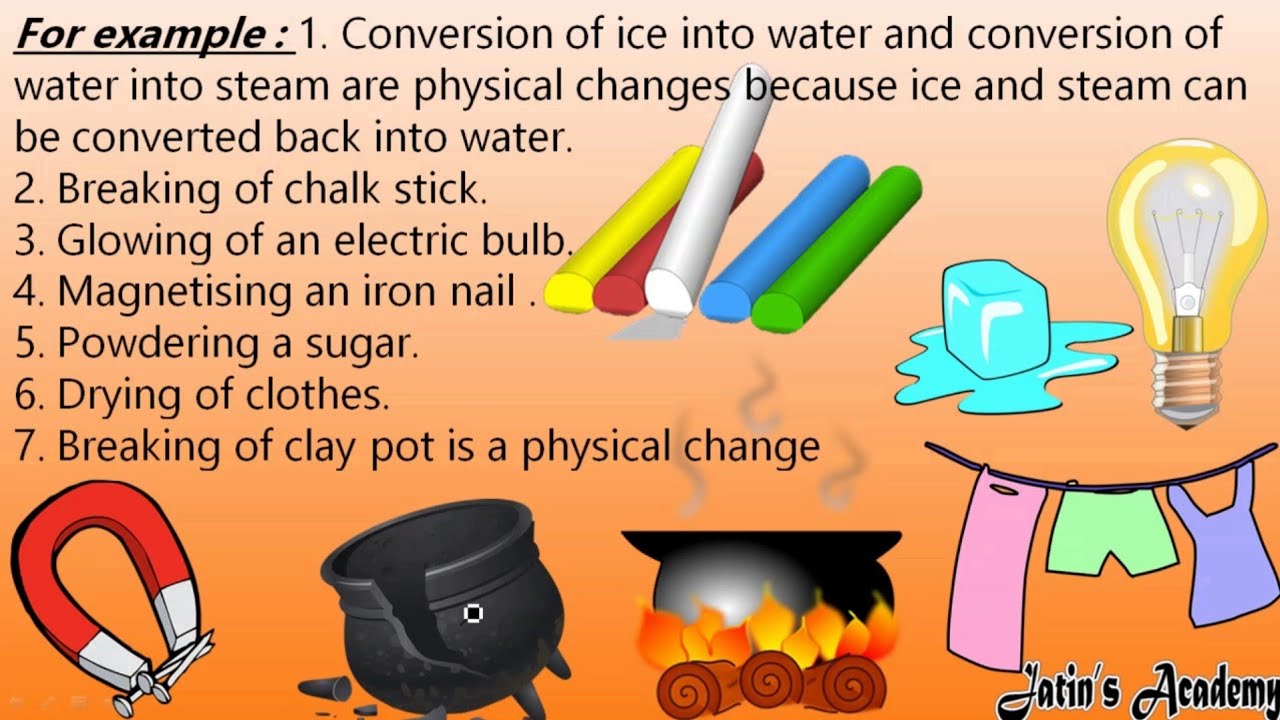
- State Changes: A classic illustration of a physical change is the transition between solid, liquid, and gas states. For instance, when ice melts, it changes from a solid to a liquid, yet retains its chemical identity as H2O. Similarly, when water vapor condenses back into liquid water, it exemplifies a reversal of the phase change.
- Dissolution: This process involves a solute dissolving in a solvent, resulting in a homogeneous mixture. For example, when table salt is added to water, it dissolves, creating a saline solution. Despite the salt appearing to vanish, its molecular structure remains unchanged; it is simply dispersed within the solvent.
- Mechanical Changes: These changes occur through physical forces and manipulations. Examples include cutting, grinding, or crushing substances. A compelling sample is the pulverization of a sugar cube—while its size and shape transform, it remains chemically unchanged as sugar.
- Phase Separations: When two or more immiscible liquids, such as oil and water, are combined, a physical change occurs as they separate into distinct layers. This phenomenon highlights the unique properties of each liquid, despite the temporary mixture.
- Mixing: The act of combining different substances can yield physical changes without chemical reactions. A salad exemplifies this; mixing various vegetables results in a new arrangement, yet the individual components retain their properties and flavors.
Significance of Physical Changes
Physical changes are not merely academic observations; they hold profound implications in various domains. In the culinary world, chefs leverage these changes to achieve desired textures and flavors. Consider the art of candy-making—cooking sugar transforms its physical state as it melts, and the careful cooling creates a solid confection. Here, the interplay of temperature and time engenders delightful sweets with varied textures, all stemming from physical transformations.
In the field of materials science, physical changes provide a gateway to innovation. Engineers and designers frequently manipulate the physical properties of materials to enhance performance. For instance, the creation of alloys exemplifies how metals are combined, maintaining the original compositions while producing new physical characteristics suited for specific applications, such as increased strength and reduced weight.
Everyday Examples of Physical Changes
The prevalence of physical changes in our daily lives cannot be overstated. Consider ice melting in a glass of water—this everyday occurrence signifies a state change that many may overlook, yet it serves as a vivid reminder of the principles of thermodynamics and energy transfer. Similarly, the act of baking bread involves numerous physical changes, from kneading dough—a mechanical change—to the expansion and baking of the mixture, which incorporates gas bubbles and transforms the dough into a fluffy loaf.
One cannot dismiss the impact of physical changes in environmental contexts. The Earth’s water cycle epitomizes this, showcasing evaporation, condensation, and precipitation, all of which are intrinsic physical changes. These are vital for sustaining ecosystems and climate patterns, demonstrating the interconnectedness of physical transformations in nature.
Conclusion
In summary, physical changes are fundamental alterations that do not compromise the chemical identities of substances, embracing a plethora of transformations such as state changes, dissolution, and mechanical manipulation. Their significance spans a variety of fields, from culinary arts to engineering and environmental sciences. Through the lens of physical change, we glean insights into the behaviors and interactions of materials, enriching our understanding of the world around us. Whether it is the simple act of dissolving sugar in water or the intricate processes of alloy creation, physical changes are, indeed, a testament to the dynamic nature of matter and its adaptability.
As one reflects upon the various examples of physical change, it becomes clear that these phenomena are not merely scientific abstractions; they are intricately woven into the fabric of everyday life, revealing the elegance and complexity of the physical world.