Understanding the complexities of legal cases can be quite daunting, particularly for students or newcomers to the field of law. A case brief serves as an invaluable tool for distilling the essence of a case, enabling both clarity and comprehension. This article will explore the multifaceted nature of a case brief, dissecting the various components, discussions, and examples that illuminate its importance and usage.
What is a Case Brief?
A case brief is a concise summary of a legal case, designed to highlight the essential elements that were central to the court’s decision. Through clarity and succinctness, it aids in the understanding of judicial opinions, making them accessible for analysis and discussions. Law students often create case briefs as part of their studies; however, professionals in the field also utilize them for reference and case preparation.
Purpose of a Case Brief
The primary purpose of a case brief is to distill lengthy judicial opinions into manageable, digestible components. The case brief enables the reader to quickly grasp the key points of the case without having to sift through pages of legal jargon. Furthermore, a well-crafted brief can serve as a study aid, assisting students in retaining complex legal concepts, and can act as a reference point for practitioners when preparing for oral arguments or case discussions.
Essential Components of a Case Brief
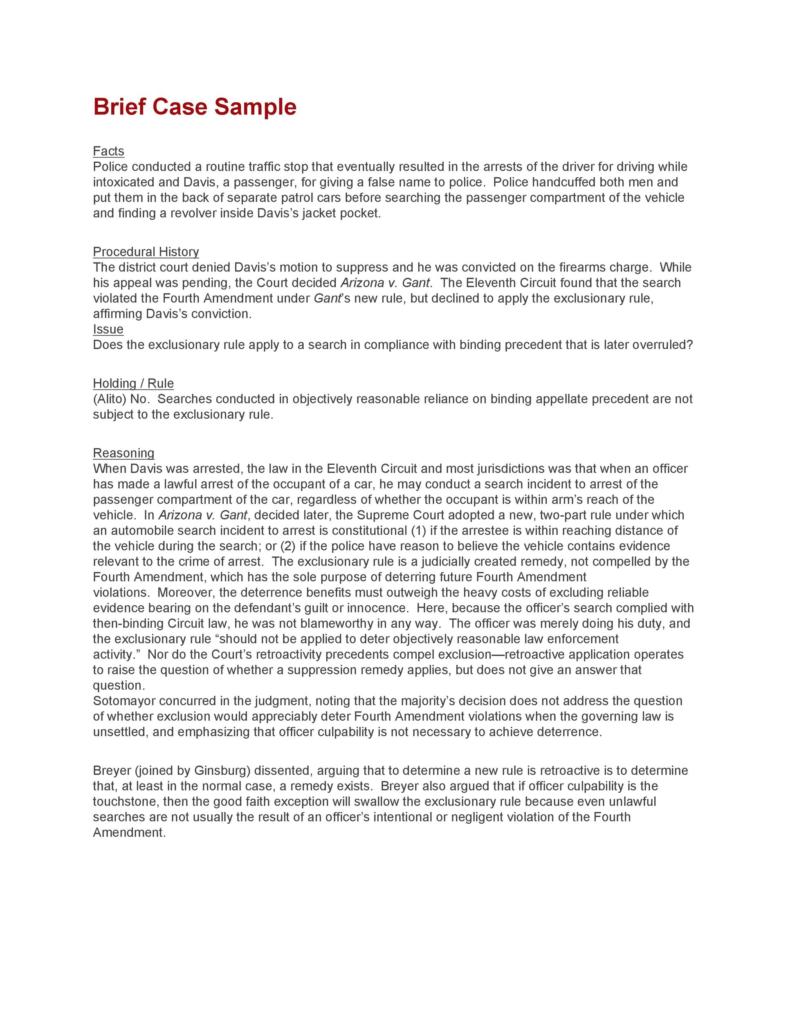
A comprehensive case brief typically encompasses several critical sections. Here, we delineate the most common components:
- Case Name and Citation: The title of the case, along with its citation, allows readers to quickly identify the case. This section typically includes the name of the parties involved and the court that issued the opinion.
- Facts: This portion presents the background information pertinent to the case. It summarizes the events leading up to the dispute and highlights the relevant facts that the court considered in its ruling.
- Issue: The issue delineates the specific legal question that the court needed to address. This section is critical as it frames the context in which the law is applied.
- Holding: The holding is the court’s answer to the issue presented. It encapsulates the core legal principle established by the case, often emphasizing the outcome for the parties involved.
- Reasoning: This section elucidates the rationale behind the court’s decision. It explores the legal theories, statutes, or precedents the court relied upon to reach its conclusion.
- Dissenting or Concurring Opinions: These opinions provide insight into differing perspectives within the court. A dissenting opinion may voice disagreement with the majority ruling, while a concurring opinion agrees with the outcome but may offer different reasoning.
- Conclusion: A concise summary encapsulating the key takeaways from the case brief. This can also include implications of the ruling and its impact on future cases.
Types of Case Briefs
Case briefs can vary greatly depending on their intended use. Here are some prevalent types:
Classroom Case Brief: Typically used by students, these briefs are more thorough and academic in nature, designed to aid in studying and preparation for exams.
Research Case Brief: Crafted by practitioners during case preparations, these briefs focus on essential legal arguments and are tailored toward specific legal strategies.
Event-Specific Case Brief: Geared toward specific events such as trial or hearings, these briefs highlight relevant facts and legal principles necessary for immediate reference in a live setting.
Comparative Case Brief: In legal studies, students may create comparative case briefs to analyze how different cases approach the same legal issue. This technique reinforces understanding through contrast.
Example of a Case Brief
Let us consider an illustrative example of a case brief, utilizing the classic case of Marbury v. Madison, a cornerstone of American law.
Case Name and Citation: Marbury v. Madison, 5 U.S. (1 Cranch) 137 (1803)
Facts: In the waning days of President Adams’ administration, he appointed several justices of the peace, including William Marbury. However, the new Secretary of State, James Madison, refused to deliver the commissions. Marbury petitioned the Supreme Court for a writ of mandamus, compelling Madison to act.
Issue: The primary issue was whether or not Marbury had a right to his commission and whether the Supreme Court had the authority to issue a writ of mandamus under the Judiciary Act of 1789.
Holding: The Supreme Court held that while Marbury had a right to his commission, the Court lacked the jurisdiction to issue the writ of mandamus as it was not authorized by the Constitution.
Reasoning: Chief Justice John Marshall reasoned that the Constitution is the supreme law of the land. He concluded that any law contradicting the Constitution is void, thereby establishing the principle of judicial review.
Dissenting or Concurring Opinions: There were no formal dissenting opinions in this case; however, the breadth of Marshall’s reasoning sparked debates among legal scholars regarding the separation of powers and judicial authority.
Conclusion: Marbury v. Madison set a precedent for the role of the judiciary in interpreting the law, solidifying the judiciary’s role as a co-equal branch of government and paving the way for the establishment of judicial review.
Conclusion
Constructing an effective case brief demands an understanding of its components and the dynamics of legal reasoning. By employing a case brief, legal professionals and students alike can navigate the intricate landscape of legal precedent with greater ease. Whether approached as an academic exercise or a practical tool in legal practice, the case brief remains a foundational element in mastering the art of law.