
In the vast realm of statistics, discrete variables emerge as alluring gems, shimmering with unique characteristics and versatility. Imagine a grand carnival, filled with the vibrant sounds of laughter, the twinkling lights of rides, and the aromas of sweet cotton candy. Within this colorful tapestry, the discrete variable thrives, capturing moments like snapshots in time. Let us delve into the captivating world of discrete variables, exploring their definitions, characteristics, and practical examples that illuminate their significance.
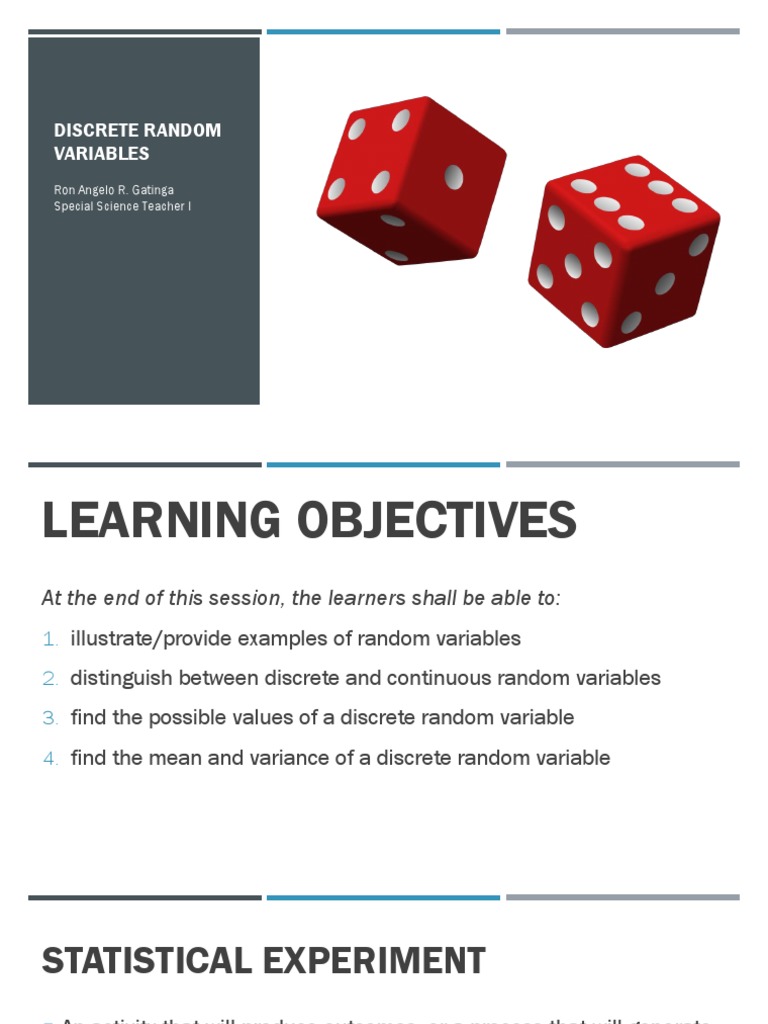
At its core, a discrete variable is akin to a collection of distinct, separable entities—much like a bookshelf crammed with unique tomes, each representing a specific value or category. These variables can only assume specific values and cannot take on fractions or decimals. For instance, when rolling a standard six-sided die, the only outcomes are the integers from one to six, encapsulating the essence of a discrete variable. This gives rise to the elegance of counting, where each value is a tangible point on the number line.
To explore this further, let’s embark on a journey through the enchanting landscape of examples of discrete variables. One of the most recognizable examples is the tally of the number of students in a classroom. Imagine a teacher, meticulously counting her students, each one being a whole number—an integer. This simple counting can evolve into complex data analysis, tracking attendance over time or examining the relationships between class size and academic performance. Each count is a discrete measurement, a distinct note in the symphony of educational dynamics.
Another quintessential example is the number of goals scored in a soccer match. Picture a thrilling game, with fans holding their breath as each player attempts to strike the elusive ball into the net. The total goals scored at the end of the match—whether it’s zero, one, two, or any upper limit—represents a discrete variable. Each goal is an achievement encapsulated in a whole number, allowing analysts to compare performances, evaluate player statistics, and draw conclusions about team effectiveness. This finite outcome illustrates a captivating aspect of discrete variables: they articulate snapshots of achievement and progress.
The realm of genetics offers yet another illustrative example. When considering the number of offspring produced by a single pair of fruit flies, researchers often work with discrete variables. Each generation can yield a specific number of offspring, ranging from zero to a maximum determined by various biological factors. This discrete measurement plays a pivotal role in genetic studies, where scientists rely on precise counts to draw insights about inheritance patterns, mutation rates, and evolutionary biology. Here, discrete variables transition from mere counts to profound revelations about the dynamism of life itself.
Furthermore, in the world of economics, discrete variables frequently make an appearance. Consider the number of items sold in a retail store during a specific time frame. Retail analysts depend on the discrete counts of individual items—a piece of clothing, a gadget, or a consumable product—to discern trends, evaluate inventory levels, and craft demand forecasts. The fluctuations in sales figures between different days, seasons, or promotional events carve a narrative that guides business strategies and market positioning. In this context, discrete variables become essential navigational tools in the convoluted waters of commerce.
In a more abstract realm, the concept of discrete variables can also be illustrated through the lens of a lottery system. Imagine a drawing where a limited number of winners are selected from a finite pool of participants. The discrete variable here represents the number of winners, which can only be a whole number—there cannot be half a winner! Each distinct outcome enhances the thrill of anticipation, transforming lives with each draw. The discrete nature of the variable reinforces its transformative power within the structured chaos of chance.
Another fascinating application can be found in the realm of technology, particularly in the context of digital communication. The number of bytes in a digital file serves as an excellent example of a discrete variable. Each byte represents a distinct unit of data, and file sizes can only be quantified in whole numbers. Whether it’s a small document of a few kilobytes or a high-definition video file encompassing gigabytes, the discrete count allows for clear categorization and facilitates efficient storage systems. As technology continues to evolve, understanding these discrete variables becomes paramount in managing vast arrays of data.
In conclusion, discrete variables encapsulate the essence of the concrete world, each count representing a tangible element in a continuum of information. They resound with the clarity of integers, whether counted in classrooms, recorded in sports, analyzed in genetics, tracked in economics, or measured in technology. Their unique appeal lies in the simplicity of counting—an innate human ability that underlies much of our understanding of the universe. By exploring the multifaceted applications of discrete variables, we appreciate the beauty of measurement and the profound significance of each numerical value, which, when pieced together, narrate the intricate stories of our lives.













