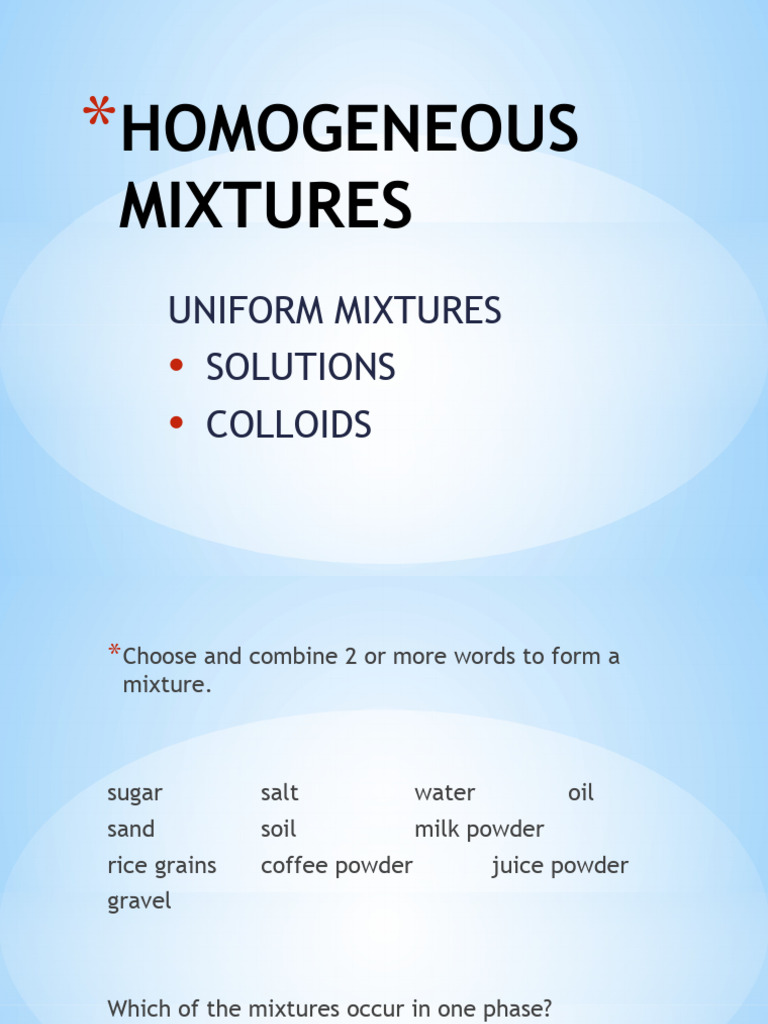
Homogeneous mixtures are ubiquitous in our everyday lives, yet they often go unnoticed as we traverse through our daily routines. These mixtures, characterized by their uniform composition and consistent appearance, embody a fascinating aspect of the physical world. They intrigue those with a penchant for science and those casually observing the world around them. Let’s delve into the compelling realm of homogeneous mixtures, exploring examples, properties, and implications that render them an enthralling subject of contemplation.
At its core, a homogeneous mixture is a blend of two or more substances that are distributed uniformly throughout. Unlike heterogeneous mixtures, where distinct components can be visually or physically differentiated, homogeneous mixtures present a seamless and consistent appearance. Classic examples abound, but perhaps none is more relatable than the common everyday beverage: a glass of sweetened iced tea.
When sugar is dissolved in tea, it creates an amalgamation where the solute (sugar) is indistinguishable from the solvent (tea). The profound satisfaction derived from this combination can be attributed not only to its delightful taste but also to the scientific marvel at play—the interaction between the solvent and solute forming a solution so harmonious that it tantalizes the senses while remaining fundamentally mundane.
But what is it that makes such mixtures so captivating? The answer lies in the principles of solubility and molecular interactions. When sugar enters the tea, it breaks down into its constituent molecules, each happily mingling with the liquid around it. This molecular dance leads to a stabilization of the resulting solution, rendering its components inseparable under typical conditions. The very act of dissolving is an exercise in chemistry, revealing the dynamic nature of matter and the balance achieved at the molecular level.
Another quintessential example of a homogeneous mixture is air. This mixture, although invisible, is a potent reminder of the complexity surrounding us. Composed primarily of nitrogen, oxygen, carbon dioxide, and trace gases, air’s composition can vary according to location, altitude, and other environmental factors. Despite its variability, the uniformity perceived in the atmosphere we breathe reflects a keen interplay between different gaseous molecules, seamlessly blending to form the air we are intimately familiar with.
Interestingly, the air we inhale does not simply comprise a static collection of gases. Its characteristics shift and evolve due to temperature fluctuations, pressure changes, and even anthropogenic influences. These nuances invite contemplation regarding our environment and the often-overlooked elements that sustain life. The invisible nature of air emphasizes the complexity inherent in mixtures, inviting deeper inquiry into the nuances of our everyday existence.
In practical applications, homogeneous mixtures take center stage in various scientific and industrial processes. For instance, the manufacturing of alloys employs the principles of homogeneity to achieve desired physical properties in metals. In this context, combining elements like copper and nickel results in a gold-like alloy known as cupronickel. Here, the homogeneous mixture is indispensable, as the resulting material boasts enhanced strength and corrosion resistance—attributes vital for maritime applications where durability is paramount.
Furthermore, homogeneous mixtures find their place in the culinary world. Hollandaise sauce, a creamy and rich emulsification of butter, egg yolks, and lemon juice, exemplifies the engineering of texture and flavor achieved through proper mixing techniques. The emulsification process allows disparate oils and water-based components to coalesce, resulting in a decadent sauce that is notably uniform in composition. Such culinary wonders demonstrate how the principles at play in homogeneous mixtures extend beyond science into the artistry of food.
The enigmatic nature of homogeneous mixtures extends into the realms of medicine and pharmacology as well. Solutions utilized in intravenous therapies serve as lifelines for patients, delivering precise concentrations of vital nutrients or medications. The meticulous formulation of these solutions exemplifies the harmony sought in achieving therapeutic efficacy. When we consider the role of homogeneous mixtures in these life-sustaining practices, the captivating potential of chemistry comes to the forefront of our awareness.
The exploration of homogeneous mixtures also introduces the concept of saturation. In solutions, the saturation point refers to the maximum amount of solute that can be dissolved in a solvent at a given temperature and pressure. Once this threshold is reached, any additional solute will remain in its solid form, showcasing a clear distinction. This phenomenon deepens our understanding of concentration and equilibria, further illustrating the complex interplay of natural laws that govern the behavior of mixtures. The visual representation of a saturated solution, such as granules of undissolved sugar resting at the bottom of an iced tea glass, serves as a striking reminder of the limits of solubility—a captivating interaction between the molecular world and our sensory perceptions.
To encapsulate the essence of homogeneous mixtures is to recognize their profound influence on both the mundane and the extraordinary facets of life. From the sugar that sweetens our tea to the gases we inhale, the myriad examples weave a tapestry of complexity and beauty that enrich our understanding of the world. Each example serves as a testament to the delicate balance and interconnectivity inherent in mixtures, sparking curiosity about the intricate workings of nature. In appreciating homogeneous mixtures, we are reminded that even the simplest of solutions can evoke a sense of wonder, inviting us to explore the science that envelops our everyday experiences.
As we conclude this exploration, let us carry forth a renewed appreciation for the homogeneity that exists in our lives—an elegant embodiment of harmony within complexity. Each glass of sweetened tea, each breath of fresh air, and each expertly crafted sauce embodies not merely a culinary or experiential pleasure but an elegant dance of molecules, endlessly captivating and intricately beautiful.