In the intricate tapestry of economics, marginal cost emerges as a crucial thread, weaving together the concepts of production and pricing. To elucidate this remarkable phenomenon, imagine a lush garden. Each flower represents a unit of production, blooming vibrantly under the care of diligent gardeners. Yet, with each additional bloom, resources—time, water, and soil nutrients—are stretched thinner, leading to an intriguing interplay between cost and output. A deep dive into the concept of marginal cost will not only illuminate its significance but will also reveal its profound impact on business decision-making.
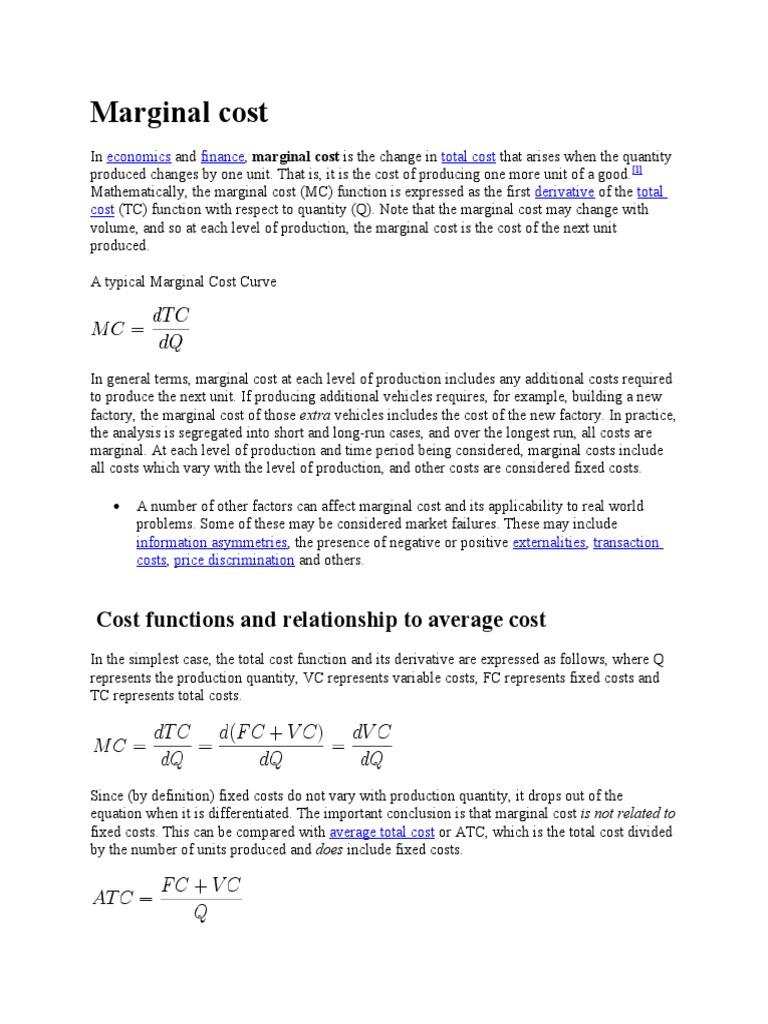
At its core, marginal cost refers to the increase in total cost that arises from the production of one additional unit of a good or service. This seemingly simple definition belies the complexities intertwined with its calculation and implications. As production scales, the components contributing to the marginal cost may fluctuate, which can further complicate economic modeling. This fluctuation is reminiscent of the waves lapping against the shore—each new wave (or unit of production) brings a unique set of challenges and hurdles to overcome.
To understand how marginal cost functions in practice, consider a bakery famed for its delectable pastries. When the bakery operates at a modest level, the marginal cost of producing a dozen croissants may be quite low. This is because the ingredients—the flour, butter, sugar, and eggs—can be procured in bulk at a favorable rate, and the labor required remains consistent. However, as demand surges, the bakery faces a dilemma. Producing more croissants necessitates hiring additional staff to manage the influx or, conversely, extending hours for existing employees. Either scenario incurs additional costs. As the bakery escalates its production level, the marginal cost of each additional dozen croissants begins to climb.
To better illustrate this concept, one can construct a hypothetical scenario where the bakery’s total costs are represented as a curve on a graph. Initially, when the production is low, marginal costs are flat, akin to a serene lake. But as production intensifies, the curve begins to rise steeply, representing the escalating costs associated with overworking equipment, diminished quality of ingredients, and overtime wages for weary staff. This rise depicts the law of diminishing returns, which states that as more resources are allocated to a particular process, the additional output generated becomes progressively less efficient.
The unique appeal of examining marginal cost lies not only in its mechanics but also in its applications. For businesses, understanding marginal cost can be the cornerstone of pricing strategy. A firm must meticulously analyze its marginal costs to decide whether to lower or raise prices, ensuring sustainability and profitability. Take, for instance, the technology sector, where companies like Apple or Google must determine how much to charge for new software updates or additional cloud storage. If the marginal cost of providing these digital services is lower than the price demanded, then the product is not just viable; it’s a goldmine waiting to be harvested.
Moreover, the marginal cost influences the competitive landscape within industries. Companies continuously assess their rivals’ pricing structures and costs, which leads to strategic adjustments. For a luxury automotive brand, navigating the waters of marginal costs might involve enhancing features or adding customizable options that justify a higher price point. Conversely, a budget car manufacturer may focus on streamlining production processes to lower its marginal costs, passing those savings on to consumers in the form of lower prices. The interplay of these strategic decisions can shift market dynamics, illustrating how deeply interconnected marginal costs are with broader economic principles.
In addition, the consequences of marginal cost extend beyond immediate financial implications. Policymakers and economists scrutinize businesses’ marginal costs to gauge economic health, monitor inflation trends, and formulate regulations that foster competition and fair pricing. Educators emphasize this concept within academic curriculums, illustrating its pivotal importance in comprehending both microeconomic and macroeconomic landscapes. This understanding can empower aspiring entrepreneurs to make informed decisions, thus reshaping industries and economies.
As one delves deeper into the subject, a fascination with marginal cost often leads to an exploration of its relationship with average cost. While average cost measures the total cost spread over multiple units produced, marginal cost zeroes in on the cost associated with increasing production by a single unit. The harmonization of these concepts is vital; they intertwine like two dancers in a tango, each requiring the other to create a captivating performance. In scenarios where marginal cost falls below average cost, businesses can benefit from economies of scale, while the opposite can indicate a need for strategic reevaluation.
In conclusion, the concept of marginal cost is an essential cog in the machine of economic understanding. This intricate idea embodies the delicate balance between production and expenditure, challenging business leaders to respond with agility and foresight. By embracing the metaphor of the garden, one can appreciate how nurturing each unit of production, while being mindful of the resources allocated, lays the groundwork for a flourishing enterprise. Recognizing the nuanced implications of marginal cost not only enriches one’s comprehension of economic principles but also equips individuals with the tools necessary to make astute decisions in an ever-evolving landscape.