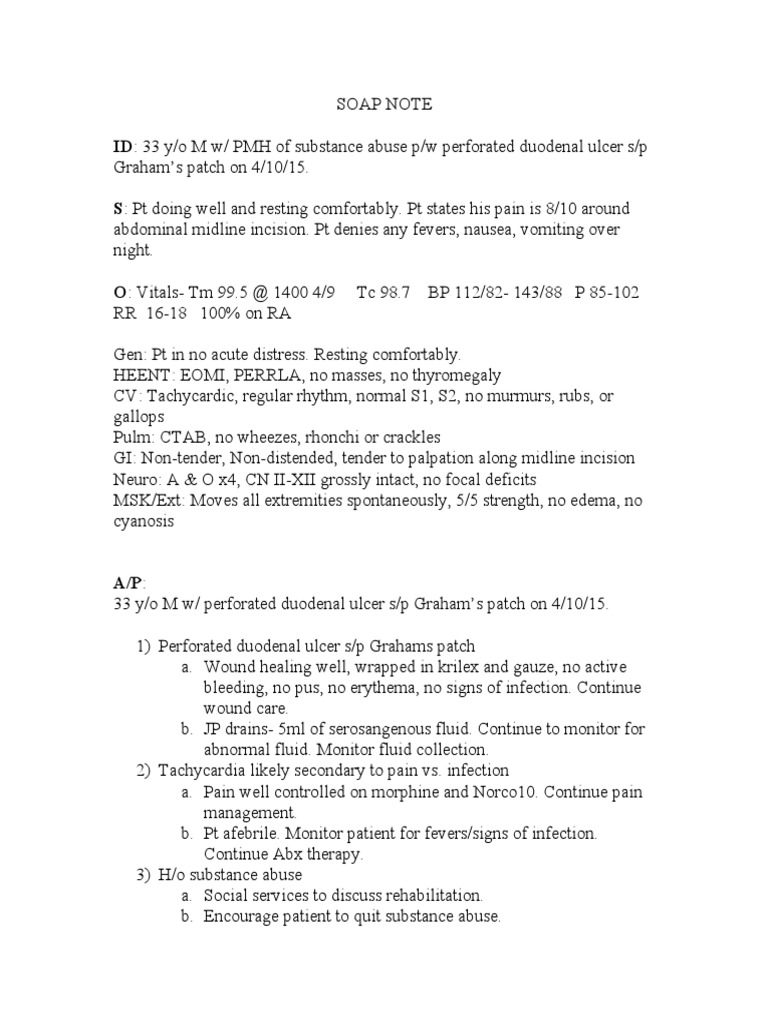
Within the realm of healthcare documentation, SOAP notes stand as an indispensable tool for narrating patient encounters with precision and lucidity. The acronym SOAP represents Subjective, Objective, Assessment, and Plan—four essential components that facilitate a systematic approach to recording patient information. Understanding this framework not only improves communication among healthcare providers but also enriches the patient-care experience. Curiosity piques as we delve into the intricacies of SOAP notes, exploring how they promise a transformative perspective on documenting healthcare interactions.
To comprehend the significance of SOAP notes, one must first appreciate the unique elements encapsulated within each component. The Subjective section invites the patient to narrate their personal experience. It encompasses their symptoms, feelings, and perceptions. Here, you may witness the vivid expression of discomfort that transcends mere clinical jargon. The art of listening comes to the fore, as healthcare practitioners strive to capture the essence of the patient’s narrative. This portion of the SOAP note is uniquely pivotal—it is a canvas painted with the colors of the patient’s reality.
Transitioning to the Objective component, we shift gears into the empirical realm, where observable facts and measurable data reign supreme. This section houses vital signs, physical examination findings, laboratory results, and diagnostic imaging reports. The objective data contrasts strikingly with the subjective experience, providing a comprehensive tableau of health status. This juxtaposition solidifies the foundation upon which informed clinical decisions rest. Armed with both subjective insights and objective evidence, a healthcare provider can begin to unravel the complexities of the patient’s condition.
The Assessment segment serves as a pivotal juncture, where the clinician synthesizes the gathered information into a coherent understanding of the patient’s issues. This is where experience and expertise converge to formulate a differential diagnosis. Here, the healthcare provider assesses not just potential ailments but also implements critical thinking, weighing the interplay of symptoms and signs. In doing so, they cultivate a narrative that ties together the subjective and objective components, ultimately illuminating the clinical picture. It’s intriguing to consider how this narrative is ever-evolving, as the patient’s condition and responses to treatment unfold over time.
Finally, the Plan section details the roadmap for patient management moving forward. It encompasses treatment interventions, follow-up appointments, and referrals to specialists. The plan is not merely utilitarian; it is a promise, a commitment to the patient’s journey toward wellness. In this segment, the healthcare provider articulates their strategy while fostering collaboration with the patient. Engaging patients in shared decision-making empowers them to take ownership of their health and cultivates a therapeutic alliance grounded in trust and transparency.
But the bountiful offerings of SOAP notes do not stop at mere documentation. Engaging with this format invites a shift in perspective that raises profound questions about patient interactions. For instance, how might a clinician’s understanding evolve when they shift their focus from clinical findings to the patient’s narrative? The act of eliciting subjective experiences enriches the data collection process and fosters empathy. When patients feel understood, they are often more inclined to participate actively in their care, reinforcing the importance of reciprocal dialogue in the healthcare setting.
Moreover, the structured nature of SOAP notes enhances continuity of care. As patients traverse different phases of treatment, or shift between various healthcare providers, SOAP notes act as a clinical passport, detailing their medical journey. This can lead to fewer misunderstandings and ensure that each provider possesses a comprehensive understanding of the patient’s history. It’s captivating to ponder how the meticulous documentation of SOAP notes transcends mere record-keeping and becomes the bedrock of collaborative, integrated healthcare.
Furthermore, in an era characterized by technological evolution, the transition from paper-based SOAP notes to Electronic Health Records (EHRs) has redefined how healthcare is documented and shared. EHR systems permit real-time updates and rapid access to patient data. They also hold the potential for advanced data analytics, yielding insights that can inform public health initiatives and enhance clinical practices even further. The evolution of SOAP notes reflects a broader shift toward digitization in healthcare, providing new avenues for quality improvement and patient empowerment.
A compelling case study exemplifies the transformative potential of SOAP notes. Consider a patient presenting with chronic pain—a malady often steeped in ambiguity. By employing the SOAP format, clinicians can draw accurate correlations between subjective reports and objective findings, assessing underlying psychological factors or lifestyle influences. This comprehensive understanding enables targeted interventions and optimal treatment strategies, ultimately leading to a profound impact on the patient’s quality of life. The situation exemplifies how this structured methodology can augment care and engender positive outcomes.
As we traverse the landscape of healthcare documentation, SOAP notes emerge as more than a standardized form; they are an essential narrative tool, breathing life into the clinical encounter. Each entry is an opportunity to reflect on the patient experience while ensuring that objective medical data inform clinical decisions. As practitioners continue to engage with this format, the potential for enhanced communication, collaboration, and patient-centered care remains limitless. With their promising shift in perspective, SOAP notes beckon healthcare professionals to embrace a more holistic view of patient encounters, ultimately redefining the healthcare landscape for the better.