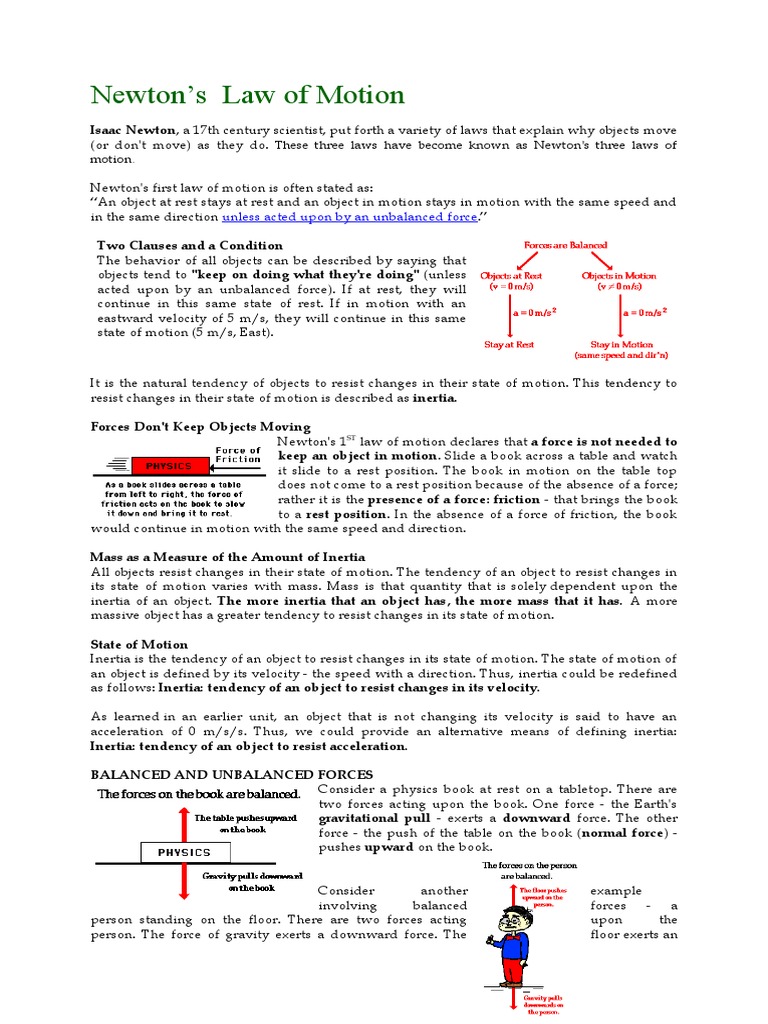
The first law of motion, commonly referred to as Newton’s First Law, serves as a foundational principle in understanding the mechanics of physical objects. This law asserts that an object at rest remains at rest, and an object in motion continues in its state of motion with the same speed and in the same direction unless acted upon by an external force. Let us delve into this principle through various examples that not only clarify the concept but also illuminate how this law governs motion in our everyday lives and the universe at large.
1. The Unmoving Book
Imagine a heavy book resting on a table. The forces acting on the book comprise its weight pulling it downward and the table pushing it upward, resulting in a state of equilibrium. According to the first law of motion, this book will remain in its state of rest indefinitely unless an external force, such as a hand, applies a push to move it. This simple yet profound observation showcases inertia—a property that resists changes in motion. It reveals how objects favor the status quo unless compelled to change.
2. The Rolling Ball
Now, envision a ball rolling across a flat surface. Initially, as it moves, the ball exemplifies a state of motion, perpetuated by its inertia. However, the moment it encounters resistance from a rough surface or a slight incline, the ball experiences deceleration. If no impediments existed, the ball would glide indefinitely, underscoring the first law’s assertion: without external forces, an object in motion stays in motion. This phenomenon prompts a deeper understanding of friction as a counteracting force that intervenes in natural motion.
3. The Spectacle of Space
Expand this notion to celestial bodies traversing the vastness of space. Planets orbiting stars exemplify Newton’s First Law on a grandiose scale. In the vacuum of space, devoid of atmospheric friction and interference, a planet maintains its trajectory around the sun with unceasing velocity. Such celestial dance is devoid of the need for propulsion once the initial momentum is achieved. Here too, we observe inertia—a cosmic ballet that endures until external gravitation forces alter these paths.
4. A Passenger in a Car
Consider the experience of a passenger seated in a vehicle maneuvering through city traffic. When the driver abruptly accelerates, the passenger lurches backward against the seat. Conversely, when the car decelerates suddenly, the passenger feels a force compelling them forward. These reactions exemplify inertia and the influence of unbalanced forces. The first law of motion becomes palpable in this scenario, making it an everyday illustration of how inertia affects our daily experiences.
5. The Basketball Shot
In the realm of sports, Newton’s First Law is conspicuously present in the art of a basketball shot. When a player releases the ball towards the hoop, it travels in a straight line until gravitational force acts upon it. The basketball will follow this path until it either hits the ground or encounters the net. Here, momentum, combined with gravitational influence, demonstrates the first law in action. The precise application of force in executing the arc of the shot highlights how athletes unconsciously exploit these principles to achieve success.
6. The Importance of Safety Belts
Broader implications of this concept are evident in automotive safety design. Safety belts are engineered to counteract the effects of inertia that would otherwise result in serious injury during sudden stops or collisions. In the event of a crash, an unrestrained passenger experiences inertia, propelling them forward at the same speed the car was traveling. Buckling up acts as a proactive measure against this uncontrollable motion, emphasizing the necessity of understanding Newton’s First Law for personal safety.
7. The Impetus of Technology
Modern technology, from space exploration to everyday gadgets, is deeply rooted in the principles of motion described by Newton’s First Law. The engineering of rockets hinges on the law of inertia; they remain stationary until propulsion is applied. Once in space, rockets coast with astoundingly minimal fuel consumption due to the absence of external forces. By harnessing this fundamental principle, scientists and engineers design innovative technologies that revolutionize our interactions with the universe.
8. Conclusion: A Paradigm Shift
Newton’s First Law of Motion offers an enlightening perspective not only on the mechanics of movement but also serves as an allegorical framework for understanding resilience in life. Just as an object resists changes to its state unless acted upon by an external force, so too do individuals often remain in their comfort zones until motivated by circumstances. Recognizing this can invigorate a transformative mindset, propelling one to embrace change and challenge their status quo.
In essence, the first law of motion transcends mere physics, becoming a metaphor for progress. Whether it’s an unmoving book, a rolling ball, or the intricacies of the cosmos, each example enriches our comprehension of inertia and the requisite forces for change. Exploring these examples sparks curiosity and fosters a deeper appreciation for the fundamental laws governing not only the universe but also our everyday experiences.