Have you ever wondered how a simple structure could pave the way for a complex masterpiece? Crafting a research paper can certainly feel like an overwhelming endeavor. However, with the right outline, that labyrinth of ideas, facts, and arguments can be navigated with relative ease. What happens when you embark on this exploratory journey with a meticulous guide? The potential for clarity and depth seems boundless. An effective research paper outline serves as the framework, ensuring that every variable speaks in harmony, contributing to the overall thesis with elegance and precision.
To illustrate the power of a robust outline, let’s delve into the anatomy of ideal research paper structures, categorized by various strands of academic inquiry. Whether you are embarking on your first scholarly adventure or are a seasoned researcher, these examples will ignite your creativity and inspire meticulous planning.
1. Traditional Argumentative Research Paper Outline
This particular structure is ubiquitous in academic settings, often adopted in subjects that require a stance on prevailing debates. The intent here is to articulate a compelling argument while adhering to logical coherence.
- Introduction
- Background information regarding the topic.
- Thesis statement clearly defining your position.
- Literature Review
- Summaries of key studies relevant to the argument.
- Contrasting viewpoints acknowledged to enhance credibility.
- Supporting Arguments
- First supporting argument with evidence and citations.
- Second supporting argument with evidence and citations.
- Third supporting argument with evidence and citations.
- Counterarguments
- Acknowledge major counterarguments.
- Refutations to strengthen your position.
- Conclusion
- Restate the thesis in light of the arguments presented.
- Closing thoughts on the matter and potential implications.
2. Empirical Research Paper Outline
Empirical research papers thrive on firsthand data collection and analysis. Investigators often grapple with intricate methodologies and the interpretation of empirical findings. This outline lends structure to data-driven analysis.
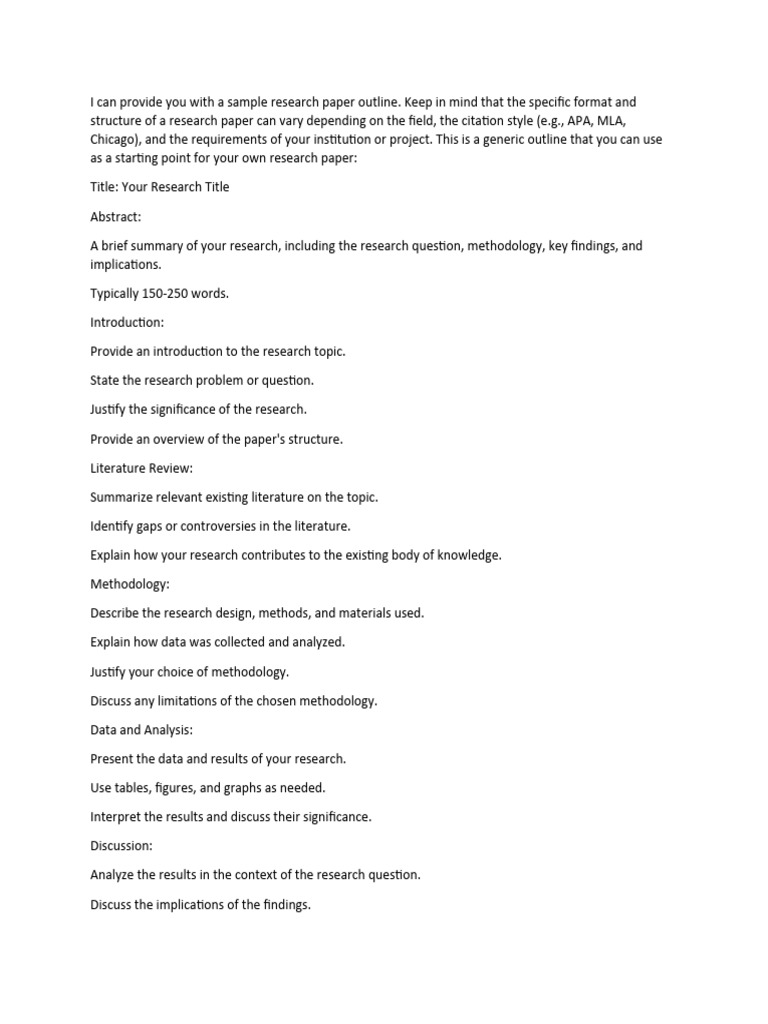
- Abstract
- A concise summary of the study.
- Introduction
- Introduce the research problem and significance.
- Research question and hypotheses.
- Literature Review
- Discussion of existing literature relevant to your hypothesis.
- Gaps identified that your research aims to fill.
- Methodology
- Detailed description of research design.
- Participants, instruments, and procedures.
- Data collection and analysis methods.
- Results
- Presentation of findings using tables and figures.
- Interpretation of key results.
- Discussion
- Comparison of findings with existing literature.
- Implications for future research.
- Conclusion
- Summarization of key insights.
- Final thoughts on broader implications.
3. Narrative Research Paper Outline
In disciplines such as literature, history, or sociology, narrative structures can manifest as compelling storytelling devices. Outlining a narrative research paper requires integrating personal anecdotes with scholarly discourse.
- Introduction
- Hook—an engaging anecdote or quote.
- Thesis statement presenting the narrative arc.
- Personal Narrative
- Key events that shape your understanding of the topic.
- Reflections on those events with scholarly connections.
- Scholarly Research
- Incorporation of literature and studies that inform your narrative.
- Contrast between personal experiences and researched facts.
- Analysis
- Examine the implications of your narrative within broader contexts.
- Connect personal experiences to larger societal narratives.
- Conclusion
- Reflection on the journey and insights gained.
- Call to action or further questions to ponder.
Each of these outlines encapsulates the essence of structured academic writing, but each serves a distinct purpose and audience. The act of outlining is not mere busywork; it urges one to critically analyze and refine their argumentation and methodology before embarking on the actual writing journey. The act of crafting an outline can simplify what often feels like a daunting task, transforming it into a poignant exploration of ideas.
As you contemplate the various examples provided, consider the question: How might your own research journey benefit from an effective outline? What challenges would you reckon with, and how could a well-structured framework ease your path? The possibilities are vast, and the rewards can be profound. Happy outlining!