Have you ever pondered whether purchasing insurance is merely a safety net or a paradoxical leap of faith? In a world rife with uncertainties, the act of acquiring insurance epitomizes a fascinating interplay between risk management and human psychology. This article delves into the intricate relationship between purchasing insurance and the concept of risk—exploring the motivations, implications, and nuances that shape our understanding of this essential financial product.
At its core, insurance serves as a financial safeguard against the unpredictable ebbs and flows of life. As soon as an individual provides their premium payment, a contract is established, binding them to the insurer in an intricate dance of trust and expectation. The policyholder places confidence in the insurer’s ability to compensate for potential losses while simultaneously acknowledging the inherent uncertainties that life brings. But why do we embrace this paradox of willingly paying for something we hope never to experience?
The rationale behind purchasing insurance often emanates from our innate desire for security and assurance. This psychological comfort comes from the belief that a financial safety net shields us from ruinous consequences. Conceiving an accident or misfortune is disquieting; yet, the prospect of such events catalyzes the insurance purchase. In effect, buying insurance is akin to gambling on the very occurrences one fervently wishes to avoid. Is it not intriguing how we invest in our protection from risk, knowing full well it is a gamble that involves mitigating the very thing we dread?
Moreover, these decisions are seldom straightforward. They encompass varying degrees of complexity—from selecting the appropriate type of coverage to grappling with the subtleties of deductibles and premiums. The multiplicity of choices can be daunting, and navigating the labyrinth of insurance can pose a formidable challenge even for the most astute consumer. For instance, auto insurance may offer collision and comprehensive coverage, each with distinct advantages and costs, leading to a critical juncture: how much risk is one willing to retain versus transfer? In these decisions, risk becomes intensely personal, intermingling with individual priorities and financial limitations.
Additionally, insurance extends beyond personal welfare; it plays a pivotal role in economic stability and societal welfare. When businesses insure their assets, they contribute to an ecosystem that enables recovery and bolstered resilience in the face of calamities. Consider a factory ravaged by fire. With adequate insurance coverage, the closure may be temporary rather than permanent; jobs are preserved, and the local economy is safeguarded against the cascading effects of loss. Thus, the act of purchasing insurance should be viewed not merely as an individualistic endeavor but as a collective responsibility that influences broader community dynamics.
Furthermore, this intricate interrelation between insurance and risk manifests in varying forms across different sectors. Health insurance, for instance, embodies a spectrum of risk-sharing, where individuals pay premiums into a pool, collectively mitigating the financial burden of health emergencies. Yet, the narrative can turn contentious—how do we balance the moral implications of risk-sharing when some choose not to engage? What happens when the healthy subsidize the costs of the ill? These are probing questions that challenge the very fabric of insurance systems and demand deliberation.
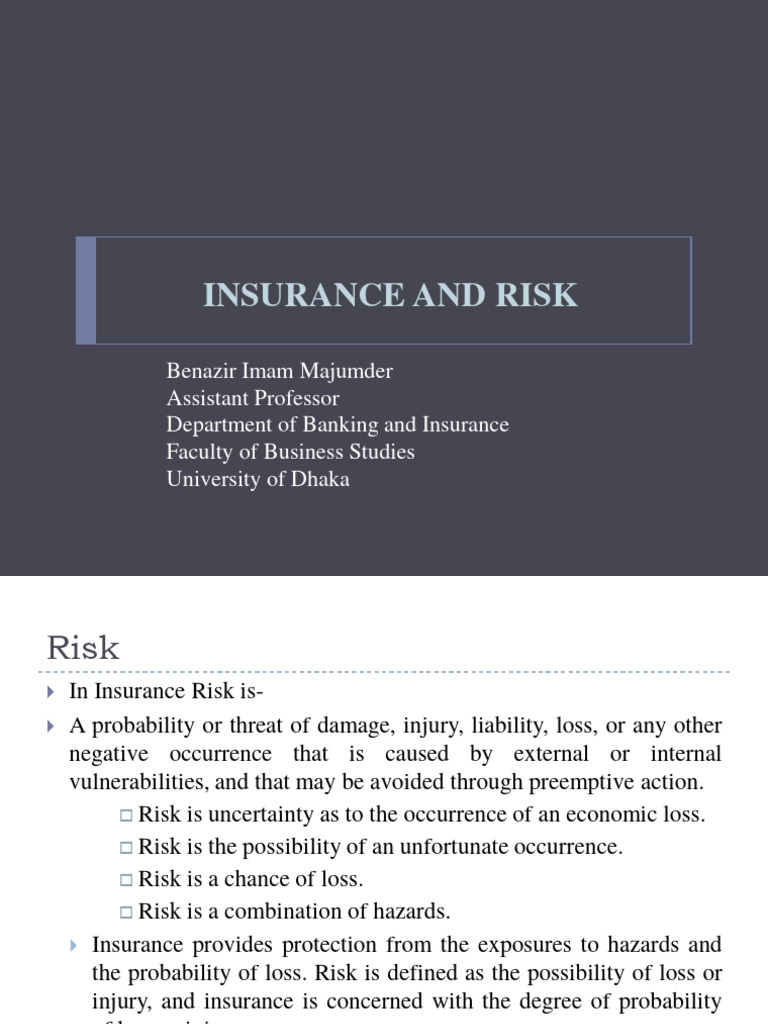
Delving deeper into the concept of risk, it becomes evident that not all risks are created equal. In fact, they can be categorized into numerous types, such as pure risk versus speculative risk. Pure risks entail scenarios where loss is the only outcome, such as natural disasters or theft, while speculative risks may result in gains, like stock market investments. When we purchase insurance, we primarily navigate pure risks, pondering the ‘what ifs’ that life might throw our way. This purview creates a consciousness regarding what risks are deemed acceptable and which warrant coverage—a nuanced decision-making process that inevitably fluctuates throughout one’s life course.
Moreover, the evolution of technology and data analytics has further revolutionized the landscape of risk assessment. Insurers can now utilize predictive modeling and big data to better ascertain potential losses, tailoring policies that align with individual risk profiles. These advancements, however, invite a complex quandary—does this commodification of risk shift our perceptions of personal accountability? As algorithms increasingly dictate our premiums, we may unwittingly cede our responsibility to a machine, complicating the human experience of risk and insurance.
As we continue to delve into the complexities of this vital financial mechanism, it becomes patently clear that purchasing insurance is a multifaceted endeavor enriched with nuanced implications. This juxtaposition of protection against risk illuminates a fundamental aspect of human nature—our ceaseless quest for control amidst uncertainty. Whether one perceives insurance as a pragmatic safeguard or an intriguing gamble, it ultimately engenders a vital conversation about how we confront the unpredictability of existence.
In conclusion, while the act of purchasing insurance embodies a myriad of motivations, it primarily connotes a strategic response to risk. It invites contemplation on societal obligations versus individual rights and the philosophical ramifications entwined within the financial framework. So next time you consider acquiring insurance, ask yourself: are you merely purchasing a policy, or are you actively participating in a broader narrative that encompasses both risk and the human experience?