
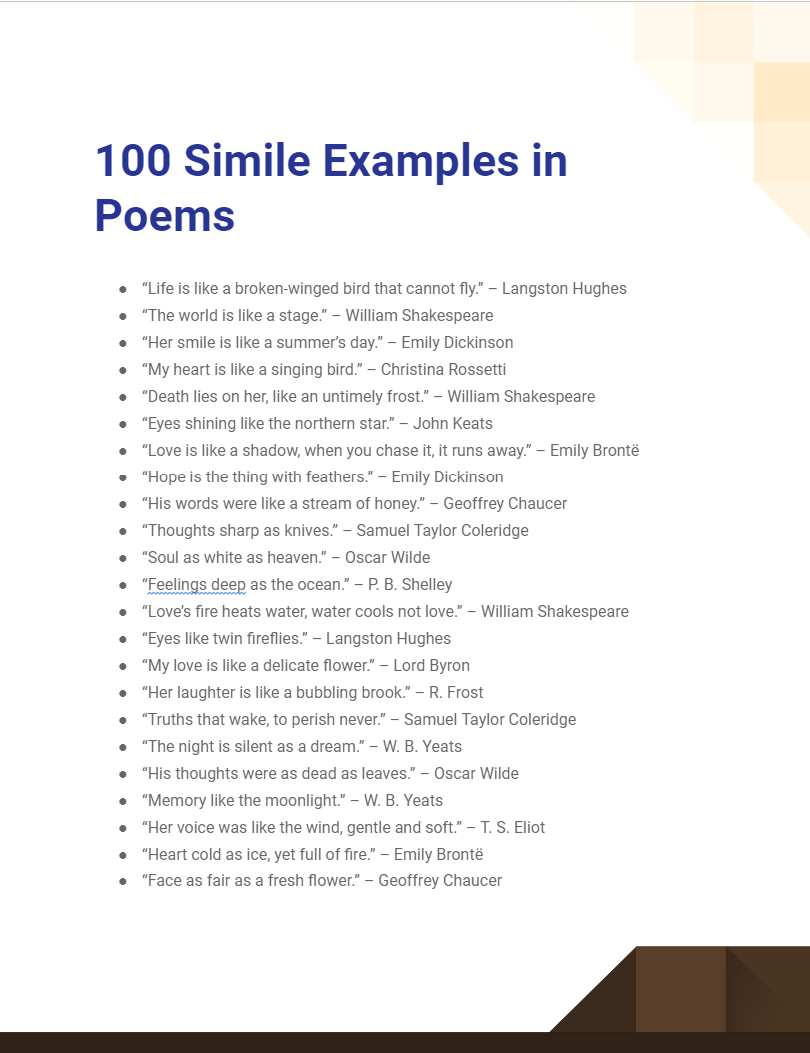
Similes are ubiquitous in literature and everyday language, weaving intricate webs of imagery that breathe life into descriptions. To grasp the essence of a simile, one must first dismantle its very fabric. A simile is a figure of speech that directly compares two distinct entities, typically introduced by the words “like” or “as.” This comparison creates a vivid connection that allows the reader or listener to visualize a concept in fresh and engaging ways. But what does this look like in practice? Here, we delve deep into the world of similes, unveiling captivating examples and investigating their compelling impact.
To appreciate the power of a simile, consider this example: “Her smile was like a ray of sunshine.” The image conjured is not merely a comparison between a smile and sunlight; it evokes warmth, cheerfulness, and the invigorating prospects of a bright day. Such vivid imagery distills complex emotions and characteristics into relatable representations. The purpose of using similes transcends mere embellishment; it promises a transformation in perspective for both the writer and the reader.
At the core of similes lies the art of abstraction. When one states, “His heart was as cold as ice,” the intention goes beyond a factual description of emotional indifference. Here, an entire narrative unfolds—of frigid sentiments and the stark loneliness that often accompanies emotional fortification. Through such a simile, feelings become palpable and relatable, inviting readers to reflect on their own experiences with emotional resilience.
Moreover, similes function as bridges, linking the familiar to the unfamiliar. Think of the phrase “She danced like a leaf in the wind.” This simile draws upon a mundane image—the delicate, unanchored movement of a leaf—to describe the fluidity and grace of a dancer. Such comparisons elicit curiosity and elation by enabling readers to visualize dance in an unpredictable, organic manner. The imagery fosters an appreciation for the subtleties of movement, thereby deepening the reader’s engagement with both the writing and the theme it embodies.
Similes are not just confined to the realm of poetry or literature; they permeate conversation and advertisements alike. When an advertisement proclaims a product is “as smooth as butter,” it does more than highlight texture; it evokes a feeling of satisfaction and indulgence, persuading the audience of the desirability of the product. In these contexts, similes encapsulate complex ideas into digestible nuggets, often playing on cultural connotations to maximize impact.
Yet, an effective simile does more than just capture attention; it can challenge preconceived notions. For instance, “Time is like a thief in the night” conjures a duality between time’s inevitable progression and the stealthy nature of loss. This nuance strikes at the heart of human experience, prompting reflection on mortality and the ephemeral nature of existence. Such thought-provoking comparisons invite readers to rethink their relationship with time, fostering a sense of urgency or appreciation that they might not have previously entertained.
As the conversation evolves around similes, their ability to encapsulate ambiguity becomes apparent. In literature, ambiguity can be a formidable tool, allowing for multiple interpretations. The phrase “He fought like a lion” could symbolize bravery, ferocity, or even reckless abandon depending on the context. This complexity can stimulate debate and discussion, evoking varied emotional responses and engagements. The cognitive dissonance generated by similes serves to pique curiosity, compelling readers to delve deeper into the narrative fabric.
Even further, similes find their way into social commentary and political rhetoric. Phrases such as “She rallied her supporters like a firebrand” can evoke urgency and fervor, colorfully illustrating the impact of a compelling leader. In this way, similes can synthesize complex social dynamics into relatable commentary, fostering an understanding of movements, ideologies, and conflicts in visceral terms. When writers wield similes with precision, they illuminate intricate social phenomena that might otherwise remain obscured by abstract language.
In crafting similes, however, one must tread carefully. The effectiveness of a simile often lies in its ability to surprise and resonate without feeling cliché or forced. A well-crafted simile feels spontaneous; it flows organically from the narrative rather than merely serving as ornamental language. For instance, compare the prosaic phrase “He was happy as a clam” with a more inventive simile: “His laughter erupted like a spring’s first bloom.” The latter bursts with imagery, inviting readers to experience not just happiness but also renewal and freshness. With such variations, the impact of similes becomes a harmonic balance between novelty and familiarity.
In conclusion, examples of similes resonate across various forms of expression, enchanting readers and sparking curiosity through vivid comparisons that illuminate complex emotions and thoughts. Their transcendent ability to connect disparate concepts grants them a unique place in both language and literature. As they bridge the gap between the mundane and the extraordinary, similes not only enrich our understanding but draw us into a world where abstraction meets reality. In this intricate dance of words, similes beckon us to shift perspectives, reframe thoughts, and indulge our imaginations in ways that resonate long after the last line is read. Their artistry infuses our dialogue, narrative, and imagination—a poetic transmutation of thoughts into feelings that linger, provoking contemplation long after their creation.













