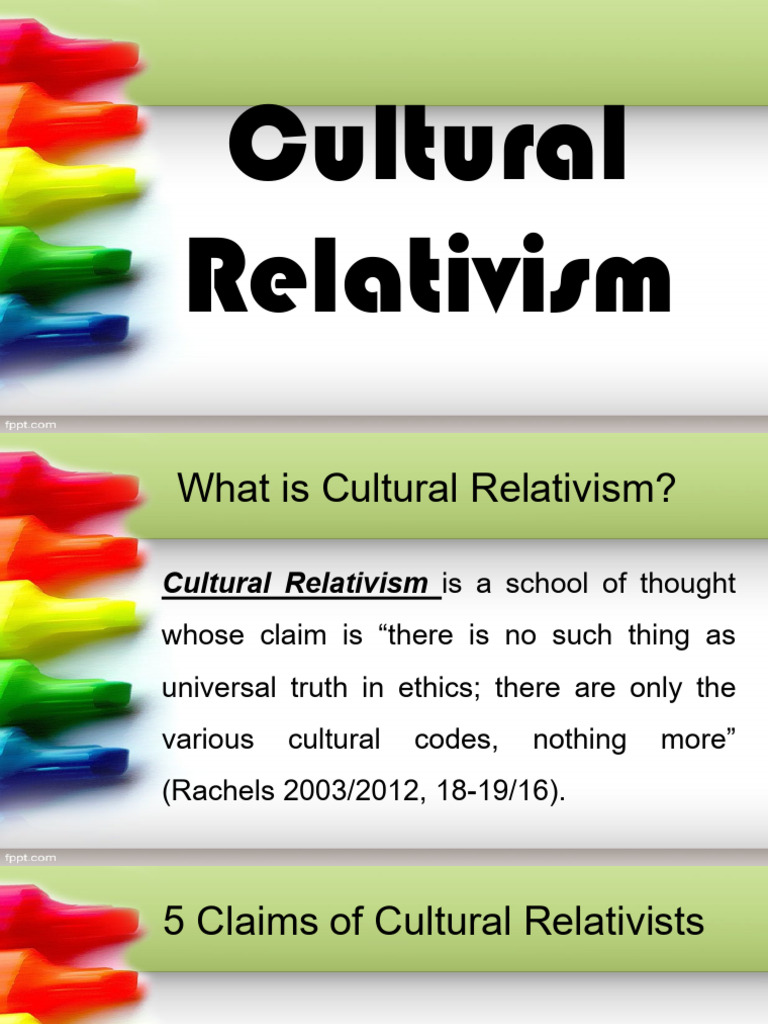
The world is a kaleidoscope of cultures, an intricate tapestry woven from diverse threads of history, tradition, and belief. Each strand possesses its own vibrancy, yet they all contribute to the larger picture of human experience. At the heart of this complexity lies the concept of cultural relativism, which posits that an individual’s beliefs and activities should be understood based on that individual’s culture, rather than be evaluated against the criteria of another culture. In this exploration, we delve into examples that epitomize cultural relativism, illuminating its relevance in contemporary discourse.
To grasp the essence of cultural relativism, consider the metaphor of the ocean. Each wave can be seen as a unique cultural expression, crashing against the shores of society. Some waves are gentle, bringing with them thoughts of harmony, while others are tumultuous, representing debates and dissent. Understanding these waves requires immersion, an acknowledgment that no one wave is superior or inferior; rather, they are all part of the same vast body of water.
One of the most poignant examples of cultural relativism can be found in the realm of marriage customs. Take, for instance, the practice of arranged marriages prevalent in many parts of the world. In Western societies, the notion of love and choice often dominates discussions about marriage. The concept of marrying for love is exalted, and anything diverging from this ideal is frequently vilified. However, in cultures where arranged marriages are customary, the practice is not merely a transaction but a profound commitment involving families and communities. Here, the bond transcends individual desires, rooting itself in collective values and long-standing traditions.
In this context, to impose a Western perspective onto an arranged marriage would be akin to placing a square peg into a round hole — a misalignment that can lead to misunderstanding. Cultural relativism challenges us to explore and respect the meanings behind practices as they manifest in their societal contexts, rather than rigidly adhering to our own preconceptions.
Another vivid illustration can be found in gastronomical traditions across various cultures. A dish that one culture reveres, such as sushi in Japan—where raw fish is a delicacy and a symbol of culinary artistry—may evoke raised eyebrows in another culture. In some regions, consuming raw seafood is fraught with health concerns or simply deemed unpalatable. Yet, the practice of sushi-making is steeped in historical significance and artistry. Its reverence in Japan stems from centuries of tradition and a profound relationship with the sea. Advocating for a one-size-fits-all culinary standard diminishes the rich narratives embedded within these dishes.
Additionally, consider the rich tapestry of rituals surrounding death in different cultures. In some societies, like the Toraja people of Indonesia, death and funeral ceremonies are celebrated with elaborate rituals. This contrasts sharply with cultures that may view death as somber and sad, focusing on mourning. The Toraja celebrate their deceased relatives, viewing death as a continuation of a journey rather than an end. To apply one culture’s values to the understanding of another’s death customs denies the spiritual significance of these observances, a hallmark of cultural relativism.
When addressing issues of morality, cultural relativism reveals the complexities that arise in ethical considerations. For instance, the practice of polygamy is accepted and celebrated in various cultures, where it may serve as a reflection of social structures and communal living. Yet, many Western cultures approach this practice with criticism, seeing it through a lens of monogamous ideals. Cultural relativism invites an exploration of how different societies construct familial relationships and the values that underpin these decisions. In doing so, it fosters a dialogue that encourages understanding instead of judgment.
Education, too, shines as a fertile ground for the exploration of cultural relativism. The educational paradigms that exist globally are products of cultural histories, socioeconomic factors, and communal values. While Western educational systems might emphasize standardized testing and quantitative assessments, other cultures may prioritize oral traditions and wisdom-sharing. For instance, Indigenous Australian education often incorporates storytelling and experiential learning, viewing knowledge as something to be shared in a communal context. Here again, cultural relativism urges an appreciation for the myriad ways knowledge can be imparted and valued.
Moreover, cultural relativism plays a crucial role in the arena of human rights. As we navigate the increasingly interconnected world, it’s essential to consider how concepts of human rights are not uniform; they are shaped by cultural nuances. The interpretation of rights, justice, and community responsibility can vastly differ across societies. Engaging with cultural relativism helps create a more comprehensive understanding of these differences, reinforcing the importance of context in discussions surrounding universal rights and freedoms.
In a world brimming with complexity, the lens of cultural relativism beckons us to embrace the variations that exist between cultures. It is an invitation to step away from the pedestal of our biases and engage in a meaningful dialogue that prioritizes understanding over judgment. Embracing this approach is akin to becoming a traveler in a foreign land—one who listens, learns, and respects the paths walked by others.
Ultimately, cultural relativism challenges individuals to expand their horizons, fostering a more inclusive world. It paints a picture of humanity, rich in its diversity, inviting all to appreciate and celebrate the stunning array of cultures that comprise our global society. Thus, as we navigate the complexities of our interconnected lives, let us remember that each culture is a vital thread in the grand tapestry of existence, one deserving of inquiry, respect, and understanding.