
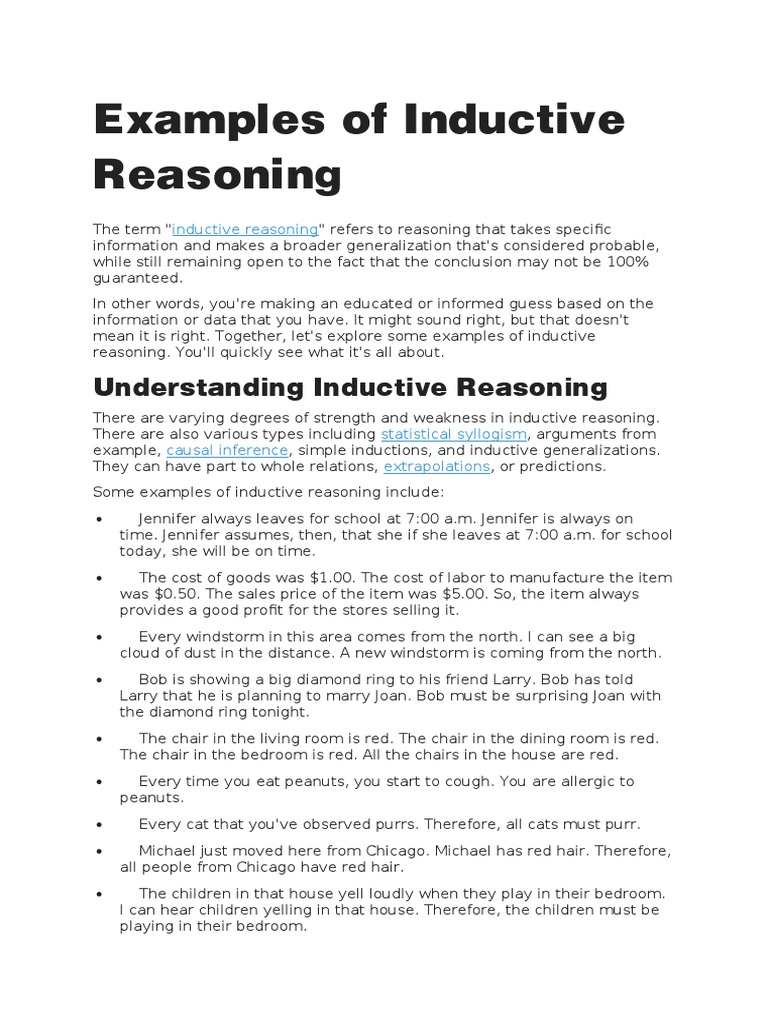
Have you ever pondered how we arrive at certain conclusions based on a sequence of observations? Imagine this scenario: every day for a week, you noticed that your neighbor watered their garden in the early morning. Do you think you could deduce that they always water their garden in the morning? This question leads us into the fascinating world of inductive reasoning—a fundamental aspect of human cognition that allows us to generalize from specific instances. But what exactly constitutes an example of inductive reasoning? Let’s delve deeper into this intriguing method of thinking and explore various facets, examples, and implications.
Understanding Inductive Reasoning
Inductive reasoning, at its core, refers to the process of drawing general conclusions from specific observations. Unlike deductive reasoning, where conclusions are guaranteed provided the premises are true, inductive reasoning allows for conclusions that may be probable but not certain. This is the essence of everyday reasoning, shaping how we perceive reality and make predictions.
Consider the classic example of observing the sun rising in the east each day. Based on this repeated experience, one might conclude that the sun will rise in the east tomorrow as well. Although this conclusion appears sensible, it is not infallible. Nevertheless, inductive reasoning is invaluable in crafting theories and hypotheses across various disciplines, including science, philosophy, and law.
Examples of Inductive Reasoning in Everyday Life
Inductive reasoning manifests itself in numerous facets of daily life, enriching our decision-making processes. Here are some vivid examples:
- Weather Predictions: Meteorologists often base their forecasts on patterns observed in past weather conditions. If it rained consistently during specific months over the years, they may conclude that similar weather patterns will recur. While this reasoning is grounded in inductive logic, it doesn’t guarantee accurate outcomes, as anomalies can disrupt established trends.
- Consumer Behavior: Marketers study past purchasing behaviors to predict future trends. If a particular product sees a rise in sales during a festive season year after year, they may conclude that it will continue to perform well in coming seasons. However, shifts in consumer preferences could challenge this assumption, showcasing the inherent uncertainty of inductive reasoning.
- Animal Behavior: Observations of animals can lead to generalizations about their habits. If one notices that a specific dog barks whenever someone approaches the door, one might infer that all dogs bark at visitors. Yet, this generalization can be precarious as individual differences among dogs may arise.
The Role of Inductive Reasoning in Science
In scientific discourse, inductive reasoning is pivotal. Most scientific theories begin with observations that lead to broader generalizations. For instance, consider the work of early naturalists who studied various species of plants and animals. Upon observing that certain traits were consistent across specific species, they formulated theories about biological classification. This role of inductive reasoning allows science to advance progressively, although it must contend with the potential pitfalls of overgeneralization.
The Potential Pitfalls of Inductive Reasoning
Despite its utility, inductive reasoning comes with inherent challenges. The most salient pitfall is the fallacy of hasty generalization—drawing a conclusion from insufficient evidence. Suppose you meet two people from a city who are unfriendly. You might be tempted to conclude that everyone from that city shares the same disposition. This logical misstep can lead to stereotypes and misguided actions.
Thus, while inductive reasoning is integral in forming theories and recognizing patterns, it must be practiced with caution. Acknowledging the limitations and refining our inductive practices can lead to more nuanced understandings and better judgments.
Encouraging Critical Thinking
In pursuing knowledge, engaging with inductive reasoning cultivates critical thinking skills. Learning to distinguish between strong and weak inductive arguments encourages individuals to evaluate the evidence meticulously. This level of scrutiny can elevate one’s reasoning capabilities and enhance decision-making processes.
Imagine you are presented with several statements about a phenomenon. By meticulously analyzing each, questioning underlying assumptions, and contemplating counterexamples, you hone sounds reasoning skills. This meticulous approach fosters a culture of inquiry—where curiosity leads to deeper understanding and knowledge expansion.
Practical Application of Inductive Reasoning
To practically apply inductive reasoning, start by observing patterns in various situations. Maintain an open mind and continually test your hypotheses against new observations. For example, if you are considering the impact of exercise on health, observe changes in your own health metrics over time. Compare these observations with broader studies to refine or question your initial conclusions.
Furthermore, engaging with diverse perspectives can enhance your inductive reasoning. Conversations with individuals from different backgrounds or fields can provide rich insights that challenge or support your generalizations, leading to a more comprehensive understanding of the subject matter.
Conclusion
Inductive reasoning is an essential cognitive tool that supports our ability to navigate an unpredictable world. From daily decisions to scientific discoveries, the power of inductive reasoning allows us to draw meaningful conclusions based on empirical experiences. By remaining aware of its limitations and refining our approach, we can harness inductive reasoning to foster critical thinking, prevent hasty generalizations, and ultimately enrich our understanding of the world around us. So next time you find yourself wondering about an observation, ask yourself: Is this an instance of inductive reasoning? And what does it truly imply?













