
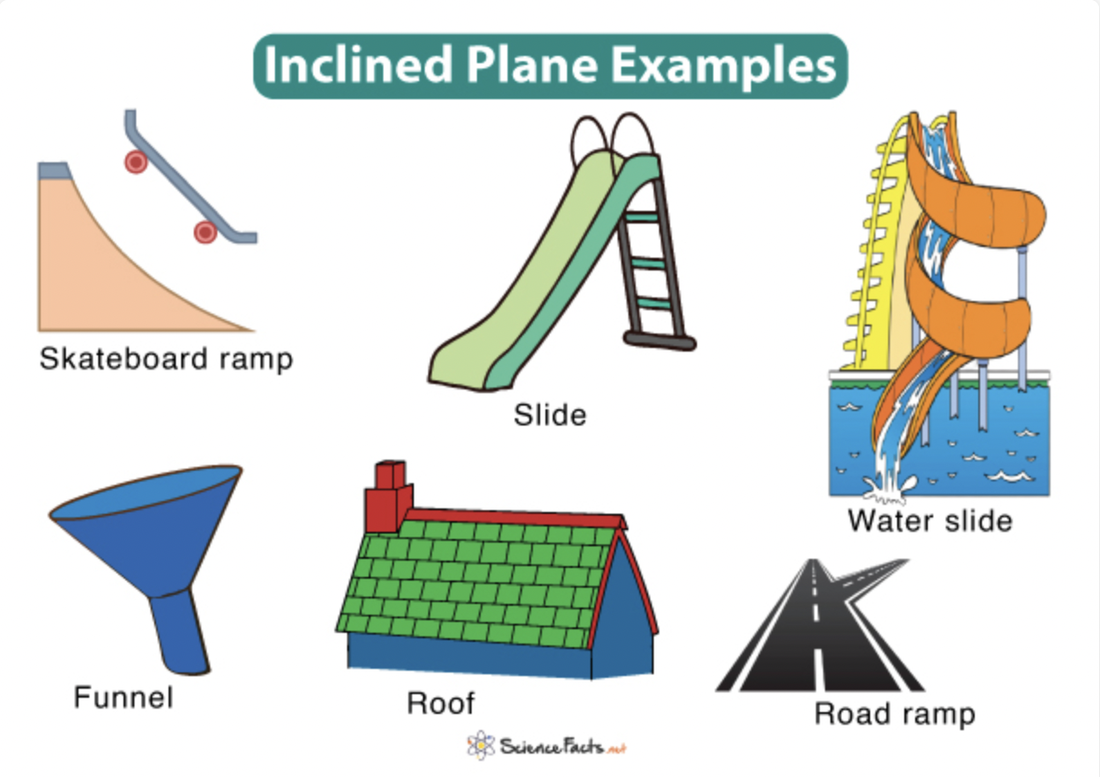
Inclined planes are one of the six classical simple machines, and they play a pivotal role in our everyday life. Their significance spans various domains—from engineering to physics, and even in our mundane tasks. Understanding inclined planes is not merely an academic exercise but an exploration of the principles of mechanics and practical applications that abound. This article will delve into diverse aspects of inclined planes, offering examples and elucidating on their multifaceted applications.
At its core, an inclined plane is a flat surface that is tilted at an angle, facilitating the movement of loads from one elevation to another. This ingenious design reduces the amount of force required to lift objects vertically. Instead of lifting an object straight up, one can exert less effort to push or pull it up the slope—this is the fundamental principle behind inclined planes.
### Types of Inclined Planes
Inclined planes can be categorized into various types based on their design and function. Each type demonstrates unique features that cater to specific tasks. Some prominent examples include:
1. **Ramps**: Perhaps the most recognizable form of an inclined plane, ramps are used in a multitude of settings—like loading docks, wheelchair access points, and construction sites. They provide a gradual slope, facilitating the effortless ascent or descent of wheeled objects. A well-designed ramp adheres to specific gradient standards to ensure that it is safe for all users, particularly those with mobility challenges.
2. **Slides**: Commonly found in playgrounds, slides illustrate the concept of inclined planes in a recreational context. A child climbs a staircase to reach the top and then joyfully glides down, experiencing the various forces at play—gravity being the most primary. Slides demonstrate how inclined planes can convert potential energy into kinetic energy, offering an exhilarating experience.
3. **Hills or Slopes**: Nature provides its own examples of inclined planes in the form of hills and slopes. These natural terrains profoundly affect human activities, influencing everything from the paths we take while hiking to the design of roads and highways that accommodate elevation changes. Engineers must consider the incline of these roadways, employing techniques that ensure safety while maximizing efficiency.
4. **Chutes**: Industrial applications often employ chutes, another form of inclined plane, to transport materials from one level to another. In a factory setting, a chute can convey products from an upper conveyor belt down to a packaging area, minimizing labor while maximizing efficiency. The angle and materials used in the construction of chutes are crucial for controlling the speed at which items traverse the slope.
### Scientific Principles Behind Inclined Planes
Inclined planes are steeped in scientific theory that merits exploration. The mechanical advantage gained from using an inclined plane can be expressed through the ratio of the length of the incline to its height. This ratio signifies the trade-off between distance and force; the longer the plane, the less force needed to overcome gravitational pull. In essence, inclined planes allow for the redistribution of force and energy in a manner that makes lifting heavy objects significantly easier.
Moreover, inclined planes illustrate the principles of friction. The smoother the surface, the less frictional force opposes the movement of an object. In this context, material selection becomes critical; surfaces constructed from materials with low coefficients of friction can optimize efficiency, particularly in industrial applications.
### Applications of Inclined Planes in Modern Technology
In our technologically advanced age, inclined planes find extensive applications that translate into efficiencies and innovations across numerous sectors. For example:
– **Construction**: The use of cranes with inclined planes as part of their design dramatically enhances their ability to lift and lower heavy materials. The inclined slopes provide leverage that amplifies lifting capabilities, essential for building skyscrapers and bridges.
– **Automotive Design**: Car ramps, a type of inclined plane, offer a safe method for accessing an automobile’s undercarriage for repairs and maintenance. Additionally, features like inclined driveways are engineered to facilitate the movement of vehicles without undue strain on their engines.
– **Sports Facilities**: Modern sports arenas often incorporate inclined planes in the form of tiered seating. This design not only maximizes visibility but also promotes efficient movement, allowing spectators to ascend or descend seats easily without excessive energy exertion.
### Challenges and Limitations
While inclined planes present a wealth of advantages, they are not without their challenges. The effectiveness of an inclined plane is contingent upon various factors, such as the angle of elevation and the material used for the surface. If the slope is too steep, it could lead to instability, endangering those who use it. Furthermore, manual handling on ramps and slides may pose risks for individuals with mobility impairments, necessitating careful design considerations to ensure inclusivity.
### Conclusion
Inclined planes represent a simple yet extraordinarily versatile tool that encompasses both elementary mechanics and complex technological applications. Their natural prevalence in the world around us, along with their diverse applications, make inclined planes a subject worthy of study and appreciation. From helping children play on slides to facilitating heavy lifting in construction, the significance of inclined planes is both profound and practical, offering a fascinating glimpse into the intersection of physics and everyday life.













