Meter in poetry serves as the rhythmic backbone of verse, inviting both reader and writer to engage in a dance of syllables. But how does one truly grasp the intricacies of meter? Are there poetic forms that exemplify its use? Today, we embark on an exploration of meter, punctuated by a delightful example that not only elucidates the concept but also poses a playful question: Can meter truly enhance the emotive resonance of poetry, or does it constrain creativity?
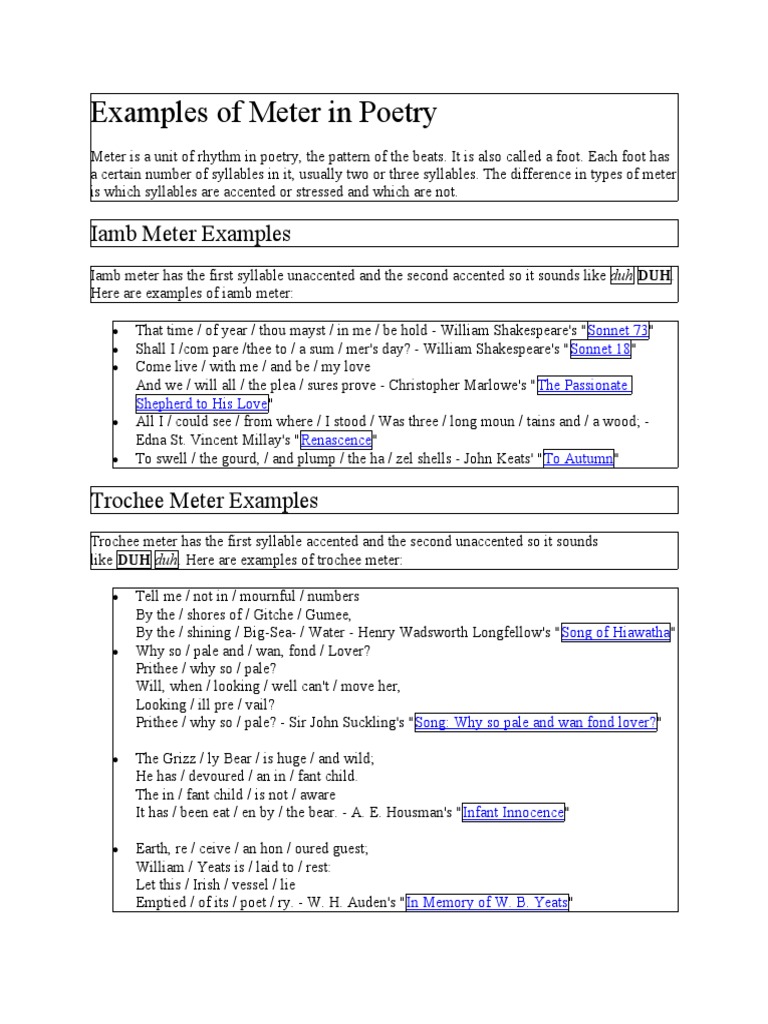
The world of poetry is replete with variety, yet meter provides a foundational structure that can either bolster a poem’s impact or pose a challenge to its form. Meter consists of the arrangement of stressed and unstressed syllables, creating patterns that evoke musicality and, ultimately, emotion. From the iambic pentameter of Shakespeare to the adventurous rhythms employed by contemporary poets, meter offers a lens through which we can examine the emotional weight of words.
To illustrate this notion, let us consider an example poem that dabbles in the playful realm of meter. Imagine a poem that adheres to the traditional structure of alternating lines of iambic tetrameter and iambic trimeter. We present “The Dancing Leaves,” a whimsical piece inviting readers to ponder the implications of nature and change:
The Dancing Leaves
In autumn’s glow, the leaves descend,
They twirl and spin without a care,
With whispered tales of summer’s end,
They flutter lightly through the air.
Each leaf, a story, softly told,
Of sunlit days and moonlit nights,
In colors bright, both brave and bold,
They swirl in joyous, fleeting flights.
Yet here lies the challenge: as we read this poem, do we allow the meter to dictate our interpretation, or do we break free from its confines to embrace a more visceral engagement with the imagery? The playfulness of the question lies in the duality of structure and freedom. Can strict adherence to meter sometimes stifle the raw emotional weight of a poetic moment, or does it enrich the experience by providing familiar patterns that comfort and invite reminiscence?
Exploring this example further, we recognize the rhythm inherent in the meter. The alternating patterns create a musicality that draws the reader in, compelling them to go beyond the surface to decipher the deeper meanings nestled within each line. The repetition of sounds and stresses cultivates a sense of familiarity, like a beloved melody that we cannot help but hum along to. It transforms the reading experience into something immersive and participatory.
Moreover, consider the thematic implications of “The Dancing Leaves.” The leaves’ descent symbolizes transience, a concept that resonates deeply within the human experience. Each flutter and spin invites readers to reflect on their own lives, the seasons of change they endure, and the fleeting nature of joy. The meter accentuates the poem’s contemplative tone, while also inviting a momentary pause for reflection—a moment where creativity and structure harmonize beautifully.
Now, as we contemplate the tension between meter and spontaneity, we venture into the territory of free verse, where poets exercise their creativity without the constraints of traditional rhythm. Yet, it is crucial to note that meter can exist within free verse as well. Poets often oscillate between rigid patterns and free-form expressions to elicit specific emotional responses or emphasize certain lines. In this sense, meter is not merely a formality, but a dynamic tool used to sculpt meaning and evoke feeling.
The joy of engaging with meter lies in its flexibility. For instance, a poet may choose to employ anapestic meter—a pattern that consists of two unstressed syllables followed by a stressed syllable—to evoke a sense of lightness or buoyancy. This could blend seamlessly with the more cadenced rhythms of an iambic line, creating a lovely juxtaposition that reflects the very subject matter of the poem itself.
Returning to our example, one may ponder whether this playful exploration of meter enables a deeper understanding of the poet’s intent. What if we were to alter the meter, perhaps introducing a spondee in the second line to disrupt the flow momentarily? The heightened tension could amplify the emotion, prompting readers to contemplate the complexities of their own experiences with loss, change, and acceptance. The playful question emerges once again: does the remodeling of meter enhance or dilute the poem’s potency?
Ultimately, the exploration of meter serves as a testament to the boundless creativity within the realm of poetry. It invites readers to engage as active participants—pondering, interpreting, and sometimes challenging the very structures that bind us. Through our exploration of “The Dancing Leaves” and the multifaceted nature of meter, we discover that poetry is not merely a collection of words; it is a living entity, dynamic and ever-evolving.
In conclusion, the examination of meter offers a fascinating glimpse into how rhythmic structures shape our understanding of poetry. The interplay between rigidity and spontaneity fosters a rich landscape where emotion thrives and creativity flourishes. So, as you delve deeper into the world of meter, remember the playful question posed: Can meter facilitate a deeper connection to the soul of poetry? In this exploration, it seems the answer lies in the delicate balance between structure and the irrepressible fervor of creativity.