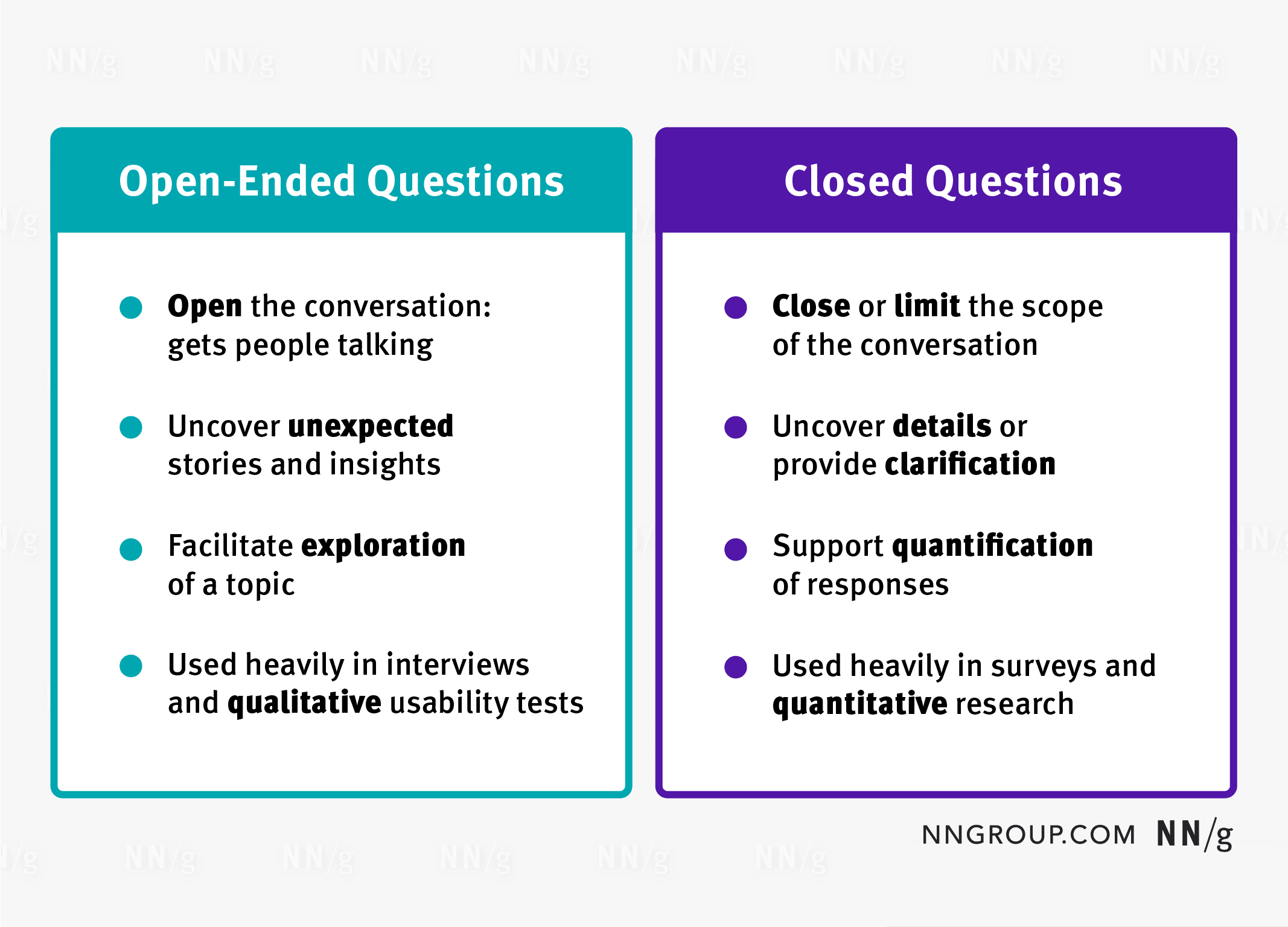
In the realm of communication, questions serve as the lifeblood of interaction, driving the dialogue and shaping the exchange of ideas. Among the plethora of questioning techniques, closed-ended questions often reign supreme in specific contexts—primarily in surveys, interviews, and structured settings where succinctness and clarity are paramount. By their very nature, closed-ended questions demand a brief, definitive response, typically circumscribed to “yes” or “no.” However, this simplicity conceals a robust utility, making them indispensable across various domains.
As we delve into the world of closed-ended questions, one cannot help but notice a common observation: they often elicit a quick response, facilitating expedient decision-making. This characteristic underscores their appeal in environments where time is of the essence, such as in market research or diagnostic assessments. By requiring limited and specific answers, closed-ended questions minimize ambiguity, thereby streamlining data collection and analysis. Yet, as we unfold this exploration, the fascination with closed-ended questions transcends their utility. It beckons us to ponder the underlying implications of such structured inquiries.
1. The Architecture of Closed-Ended Questions
Closed-ended questions are crafted with precision. Their architecture is designed to elicit quantifiable data, often employing a variety of formats, such as multiple-choice, dichotomous (yes/no), or scaled responses (e.g., Likert scales). This meticulous construction allows for an implicit control over the survey’s direction and the respondent’s options, framing the discourse in a concretized manner.
For instance, consider a simple closed-ended question: “Do you enjoy outdoor activities?” This inquiry offers a choice between “yes” or “no,” but it simultaneously constrains the respondent’s reflection on the complexity of their engagement with outdoor activities. The simplicity favors researchers who seek to gather data rapidly, yet it may also inadvertently strip away the nuances that lie beneath the surface.
2. Practical Applications Across Sectors
The utility of closed-ended questions permeates numerous sectors, ranging from education to healthcare. In educational settings, for instance, teachers might employ them to assess student comprehension efficiently. Questions like “Did you understand the lesson?” facilitate immediate feedback, guiding educators in their instructional methodologies. Meanwhile, in healthcare, closed-ended questions such as “Are you experiencing any pain?” assist medical professionals in diagnosing conditions swiftly, allowing timely interventions that could be critical to patient outcomes.
In the business world, closed-ended questions find their place in customer feedback tools, galvanizing organizations to tailor their offerings according to consumer satisfaction. Understandably, the consolidation of feedback into manageable quantitative data empowers businesses to track trends over time, shaping future strategies with a data-driven approach.
3. The Psychological Dimension
Beneath the surface of mere functionality lies an intriguing psychological dimension that merits exploration. Closed-ended questions can evoke a dichotomy in respondent psyches—while they provide a sense of security and decisiveness, they may also incite frustration in those who perceive their complexity as being inadequately addressed. Respondents may feel boxed into binary choices, longing to articulate their intricacies yet hindered by the constraining nature of the inquiry.
This phenomenon invokes deeper questions about human expression. How does one encapsulate their multifaceted experiences into dichotomous responses? The lack of space for elaboration may, on occasion, disengage respondents, inadvertently leading to shallow data. This psychological tug-of-war between the need for succinctness and the yearning for complexity underscores the duality at the heart of closed-ended questioning.
4. Crafting Effective Closed-Ended Questions
Given their utility, crafting effective closed-ended questions becomes a pivotal endeavor. The formulation requires careful consideration of language and clarity, ensuring that questions are not only direct but also comprehensible to the target demographic. For example, rather than asking, “Are you satisfied with our service?” a more effective approach might involve breaking down the question: “Was your service experience timely?” followed by, “Was our staff helpful?”
This layered questioning not only preserves the closed-ended format but also allows organizations to dissect the facets of customer experiences, ruling out surface-level dissatisfaction and encouraging a more nuanced understanding.
5. Tips for Utilizing Closed-Ended Questions
To optimize the efficacy of closed-ended questions, several strategies can be implemented:
- Define Objectives: Clearly delineate the purpose of the inquiry, ensuring that the questions align with the overarching goals of the research.
- Maintain Simplicity: Use straightforward language to eliminate potential confusion, thereby enhancing response quality.
- Balance Choices: Provide equally weighted response options to avoid introducing bias, fostering a sense of fairness in the assessment process.
- Pilot Tests: Validate your questions through pilot testing, allowing premature errors to be identified and rectified prior to broader deployment.
6. Conclusion: The Dual Edge of Simplicity
In conclusion, the exploration of closed-ended questions reveals a dual-edged sword. While they excel in terms of clarity and efficiency, their overarching simplicity can sometimes mask the deeper, more intricate realities of human experience. Closed-ended questions are not merely instruments for data collection; they are facilitators of dialogue, beckoning us to examine not only the answers provided but also the experiences and motivations that underpin them. As we navigate the labyrinth of inquiry, the balance between simplicity and complexity remains a focal point, inviting us to delve deeper into the narratives that shape our realities.