
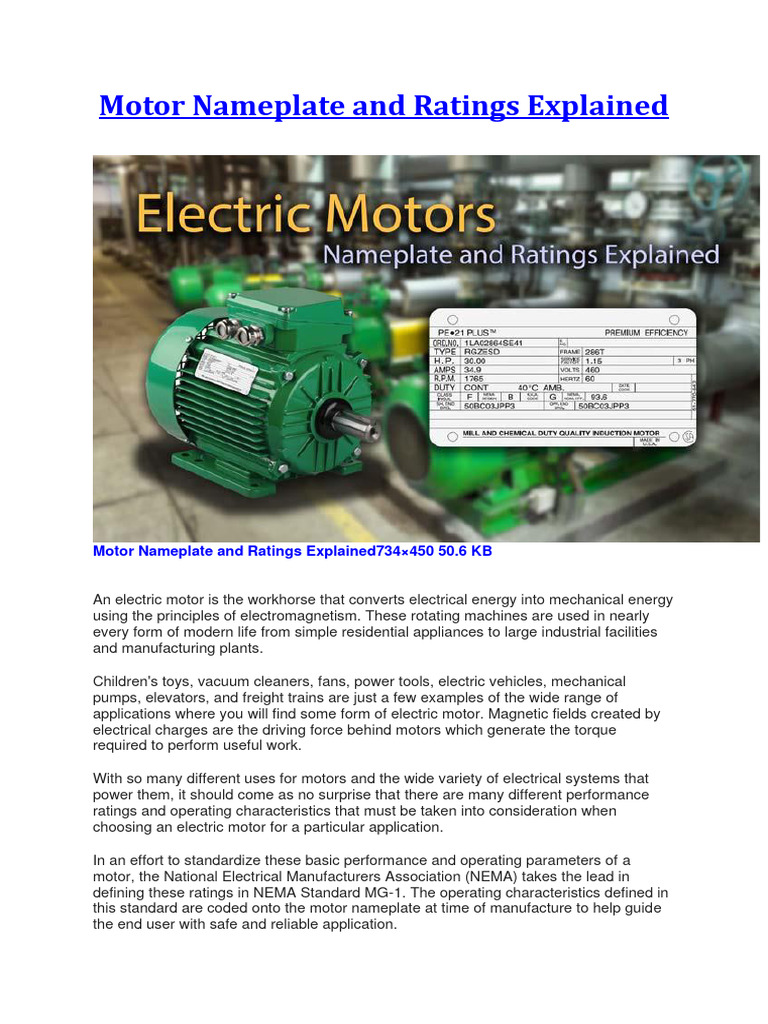
Understanding the workings of electric motors can be a fascinating journey. Among the myriad of designations found on motor nameplates, one that often raises eyebrows is the “2P.” It serves as a pivotal indicator of the motor’s functionality, yet it is frequently misunderstood. This article will unpack the meaning of 2P, delve into electrical ratings, and illuminate the implications of these numbers in the context of motor performance.
At the outset, let’s clarify what 2P denotes. The “P” in 2P symbolizes the number of poles present in the motor. In electric motors, poles are crucial elements that influence not only the motor’s operational efficiency but also its speed and capability. A motor designated as 2P possesses two poles, which has significant implications for its rotational speed and torque characteristics.
The concept of motor poles is integral to the basic operation of motors. Generally, the synchronous speed of a motor can be calculated using the formula:
Speed (RPM) = (120 × Frequency) / P
In this formula, the frequency is measured in hertz (Hz) and P represents the number of poles. For a 50 Hz supply, a motor with 2 poles would operate at a synchronous speed of 3000 RPM, while a 4-pole motor would only achieve a maximum of 1500 RPM under similar conditions. This intrinsic relationship between the number of poles and operational speed explains why motors are often selected based on their pole counts.
Furthermore, when examining 2P motors, one must consider their torque performance. Generally speaking, a motor with fewer poles—like a 2P motor—will produce less torque compared to its 4-pole or 6-pole counterparts, primarily because as the speed increases, the load-bearing capacity diminishes. Thus, while a 2P motor is adept at providing higher speeds, it may not be the best choice for applications requiring significant torque, such as heavy machinery.
It is imperative to note that the efficiency of a motor does not solely depend on the number of poles. Factors such as the motor’s design, materials used, and intended application play vital roles in determining overall efficiency. Motors with higher pole counts tend to operate more efficiently at lower speeds, making them suitable for high-torque applications, whereas a 2P motor is better suited for applications where speed is prioritized over torque.
Examining further, the electrical ratings on a motor nameplate reveal essential information regarding not just its pole configuration but also its power requirements and operational voltage. Understanding these electrical ratings is essential for successful integration into any electrical system. For instance, a motor may be rated at 230 volts and have a current rating indicating the maximum safe current it can handle. Exceeding this current can lead to overheating and potential motor failure.
Furthermore, it is important to be cognizant of the motor’s efficiency class, which signals how well a motor converts electrical energy into mechanical energy. The efficiency ratings, categorized as IE1, IE2, IE3, and so forth, indicate progressively higher efficiency standards. A 2P motor that is also classified as IE3 will not only deliver high speeds but will also be energy-efficient—a factor increasingly critical in today’s environmentally-conscious world.
One may wonder: why are 2P motors prevalent in various applications? This is primarily due to their unique balance of speed and compact size, making them exceedingly suitable for equipment where space is at a premium. Common applications include fans, blowers, and small pumps, where rapid movement is advantageous and torque requirements are not excessively high.
Moreover, the simplicity of 2P motors contributes to their popularity. With fewer windings and a more straightforward design compared to higher-pole-count motors, they often enjoy a longer lifespan and lower maintenance demands. This simplicity can be particularly appealing in industrial environments where prolonged operation without interruption is paramount.
On an even broader scope, the characteristics of 2P motors indirectly contribute to advancements in technology and efficiency in sectors such as HVAC (Heating, Ventilation, and Air Conditioning), automation, and robotics. As manufacturers strive for faster and more efficient systems, the demand for high-speed motors grows. Thus, understanding the nuances of motor ratings, including 2P, arms engineers and designers with the knowledge needed to make informed choices in motor selection, contributing to enhanced performance in applications worldwide.
In summary, the designation of 2P on a motor encapsulates significant information about its structure and performance. The relationship between the number of poles, operational speed, torque output, and electrical ratings forms a complex matrix that is crucial for engineers and technicians alike. As industries continue to evolve, a comprehensive understanding of these concepts will lead to more efficient, reliable, and effective use of electric motors in a multitude of applications.












