
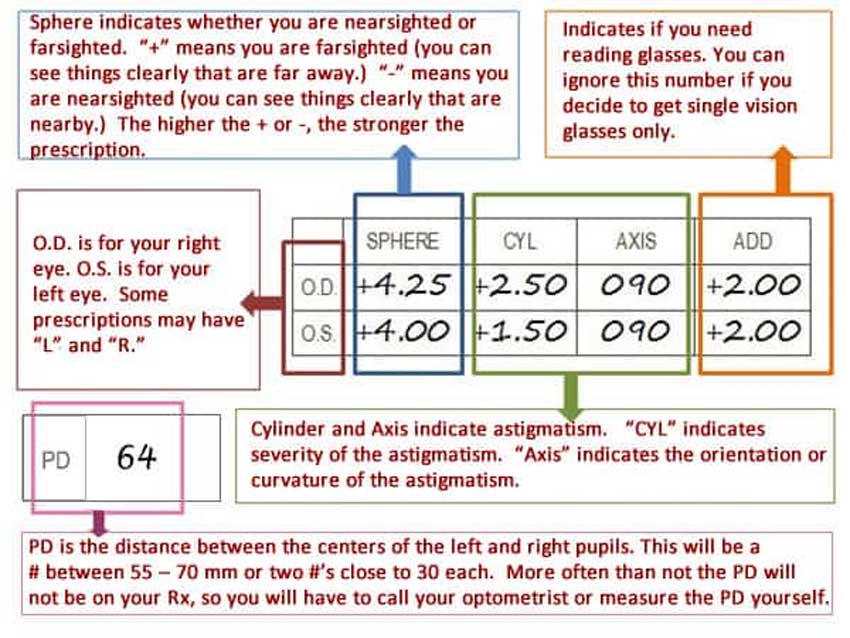
When you receive your eye prescription, you might notice an array of numbers and terms, each representing an aspect of your vision needs. One term that often confounds patients is the “axis.” Understanding what the axis signifies is crucial for deciphering your prescription. In this article, we will demystify the axis in an eye prescription, exploring its significance, measurement, and the broader context of vision correction.
Understanding the Basics: Prescription Components
Before diving into the specifics of the axis, let’s briefly review the key components of a typical eye prescription. Eye prescriptions generally include values for spherical power (SPH), cylindrical power (CYL), and axis, among others. SPH measures nearsightedness or farsightedness, CYL represents astigmatism, and the axis indicates the orientation of the cylindrical correction.
Defining the Axis
The axis is an angular measurement expressed in degrees, ranging from 1 to 180. It indicates the orientation of astigmatism in the eye. If you have astigmatism, light rays do not converge evenly on the retina, leading to blurred or distorted vision. The cylindrical correction (measured in CYL) is applied at a specific angle to counteract this uneven curvature of the cornea or lens. Thus, the axis number tells the optician where to apply this correction.
Why is the Axis Important?
The presence of astigmatism necessitates precise correction to achieve optimal vision. A misalignment in the axis can lead to visual discomfort or inadequate correction. For instance, if you receive an axis value of 160, the cylindrical lens must be oriented specifically at that angle to ensure light is properly focused onto the retina. This precision is fundamental for individuals reliant on corrective lenses for clarity and comfort.
How is the Axis Determined?
Determining the correct axis value involves a careful eye examination conducted by a qualified optometrist or ophthalmologist. During this process, various tests—such as keratometry and refraction—are utilized to assess how light interacts with your eye. The results yield the necessary values for SPH, CYL, and, importantly, the axis.
Refraction testing, which employs a phoropter to assess vision through different lenses, plays a critical role. As patients view an eye chart through varied lens strengths, the practitioner identifies the most effective lens combination, thereby ascertaining the precise axis required to remedy astigmatic vision.
Interplay of Axis and Astigmatism
Astigmatism occurs when the eye’s cornea has an irregular shape, akin to a football rather than a sphere. This irregularity results in multiple focal points, making it challenging to see clearly. The cylindrical power (CYL) indicates the strength of correction necessary, while the axis shows the orientation needed for that lens. For example, a prescription with a CYL of -2.50 and an axis of 160 denotes a significant astigmatic correction that must be aligned at 160 degrees.
Different Types of Eye Prescriptions
Eye prescriptions can vary widely, especially when considering conditions beyond astigmatism. Here are a few common types:
- Simple Myopic Astigmatism: In this case, the patient requires correction for nearsightedness along with astigmatism. Both SPH and CYL values are typically negative.
- Simple Hyperopic Astigmatism: This scenario involves farsightedness in conjunction with astigmatism, often resulting in a positive SPH and a negative CYL.
- Compound Myopic Astigmatism: Here, both SPH and CYL are negative but to varying degrees. This condition usually results in a more complex visual scenario.
- Compound Hyperopic Astigmatism: Similar to compound myopic, but both values are positive, indicating a greater need for correction.
- Mixed Astigmatism: A combination of a positive SPH and a negative CYL. This scenario typically involves different forms of visual challenges.
Choosing the Right Eyewear
Once armed with a detailed prescription that includes the axis, the next step is selecting the right eyewear. Whether opting for glasses or contact lenses, the axis value must be accurately represented to ensure maximum efficacy. For those considering contact lenses, a specialized fitting may be required to achieve an appropriate lens orientation, particularly due to the interaction of the lens with the eye’s surface.
Conclusion: The Importance of Regular Eye Exams
The axis in an eye prescription may seem like a mere number at first glance, but it embodies a vital function in vision correction, especially for those with astigmatism. Regular eye examinations ensure that your prescription remains current and accurate, ultimately leading to enhanced visual clarity and comfort. So, the next time you review your eye prescription, you’ll be equipped with the understanding of what the axis truly means and how it plays a pivotal role in your overall eye health.












