
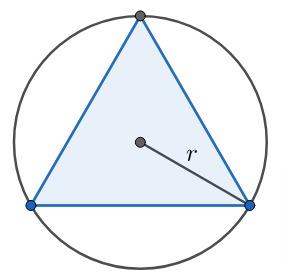
The symbolism of shapes has captivated the human mind for centuries, forcing us to ponder their meanings and implications. Among these shapes, the juxtaposition of a triangle enveloped within a circle is particularly intriguing. This geometric representation transcends mere visual aesthetics; it has acquired a wealth of meanings in various cultural, spiritual, and philosophical contexts. Here, we shall explore the multifaceted significance of this emblem, delving deep into its interpretations across different domains.
1. Geometric Significance
In its purest form, a triangle represents stability, structure, and the interplay of elements. A triangle, being a polygon with three edges and vertices, symbolizes the balance of opposites. The circle, in contrast, embodies unity, eternity, and wholeness due to its infinite curve. When these two shapes converge, the triangle within the circle embodies a potent synthesis of dualities: the finite and the infinite, the mundane and the divine. In sacred geometry, these shapes coalesce into a powerful iconography representing the cosmos and the nature of existence.
2. Spiritual Interpretations
Many spiritual traditions have ascribed profound meanings to the triangle-circle motif. In the realm of alchemy, the triangle often signifies the element of fire, while the circle is a representation of the spirit. Therefore, a triangle inscribed within a circle may symbolize the integration of elemental forces and the quest for enlightenment. Various esoteric teachings suggest that this symbol serves as a reminder of the seeker’s journey towards the divine source, encapsulating the balance of earthly existence and heavenly aspiration.
3. Religious Contexts
Across multiple religions, shapes hold significant spiritual connotations. In Christianity, the triangle is frequently associated with the Holy Trinity—Father, Son, and Holy Spirit. When circumscribed by a circle, it conveys the message of eternal love and the cyclical nature of life and death. Similarly, in Hinduism, the triangle is representative of the three gunas (qualities of nature)—sattva, rajas, and tamas—that are foundational to understanding the universe. Overlaying these traits with the circle emphasizes the cyclical nature of existence, reincarnation, and the unity of the cosmos in Hindu philosophical thought.
4. Psychological Implications
The triangle-circle symbol can also be examined through the lens of psychology. Iconic psychologist Carl Jung posited that symbols arise from the collective unconscious of humanity. The triangle, with its sharp angles, may evoke feelings of alertness, ambition, and aggression, while the circle promotes a sense of calmness and inclusivity. When paired together, they create a dynamic balance that resonates with the intrinsic human experience. This balance speaks to the duality of human nature—the drive for achievement counterbalanced by the need for harmony.
5. Cultural Representations
Different cultures have embraced this geometric symbol, infusing it with localized meanings. In Native American traditions, the triangle often denotes direction—north, south, east, and west—while the circle encapsulates the cycle of life and nature’s rhythm. Thus, a triangle within a circle can symbolize the guidance of nature during life’s journey. Conversely, in ancient Greek philosophy, Pythagoreans considered triangular shapes significant in their study of mathematics and metaphysics. Hence, a triangle embedded in a circle may epitomize their pursuit of truth achieved through logical reasoning and exploration.
6. Modern Interpretations
In contemporary culture, the triangle-circle combination frequently appears in art, design, and fashion, carrying a range of meanings that reflect modern sensibilities. Graphic designers utilize this symbol to evoke a sense of direction, purpose, and cohesion in their work. Often seen in logos, branding, and tattoos, the fusion of these shapes captures an audience’s attention, drawing them into a deeper examination of the underlying messages they convey. This prevalent adaptation enhances the symbol’s relevance, allowing it to evolve while retaining its rich historical tapestry.
7. Personal Significance
Lastly, the triangle within a circle can represent individual meanings based on personal experiences and interpretations. For many, this symbol embodies a life philosophy, a reminder of their journey striving for balance among various aspects of life—emotional, spiritual, and physical. The combination may serve as a talisman, encouraging self-reflection and mindfulness. It allows individuals to make sense of their aspirations and the interconnectedness of their paths.
Conclusion
The triangle with a circle enveloping it encapsulates a plethora of meanings that traverse time, space, and cultural contexts. Whether viewed through the lenses of geometry, spirituality, psychology, or personal symbolism, this emblematic motif invites introspection and fosters a deeper understanding of existence itself. As society continues to evolve, so too will the interpretations associated with the triangle-circle combination, ensuring its relevance in the tapestry of human experience.












