
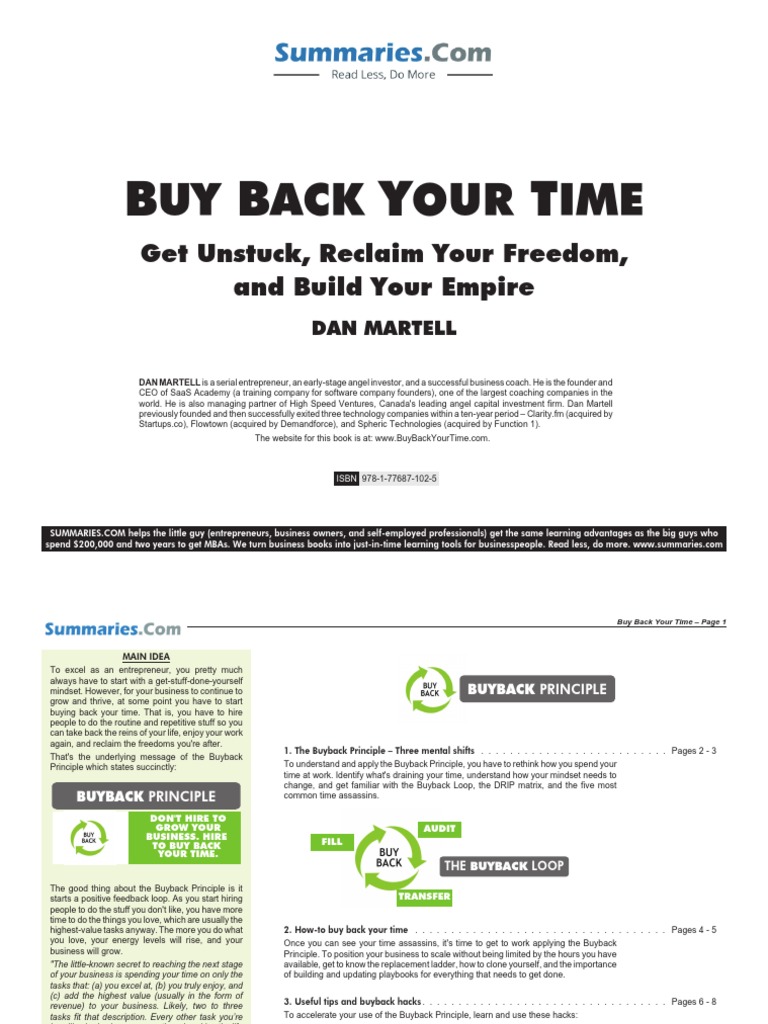
In today’s fast-paced world, the concept of time has become increasingly valuable. The phrase “buy back your time” evokes images of a marketplace where hours and minutes are traded commodities. In essence, to buy back your time means to reclaim those fleeting hours, an endeavor that can lead to enhanced productivity and a more fulfilling life. This article delves into the intricacies of this notion, exploring its implications and strategies for achieving it.
At the heart of the concept lies a striking metaphor: imagine time as a river, flowing continuously, unyieldingly. Each moment that slips away is like a drop of water disappearing beyond reach. The challenge is not merely to swim against the current but to create opportunities for respite along the banks. In a world inundated with distractions and obligations, the quest to buy back your time becomes essential.
Understanding productivity is foundational to grasping the significance of this concept. Traditionally, productivity is defined as the ratio of outputs to inputs in any given process. However, in the context of personal and professional realms, it transcends mere efficiency. It embodies the pursuit of meaningful engagement with tasks and the alignment of daily actions with overarching goals.
To embark on the journey of buying back your time, one must first confront the reality of the tools and habits that consume it. Consider the paradox of technology: while it has the potential to streamline tasks, it can also ensnare individuals in an endless cycle of notifications, social media distractions, and a plethora of digital obligations. Thus, part of reclaiming time involves a recalibration of one’s relationship with technology, an intentional decision to draw boundaries. Turning off notifications, designating specific times for email checks, and embracing periods of digital detox can foster a greater sense of control over one’s time.
However, reclaiming time is not solely about eliminating distractions; it also necessitates a strategic delegation of tasks. This is where hiring, outsourcing, or even collaborating with others comes into play. Imagine a juggler skillfully managing multiple balls in the air. For most people, attempting to juggle every obligation leads to dropped responsibilities and feelings of overwhelm. By delegating tasks to capable individuals or leveraging freelance services, one can alleviate the burden of mundane chores. This shift allows for a focus on high-impact activities that genuinely require personal attention.
A critical component of buying back your time is the art of prioritization. Employing frameworks like the Eisenhower Matrix can be invaluable. This model categorizes tasks into four quadrants based on urgency and importance, guiding individuals to discern what truly warrants their precious time. Tasks that lie at the intersection of urgency and importance deserve immediate attention, while those that are neither can be delegated or discarded altogether.
Furthermore, mindfulness plays a pivotal role in enhancing productivity and reclaiming time. Taking intentional pauses and engaging in reflective practices fosters clarity and reduces mental clutter. When one consciously steps away from a frenetic pace, it becomes easier to identify what genuinely matters. Integrating practices such as meditation, deep breathing exercises, or simply taking a nature walk can invigorate the mind, allowing for a refreshed perspective on tasks at hand.
Equally essential is the commitment to continuous learning and self-improvement. In a world that is ever-evolving, sticking to outdated methods can be a significant drain on time. Engaging with new skills, tools, or methodologies can open doors to innovative solutions that not only streamline processes but also enhance happiness and engagement at work. Embracing a growth mindset fosters resilience, allowing for adaptability in a landscape rife with change.
As one embarks on this journey of regaining control over time, a broader philosophical approach must also be considered. The pursuit of time reclamation inevitably leads to a reflection on one’s values and aspirations. Questions such as “What do I truly want to achieve?” and “How do my daily actions align with my core beliefs?” arise. Aligning daily routines with personal values creates a more authentic existence, thus enriching the sense of fulfillment derived from each day.
Moreover, the allure of buying back time extends beyond individual desires; it influences relationships and community connections. Taking time to nurture relationships often becomes a casualty of busy schedules. Reclaiming time allows individuals to prioritize meaningful interactions, enhancing both personal and professional relationships. Sharing moments with family, engaging in community service, or even pursuing hobbies together fosters deeper connections and enriches life’s tapestry.
As the metaphorical river of time flows ever onward, it is crucial to remain vigilant and intentional in managing its course. The adage “time is money” signifies the intersection of financial pressures with the relentless pursuit of productivity. However, when one shifts the perspective from intrinsic value to experiential richness, the inclination to buy back time transforms into a quest for a more meaningful existence. In the end, reclaiming time isn’t merely about what can be accomplished in an hour; it is about cultivating a life imbued with purpose and fulfillment.
In conclusion, the endeavor to buy back your time encompasses a multi-faceted approach. By redefining productivity, embracing prioritization, engaging in mindfulness, promoting continuous learning, and nurturing relationships, individuals can reclaim their most precious resource. Ultimately, the journey towards buying back time is a personal odyssey, one that holds the promise of transforming not only our schedules but our entire way of life.












