
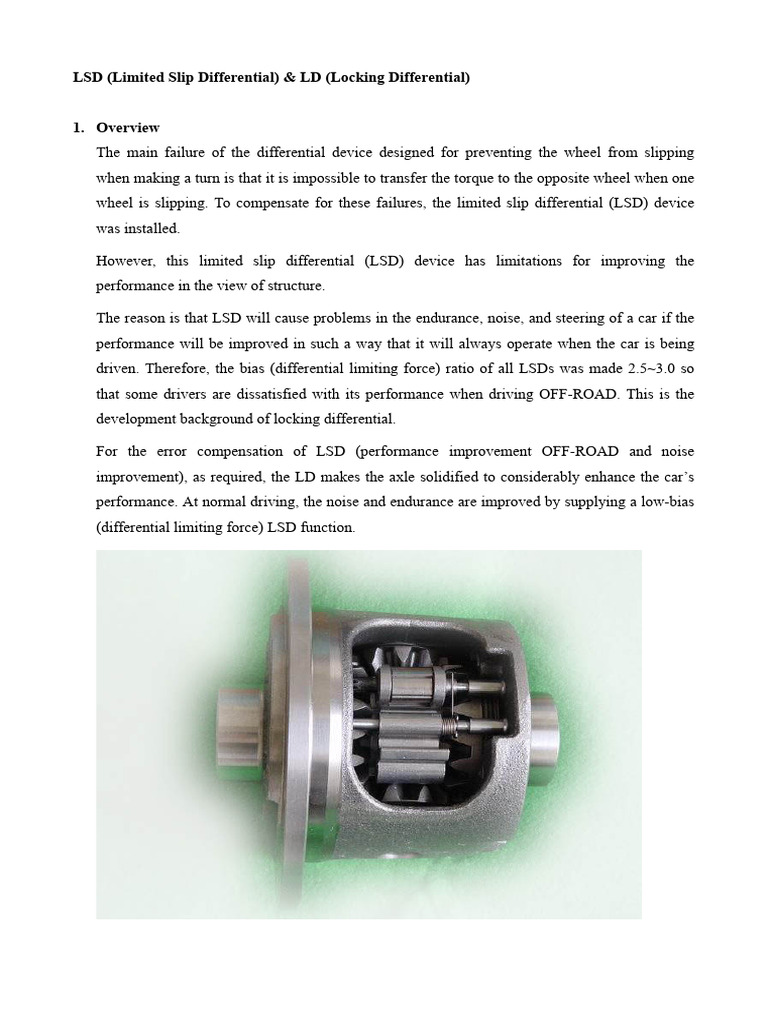
Auto LSD, or Auto Limited Slip Differential, is a term that often leaves car enthusiasts scratching their heads in curiosity. What does it genuinely mean, and how exactly does it influence a vehicle’s drivetrain performance? As we delve deeper into the mechanics behind vehicle technology, you’ll discover that understanding Auto LSD can enhance not only your knowledge of automotive systems but also your driving experience. Are you ready to shift gears and explore what Auto LSD entails?
To begin with, the term drivetrain encompasses all the components that transmit power from the engine to the wheels. This includes the transmission, driveshaft, differentials, and axles. Within this intricate system, the limited slip differential (LSD) plays a pivotal role, especially when it comes to optimizing traction. In standard vehicles, when a wheel starts to spin due to a lack of grip—say on icy roads or muddy trails—the other wheel may not receive enough torque to move the vehicle forward. This is where Auto LSD revolutionizes the driving experience.
Imagine you’re navigating through a winding mountain road. The sun glints off the freshly paved asphalt, and just as you prepare to accelerate out of a tight curve, one of your wheels loses traction. Frustrating, isn’t it? Enter Auto LSD, designed to counteract this predicament with finesse. By automatically redistributing torque between the drive wheels, it mitigates wheel slip, ensuring optimal grip, enhancing stability, and elevating the overall driving dynamics.
Understanding the intricacies of how Auto LSD operates begins with a closer look at the concept of a traditional differential. A standard open differential allows both wheels on an axle to rotate at different speeds. This function is beneficial during a turn, as the outer wheel must travel a longer distance than the inner wheel. However, this feature becomes a double-edged sword in scenarios where one wheel encounters less traction. The open differential will send more power to the wheel that spins faster, exacerbating the problem of traction loss.
In contrast, a limited slip differential employs a mode of operation that limits the amount of differentiation between the wheels. It uses clutches or gears to transfer power from the spinning wheel to the wheel with more grip, thus providing an excellent balance of power and control. Auto LSD elevates this further by proactively monitoring wheel slip and adjusting torque distribution accordingly. Picture yourself driving in adverse weather conditions—Auto LSD acts as your unseen ally, fine-tuning the torque allocation to ensure your ride remains smooth and stable.
But, how does it achieve this remarkable balance? The technology behind Auto LSD often incorporates advanced electronic control systems and sensors that detect tire spin and adjust power distribution in real-time. This seamless interplay allows for refined handling and allows drivers to maintain confidence even in precarious situations. However, there’s a lingering question: does this automation compromise driver engagement? Are we becoming too reliant on technology to support our driving experience?
Despite these contemplations, the merits of Auto LSD are hard to overlook. From improved cornering capabilities to enhanced off-road performance, vehicles equipped with this system can navigate diverse terrains with remarkable ease. For the adventure seekers, consider the implications of having Auto LSD in your vehicle when traversing gritty trails or gravel pathways. The ability to tackle such environments with power and precision invites an extraordinary level of excitement into your driving escapades.
Yet, it’s important to be cognizant that the effectiveness of Auto LSD is not without its boundaries. It’s not a blanket solution for all traction issues. If you’re accelerating excessively on a slick surface, or if your vehicle encounters deep mud or snow, other considerations such as tire selection, weight distribution, and overall driving technique will critically influence performance. Therefore, understanding your vehicle’s limitations is vital for maximizing the capabilities of Auto LSD.
Moreover, the discourse surrounding Auto LSD often invites a comparison with other technologies, such as electronic stability control (ESC) and traction control systems (TCS). While these systems work harmoniously with Auto LSD to enhance overall vehicle dynamics, each serves a distinct purpose. For example, while ESC primarily monitors vehicle stability during extreme maneuvers, Auto LSD proactively manages torque to achieve enhanced tire adhesion.
Also, it’s worth noting that not all vehicles feature Auto LSD as standard. Often found in performance and luxury models, this technology is becoming increasingly accessible across a broader range of vehicles. As more manufacturers recognize the advantages it offers, it’s common to see Auto LSD becoming a coveted feature among various car segments.
In conclusion, Auto LSD is a significant advancement in vehicle drivetrain technology that not only optimizes traction but also elevates the driving experience. As you continue to explore the vast world of automotive engineering, take a moment to appreciate how such technologies enhance your journey. While they may seem like just another benchmark on the list of features, understanding their function can deepen your connection to your vehicle. As you prepare for your next adventure, consider the unique challenges and opportunities that come with the tech at your disposal—because when it comes to driving, knowledge is power.












