
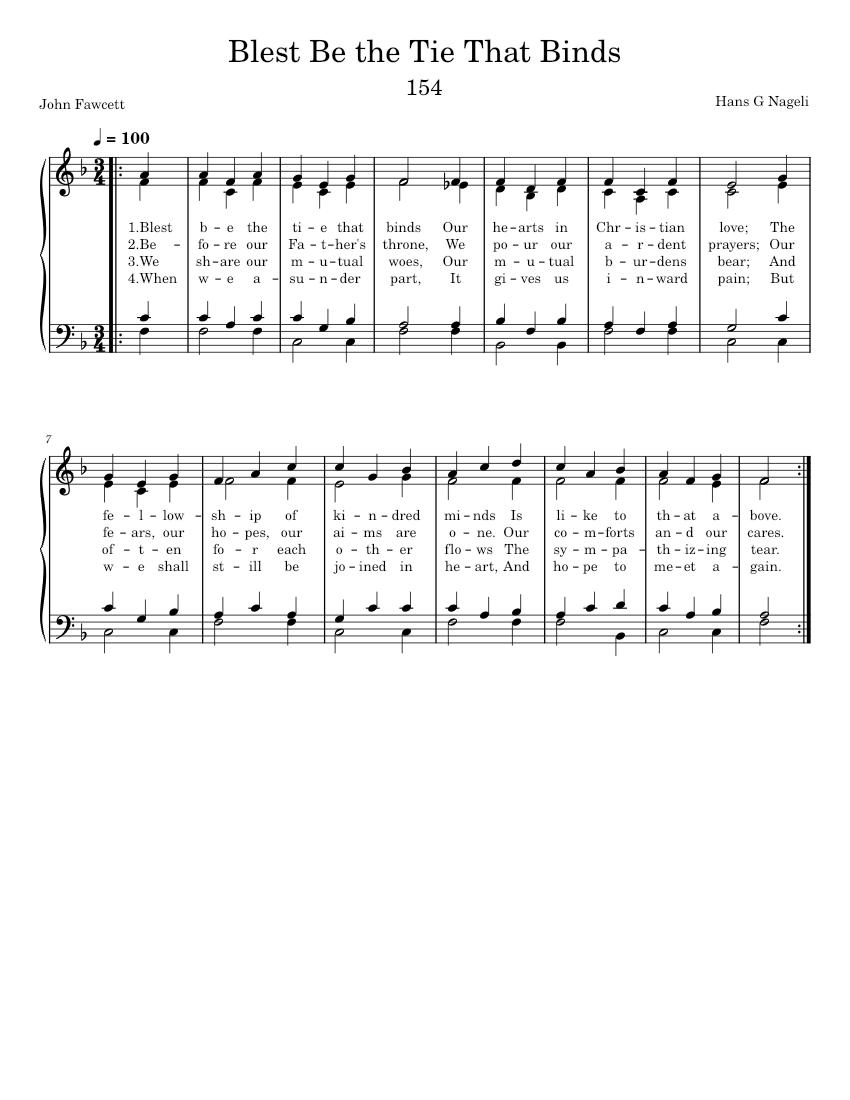
What does “Blest Be the Tie That Binds” truly mean? Have you ever pondered the deeper significance of this beloved hymn? As it resonates through church halls and community gatherings, its melody envelops listeners in a tapestry of connection and togetherness. Yet, beneath the surface simplicity lies profound meaning that invites exploration.
The hymn, originating in the late 18th century, was penned by John Fawcett. Initially conceived as a reflection on Christian fellowship, it encapsulates themes of unity, love, and shared burdens. So, what exactly does this hymn convey? And how can we relate its message to modern life where individualism often overshadows communal bonds?
To comprehend the essence of “Blest Be the Tie That Binds,” one must first consider the notion of fellowship. It posits a challenge: in an age characterized by social media and digital communication, do we still cultivate genuine connections? The hymn beckons us to reflect on the vitality of relationships, both spiritual and communal. Fawcett, a pastor, wrote this piece as a heartfelt expression of love among believers, suggesting that true unity transcends personal struggles and encompasses collective strength.
The opening lines of the hymn establish a poignant premise, alluding to a “tie” that binds individuals in shared faith and experiences. This metaphorical tie is not merely a symbolic gesture; it represents the emotional and spiritual connections that fortify our interactions. But what if we imagine this tie as a thread woven through a fabric? Each strand accounts for distinct relationships contributing to a cohesive whole.
Now consider the intricate layers of this fabric. On one level, it embodies the shared joys of worship and fellowship within a religious context. The lyrics extol the virtues of unity among congregants, reinforcing the belief that together they are stronger, able to weather the storms of life’s trials. Here, the hymn does not shy away from the idea that life can be fraught with challenges. Instead, it emphasizes the comfort found in community support, suggesting that companionship can ease burdens. Can we then extrapolate this idea to our own lives, where challenges loom large on the horizon?
At a deeper level, the hymn encourages contemplation of empathy and compassion. As we navigate through various life stages—be it triumphs or tribulations—we are often confronted with a choice: to retreat into solitude or reach out to others. The challenge posed by the hymn lies in this choice. It reminds us that embracing our collective human experience, including pain and suffering, is crucial in forming bonds strong enough to withstand life’s vicissitudes.
Transitioning from the abstract to the concrete, one can observe the hymn’s relevance in a contemporary context. In an increasingly fragmented society, feelings of isolation are pervasive. The digital revolution has ushered in unprecedented connectivity, yet many experience loneliness. People might wonder: How does one “tie” themselves to others when face-to-face interactions are replaced by screens? Or, what practices can be instituted to foster stronger community ties?
The answer resides in intentionality. Just as the hymn articulates, engaging with one another and sharing experiences is fundamental—be it through prayer groups, volunteer activities, or casual gatherings. Building communities that prioritize relationships requires effort, resilience, and an openness to vulnerability. As Fawcett articulated the importance of fellowship, he also posed its inherent challenge: fostering genuine connections requires commitment.
Moreover, this hymn transcends the religious sphere. The principles it embodies are universal—friendship, support, and solidarity exist in various contexts: social initiatives, workplaces, and neighborhoods. So ask yourself, how can you be a craftsman of connections in your own circles, whether sacred or secular? What steps can you take to strengthen existing ties, and perhaps, forge new ones?
As the final lines of the hymn resonate, they evoke the notion of divine presence amidst these connections. It is a reminder that the spirit of togetherness is not only supported by human effort; it is often undergirded by something greater. The essence of “Blest Be the Tie That Binds” does not merely point to the act of bonding but acknowledges a divine orchestration enhancing these relations. Thus, it challenges us to recognize the spiritual dimensions of our connections with others, imbuing our interactions with grace and purpose.
In conclusion, “Blest Be the Tie That Binds” offers both a celebration of fellowship and a challenge to cultivate deeper relationships. Its message serves as a clarion call to cherish the ties that bind us, even in an era marked by disconnection. By embodying its spirit, we not only enrich our lives but also uplift those within our spheres of influence. What steps will you take to honor this timeless message in your life? The thread is waiting to be woven; embark on the journey of connection today.












