
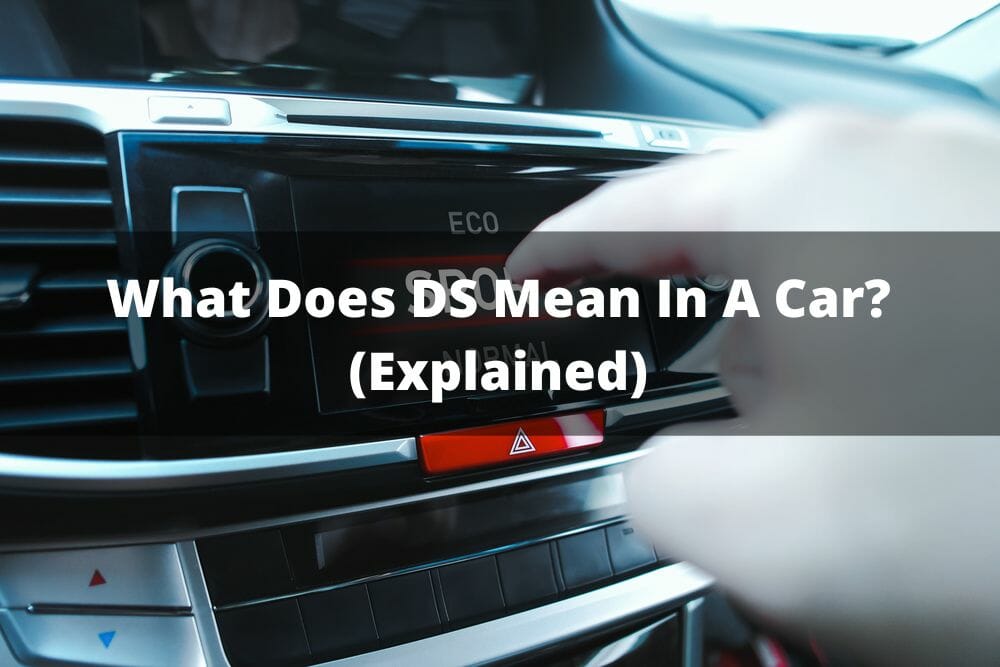
Automobiles have become an integral part of modern life, offering convenience, mobility, and even a sense of identity for those behind the wheel. Yet, amidst the myriad of buttons and gear selections, drivers often encounter the letters “D/S” on their dashboard or gear shifter. For many, this seemingly innocuous notation can spark curiosity. What does D/S mean in a car? This article delves into the intricacies of this designation, unraveling its significance in the realm of automotive transmission systems and driving dynamics.
Understanding Transmission Types
To appreciate the designation of D/S, one must first grasp the basic mechanics of automotive transmissions. The modern vehicle typically employs one of two primary types of transmissions: manual and automatic. In a manual transmission, the driver commands gear changes through a clutch pedal and a gear lever. Meanwhile, automatic transmissions utilize a more complex system, enabling the vehicle to shift gears automatically based on speed, load, and driving conditions.
Within the realm of automatic transmissions lies the continuously variable transmission (CVT), dual-clutch transmission (DCT), and the standard automatic transmission, each presenting unique features and advantages. This multiplicity of transmission types is integral to the vehicle’s performance, and thus, the interpretation of D/S becomes crucial.
Decoding D/S: Drive/Standard Mode
The “D” in the D/S notation stands for “Drive,” which is the standard mode for operating an automatic vehicle. When engaged in this mode, the car optimally selects gears automatically for the best balance of performance and fuel efficiency, adjusting seamlessly to varying conditions from stop-and-go traffic to highway cruising.
The “S,” conversely, symbolizes “Sport” mode. Drivers who select S will find that their vehicle behaves more aggressively, allowing for higher RPMs before shifting gears, resulting in increased power and responsiveness. This mode is particularly advantageous for those who desire a more spirited driving experience. It transforms mundane errands into an exhilarating journey, enhancing the thrill of acceleration and cornering.
Why Sport Mode Matters
Many drivers are captivated by the allure of sport mode due to its promise of heightened performance. Engaging S alters not just the timing of shifts, but also accentuates engine response, amplifying throttle sensitivity. This is particularly beneficial in scenarios such as merging onto the highway or navigating steep inclines, where power is essential. Moreover, it lays bare the car’s capabilities, allowing those behind the wheel to experience their machine’s full potential.
Crucially, the decision to utilize the sport mode is not merely about speed. It profoundly influences the overall driving experience, transforming every mundane errand into a dynamic encounter with the road. The increased control granted to the driver instills a sense of mastery, inviting enthusiasm and engagement rather than apathy.
The Psychological Connection to Driving Modes
The fascination with D/S encapsulates a deeper psychological connection many humans forge with their vehicles. Automobiles are not just modes of transportation; they represent freedom, individuality, and even empowerment. Differentiating between drive and sport modes taps into an innate desire to control one’s environment, navigating various terrains and situations with confidence.
When drivers shift from D to S, they are not only modifying their car’s performance but elevating their own emotional experience. It becomes a manifestation of their personal driving style, a tactile engagement with the mechanics that resonates on a more profound level. Thus, the presence of D/S is not just a technical feature; it’s an embodiment of the diverse intentions behind the wheel, catering to both utility and passion.
Practical Considerations of Using D/S
Though engaging sport mode brings a plethora of benefits, drivers should consider situational appropriateness. Sport mode may lead to increased fuel consumption and more wear on the engine, given the strain placed on the vehicle in terms of RPM management and transmission load. In contrast, the standard drive mode optimizes for efficiency, supporting those longer, less exhilarating journeys.
Additionally, navigating through urban landscapes with frequent stops may demand an adherence to the standard drive setting to maintain comfort and smooth operation. Striking a balance between the robust agility offered by S and the relaxed efficiency of D is paramount for an optimal driving experience.
Conclusion: The Duality of D/S
The D/S designation on a vehicle serves as more than a mere indicator of operational modes; it encapsulates the duality of driving – combining the demand for efficiency with the thrill of performance. As automotive technology continues to evolve, the underlying fascination with these distinctions persists, reaffirming the indelible bond between man and machine. Navigating the roads of life with the ability to switch seamlessly between modes embodies a broader metaphor: the choice between the routine and the exhilarating. Thus, understanding what D/S means in a car allows drivers to fully harness their vehicle’s potential, ensuring that each journey is not just a transit from point A to point B, but an experience filled with meaning and excitement.












