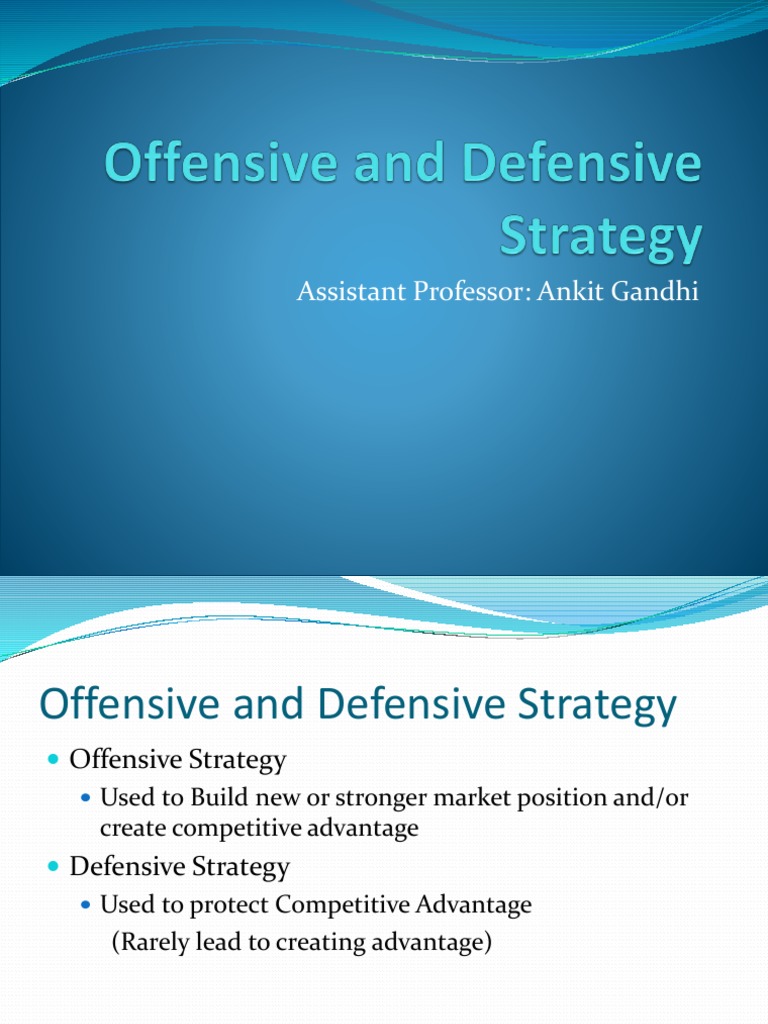
In the realm of strategy, the dichotomy between offensive and defensive approaches is not merely a tactical consideration; it represents a complex interplay of foresight, adaptability, and intuition. Understanding what it means to embody both offensive and defensive strategies unveils a myriad of layers, each ripe with implications not only for business leaders and military tacticians but also for individuals navigating personal challenges or competitive arenas. This exploration provides a deeper insight into the fascination that such duality incites.
At the core, defense and offense are not mutually exclusive. Instead, they coexist in a delicate equilibrium that can significantly influence outcomes depending on the context in which they are applied. Recognizing the merits of both strategies paves the way for a more nuanced approach, one that emphasizes flexibility and responsiveness in rapidly changing environments.
1. Defining Offensive and Defensive Strategies
Before delving into the symbiosis of these strategies, it’s crucial to delineate what is meant by offensive and defensive strategies. An offensive strategy is characterized by proactive measures aimed at gaining a competitive edge. This could manifest in various forms, such as launching innovative products, pursuing aggressive marketing campaigns, or entering new markets to capture greater market share.
In contrast, a defensive strategy is reactive. It focuses on protecting existing assets, markets, and customer bases. This often involves maintaining current market positions, mitigating risks, and employing strategies like diversification or cost-cutting. By reinforcing the existing structure, organizations or individuals can shield themselves against potential threats that arise from outside forces.
2. The Interdependence of Offense and Defense
While offense seeks to create opportunities, defense aims to preserve them. One can hardly thrive in an environment marked by volatility without recognizing how these two strategies intermingle. For instance, in the business context, a company may find that a robust defense in terms of customer loyalty and brand integrity enables it to pursue more ambitious offensive initiatives. This relationship underlines an essential truth: a strong defensive posture can free resources and bandwidth for offensive maneuvers.
Furthermore, the potential for strategic misalignment arises when organizations fail to balance these approaches. For example, a company overly fixated on offensive growth may disregard emerging threats, leading to vulnerabilities that a well-crafted defensive strategy could have mitigated. Conversely, an entity obsessed with defending its territory may become stagnant, missing out on expansion opportunities. Navigating this dynamic realistically compels organizations to foster a versatile mindset that encompasses both strategies.
3. The Role of Strategic Thinking and Planning
The duality of offense and defense necessitates a sophisticated level of strategic thinking. To excel in both realms, decision-makers must engage in rigorous analysis, forecasting potential market shifts while simultaneously preparing for unpredictable challenges. This intricate dance hinges on a keen understanding of not just one’s own capabilities, but also a comprehensive awareness of competitors’ strengths and weaknesses.
Effective strategists employ tools such as SWOT analysis (Strengths, Weaknesses, Opportunities, Threats) to harmonize offensive and defensive considerations. This framework encourages organizations to leverage their strengths in initiating growth while simultaneously reinforcing defenses against identified weaknesses and threats. Emphasizing the interconnectedness of these strategies enhances a company’s agility, allowing it to reposition itself adeptly as market conditions dictate.
4. Psychological Aspects of Being Both Offensive and Defensive
The psychological dimension plays a crucial role in how individuals and organizations perceive and implement these strategies. The inclination toward offensive tactics often stems from a desire for dominance, achievement, and innovation. Conversely, a defensive mindset may arise from fear of loss, insecurity, or the preservation of status quo. This inherent duality taps into complex human emotions and motivations.
Addressing these psychological undercurrents provides insight into the reasons why many leaders find the amalgamation of both strategies mesmerizing. The allure lies in the challenge to maintain a proactive stance while being ever vigilant against external threats. By fostering resilience and autonomy, individuals and organizations can craft a robust strategic orientation that tantalizingly combines the aggressive pursuit of opportunities with the judicious safeguarding of foundational elements.
5. Tactical Implementation in Real-World Scenarios
One must consider how to effectively implement a strategy that incorporates both offense and defense. In practice, executing such strategies often involves a plethora of tactical decisions. For instance, in the tech industry, a company might engage in an aggressive research and development initiative to innovate new products (offensive), while simultaneously investing in cybersecurity to protect its intellectual property against breaches (defensive).
A vivid example can be seen in the sports arena, where teams not only focus on scoring goals but also on fortifying their defenses. A football team, for instance, may adopt an offensive formation to press the attack while ensuring that defensive players are adept at countering opposing plays. This strategic duality cultivates a comprehensive game plan, maximizing chances of victory.
6. The Future of Dual Strategy
As markets and technologies continue to evolve, the relevance of a dual strategy remains paramount. Companies must remain agile, adapting not just to opportunities but also to emerging threats in real time. The capacity to swap seamlessly between offensive and defensive strategies will be critical for sustained success. This adaptability not only secures competitive advantage but also fosters an innovative culture poised to tackle future challenges.
In conclusion, the intricacies of embodying both offensive and defensive strategies reflect a profound understanding of strategy itself. This balance not only requires judicious planning but also an acute awareness of psychological dynamics and tactical execution. Navigating this continuum ultimately lays the groundwork for resilience, allowing individuals and organizations to thrive amid the uncertainties of the modern landscape.