
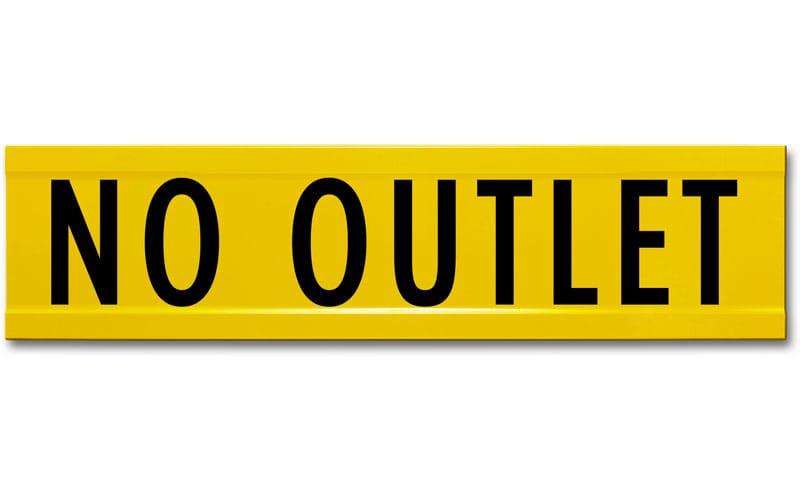
The urban landscape is dotted with countless signs, each communicating essential information to the public. Among these, the “No Outlet” sign stands out, often evoking a sense of curiosity. What does this simple phrase imply? Is it merely a warning, or does it embody deeper nuances within real estate and safety terminology? While it may seem straightforward, understanding the implications of a No Outlet sign can pose a challenge to both residents and prospective homebuyers alike.
At first glance, a No Outlet sign typically indicates that the road or path leads to a dead end. This might suggest limited vehicle traffic, fostering a sense of tranquility, but it also raises questions about accessibility and convenience. Is this the residential bliss you’ve been dreaming of, or a decision that could lead you to feel isolated from the vibrancy of suburban life?
Understanding the layers of meaning behind a No Outlet sign requires delving into both the psychological and practical implications. In many instances, real estate agents and homeowners highlight these signs as part of the charm of a locality. They are often marketed to families or individuals seeking a peaceful and less chaotic atmosphere, away from the hustle and bustle of through traffic. However, this serenity can come with its own set of challenges.
From a visual standpoint, No Outlet signs serve as crucial navigational aids, ensuring that drivers do not unwittingly venture down a road that ultimately leads nowhere. This leads us to the question: how does this affect the overall livability of the neighborhood? While it promotes a quieter ambiance, it’s essential to weigh the pros and cons, especially regarding accessibility to essential services and community resources.
This brings us to the relationship between the physical environment and real estate value. Homes situated on streets marked with a No Outlet sign can exhibit a unique appeal. However, their values may be influenced by various factors. For instance, buyers may be deterred by the perception of isolation. Imagine living in a picturesque home, but feeling somewhat cut off from surrounding amenities. Checks and balances occur when homebuyers weigh the pros of privacy against the cons of accessibility.
The safety implications of a No Outlet sign are equally noteworthy. In many residential areas, these signs are deliberately positioned to not only guide traffic but to enhance the safety of pedestrians and cyclists. Limiting vehicular access decreases the risk of accidents and fosters a more family-friendly environment. In this scenario, the No Outlet sign transitions from a mere advisory to a vital component of community safety planning.
Yet, one must also consider the potential downsides. Emergency services might face challenges accessing homes situated on dead-end streets. Consequently, homeowners should inquire about alternative routes for emergency response, ensuring that their safety is not compromised. How far are you willing to go to secure not just aesthetics but practicality in your living space?
Beyond real estate and safety, the No Outlet sign embodies a broader metaphor for life choices. It prompts reflections on the paths we take and the decisions we make. Are we willing to embrace solitude, away from the constant noise of urban life, or do we crave connectivity, no matter the chaos? The essence of a No Outlet sign invites profound consideration of what we truly value.
On a practical level, for potential homebuyers, a home at the end of a No Outlet street could symbolize both a compact community feel and a high degree of privacy. However, before making a commitment, it’s imperative to determine the implications of location: Are schools, shopping centers, and entertainment venues easily accessible? How about public transport? Will the quaint surroundings be enough to hold one’s interest long-term?
Further challenging the notion of a No Outlet street is the evolving nature of neighborhood dynamics. As urban development progresses, previously isolated areas often find themselves integrated into larger infrastructures. For those who purchased a home due to its No Outlet designation for tranquility, could forthcoming developments alter that peace? Engaging deeply with the whereabouts of No Outlet signs amidst changing urban landscapes can lead to unexpected revelations.
Interestingly, No Outlet signs extend their influence beyond just driving habits; they affect community morale. Neighbors in close-knit, dead-end communities might find deeper connections with one another, fully recognizing how their environment shapes interpersonal relationships. Yet, conversely, feelings of seclusion might lead to social isolation, posing a unique challenge to the cohesiveness of such neighborhoods.
In conclusion, the No Outlet sign is a seemingly simple landmark in the landscape of modern living, but it encapsulates complex considerations in real estate and safety. As this sign dictates, there are some roads that lead nowhere, both literally and metaphorically. Balancing the serenity of a secluded residence with practical matters of accessibility remains a nuanced consideration for homebuyers and residents alike. Ultimately, a thoughtfully placed inquiry about what it means to live at a No Outlet location can yield insight into one’s preferences for lifestyle, community, and safety. Navigating these choices may just be one of the more intriguing challenges we face in the pursuit of a harmonious living experience.












