
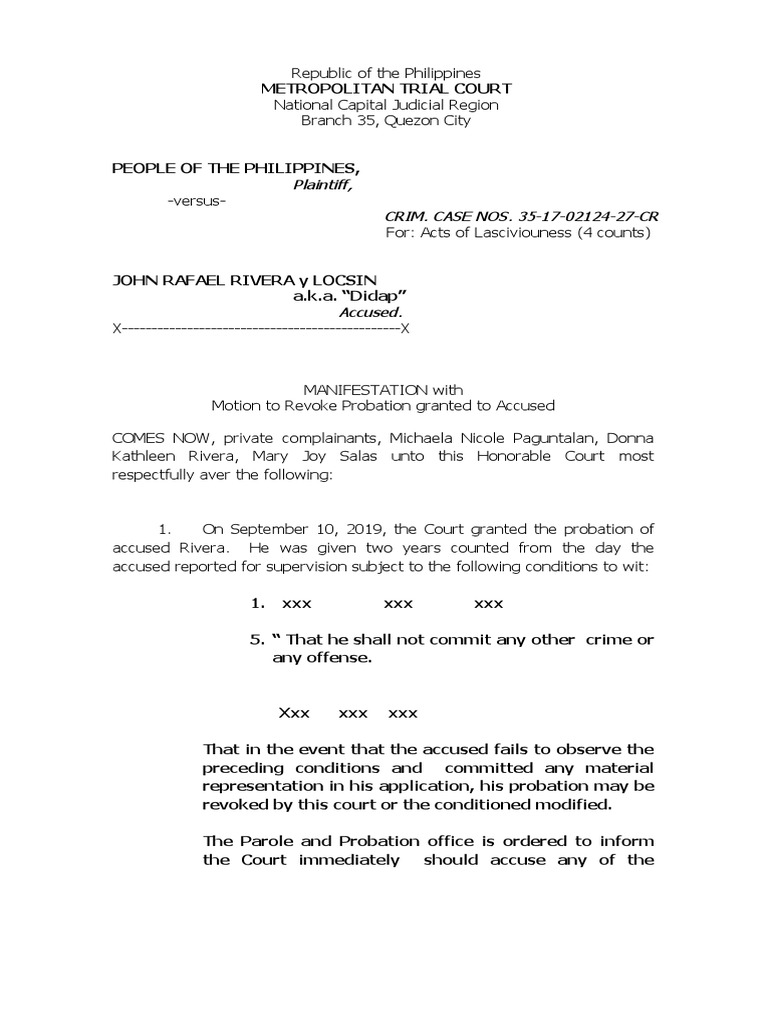
Probation is often seen as a second chance for individuals seeking rehabilitation rather than incarceration. However, the treacherous path of compliance can turn perilous if the terms and conditions of probation are violated. One of the most daunting possibilities for those on probation is the revocation of that probation, a consequence that can have profound implications. But what does it mean to revoke probation? And what legal ramifications ensue? The answers may be more intricate than one initially perceives.
To embark on this exploration, it is essential to understand the very foundation of probation. Probation serves as an alternative to imprisonment for offenders, allowing them to live in the community under specific terms set by the court. These terms might include regular check-ins with a probation officer, maintaining employment, attending counseling sessions, and refraining from criminal activity. However, when an individual fails to adhere to these stipulations, the consequences can be severe, leading to a revocation of probation.
The process of revoking probation is not simply a matter of one-size-fits-all consequences. It varies considerably depending on the jurisdiction and the nature of the violation. A probation violation may be as benign as missing an appointment with a probation officer to something more egregious, like committing a new offense. Each offense is weighed meticulously, and recourse can vary broadly. The initial inquiry should include an understanding of the potential triggers that can lead to the revocation process.
One common trigger for revocation is non-compliance. Probationers are required to abide by strict rules. Failure to keep up with such regulations—be they related to curfews, drug testing, or mandatory counseling—can lead to a violation. The implications of such non-compliance are profound. Ultimately, it may culminate in a court’s decision to revoke probation altogether. Moreover, the impact of such a development extends far beyond immediate legal repercussions; it can stain a person’s permanent record and hinder future opportunities.
Another, more serious, path leading to revocation is the commission of a new crime. A probationer’s failure to adhere to the law not only nullifies the trust bestowed upon them but also triggers a more stringent judicial examination. Essentially, the court must determine whether the new offense justifies the revocation of probation or if it is a separate issue that can be addressed independently. This decision relies heavily on the nature of the offense and whether it is a minor infraction or a more severe crime.
Once a probation violation has been identified, the court’s next step involves a formal hearing. This hearing is a crucial moment for the probationer, as it represents a chance to contest the allegations. During this process, both sides — the probation officer representing the state and the probationer (often with legal counsel) — present evidence and arguments regarding the violation. The burden of proof in these hearings often lies with the state, which must demonstrate that a violation occurred. This aspect can occasionally work in favor of the probationer, allowing them to present mitigating circumstances or evidential support to contest the allegations.
The ramifications of a probation revocation are profound and multifaceted. If the court determines that probation should indeed be revoked, several outcomes are possible. For many, this leads to a return to incarceration, with the individual serving the remainder of their sentence that would have otherwise been served under probation. The length of this incarceration can be influenced by various factors, including the severity of the violation and the terms initially set forth during sentencing.
Moreover, the precedent of revocation carries a more significant, long-term impact. A criminal record indicating a probation violation may permanently alter an individual’s trajectory. For example, applying for employment, housing, or loans could become an insurmountable challenge due to the presence of a conviction or violation in their background. A perpetual shadow looms over the individual, limiting their access to opportunities and personal growth.
Nevertheless, revocation does not have to denote an end. The legal system provides avenues for rehabilitation, allowing individuals the opportunity to address their shortcomings and re-enter society. Post-revocation, programs aimed at rehabilitation can pave a path toward restoring one’s standing within the community. Such programs emphasize education and therapy, targeting the roots of criminal behavior and encouraging positive change.
Furthermore, public perception of probation and its revocation deserves contemplation. Society often holds rigid views about offenders, frequently neglecting to recognize the complexities surrounding rehabilitation. Empathy for those on probation can spark transformative conversations. By understanding the myriad reasons behind rule violations, society can foster a more equitable approach to justice that merits rehabilitation over recidivism.
In summary, the concept of revoking probation encapsulates a plethora of elements that extend beyond mere legal terminology. It is a labyrinth of rules, consequences, remedies, and societal implications. Unraveling the intricacies of probation revocation leads to a deeper understanding of the legal system and highlights the necessity for compassion and support for individuals striving to regain stability after a misstep. It poses the question: How can society better understand and support the cyclical nature of crime and rehabilitation? Ultimately, it beckons a re-evaluation of our approach to correction, suggesting that a focus on rehabilitation might yield more fruitful outcomes than punitive measures alone.












