
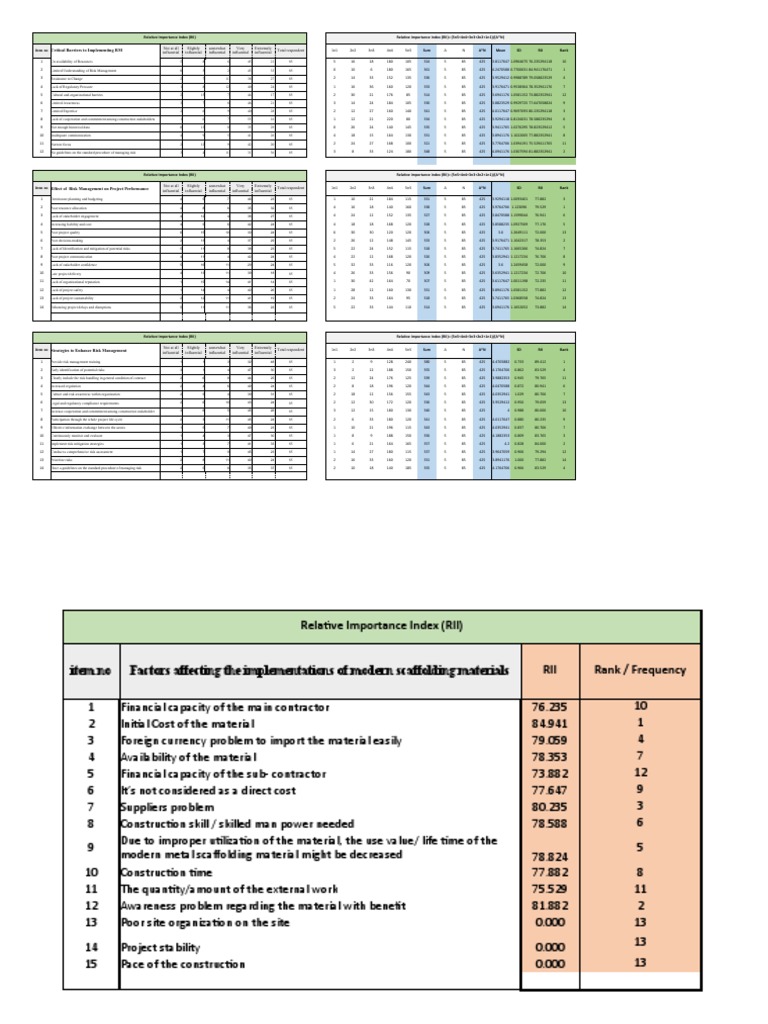
If you’ve ever stumbled upon the acronym “RII,” you might have wondered what it encompasses and the contexts in which it flourishes. As an abbreviation, RII can hold different meanings across various fields, each bearing its own significance and implications. This article elucidates the multiple interpretations of RII, traversing its complexities, applications, and far-reaching impacts.
First and foremost, RII is often used in risk management, particularly as “Risk Information Indicator.” In this context, RII serves as a crucial tool for organizations aiming to navigate uncertainties. Here, it functions much like a compass in a dense fog, offering guidance through otherwise ambiguous situations. The RII incorporates various factors to assess potential risks within a project or process, shedding light on vulnerabilities that may otherwise go unnoticed. Understanding and implementing RII can be the difference between proactive risk mitigation and reactive crisis management.
In the realm of financial analysis, RII can represent the “Return on Investment Indicator.” For investors and financial analysts, ROI—the more commonly known term—provides a quantitative measure of the profitability of an investment, while RII unveils additional layers of insight. It incorporates a broader spectrum of relevant data points, including potential future earnings, market conditions, and even economic forecasts. When investors leverage RII, they can better gauge not just the present value, but also the potential trajectory of their investments, fostering a more comprehensive understanding of financial landscapes.
The concept of RII also permeates the world of academia and research, particularly within the sphere of technology and engineering, where it is synonymous with “Reliability Importance Index.” In this context, RII assesses the reliability of different components in a complex system, allowing engineers and designers to prioritize enhancements and resource allocation. How vital is each component to the overall functionality of the system? RII addresses this query, making it indispensable in sectors like aerospace, automotive engineering, and even public infrastructure development.
As we shift our focus to the environmental sphere, RII may emerge as “Resource Intensity Indicator.” This application takes a closer look at the resources consumed by various processes or products, allowing businesses and governments to determine sustainability levels. Industries are often under scrutiny for their environmental footprints, and RII provides a metric for evaluating progress in resource efficiency. By spotlighting excessive consumption and inefficiencies, RII can catalyze transformative shifts towards greener practices.
Additionally, in the realm of human resources and organizational psychology, RII can stand for the “Recruitment Impact Indicator.” This application seeks to quantify the effectiveness of recruitment strategies. Instead of relying solely on qualitative assessments, organizations can leverage RII to determine how recruitment impacts various metrics such as employee retention, productivity, and overall organizational culture. The insights gained through RII can incite substantial transformations in hiring processes, ensuring alignment with long-term goals.
One might ponder how RII’s versatility can spark curiosity in diverse sectors. The multifaceted nature of this acronym compels individuals and organizations to delve deeper. Instead of dismissing the term as an abbreviation, consider the profound implications it holds across different domains. By exploring the varied contexts of RII, one discovers a narrative that intertwines risk management, investment analysis, reliability assessment, environmental sustainability, and human resources—all interconnected by the quest for efficiency and effectiveness.
Moreover, as businesses face increasing complexities in a globalized world, the need for robust RII frameworks has never been greater. Organizations armed with a comprehensive understanding of RII can navigate change adeptly, adapting to volatile markets while keeping an eye on strategic growth. At its core, RII embodies an ethos of proactive thinking, urging individuals to prepare for uncertainty instead of merely reacting to it. This mindset shift can empower teams to innovate and foster resilience, ultimately propelling organizations to new heights.
Additionally, the importance of technology cannot be overstated in harnessing the power of RII. Advanced data analytics, artificial intelligence, and machine learning tools offer unprecedented opportunities to extract actionable insights from RII frameworks. By leveraging these technologies, businesses can identify trends, assess risks, and optimize processes with an accuracy previously thought unattainable. The integration of technology and RII is not just a trend; it represents the future of strategic planning and operational excellence.
In conclusion, the acronym RII, while seemingly simple, unveils a world of possibilities that span various industries and disciplines. From risk management and financial analysis to engineering reliability and sustainable resource consumption, RII serves as a compass guiding decision-making amidst uncertainty. Its multifarious applications challenge individuals and organizations to think critically, adapt to changing landscapes, and ultimately foster a culture of resilience and proactivity. As you ponder the next steps in your personal or professional endeavors, consider the implications of RII—it may just illuminate paths previously unimagined.












