
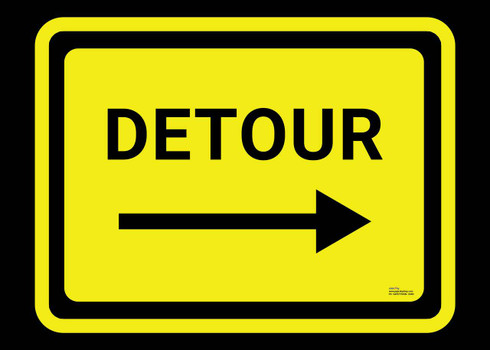
In the world of transportation, the enigmatic detour sign stands as a guardian of safety, redirecting travelers away from obstacles and into uncharted territories. It is not merely a piece of metal or a confusing array of colors; it serves as a clarion call for caution, urging drivers to embrace change on the road. But what does a detour sign truly signify, and why is it paramount to heed its message? Journeying into the depths of road safety, we unravel both the literal and metaphorical implications of this essential symbol.
At its core, a detour sign informs motorists that their customary route has been obstructed, be it by construction, an accident, or a natural disaster. Such interruptions, akin to unexpected plot twists in a gripping narrative, necessitate an immediate reevaluation of one’s path. The detour sign relinquishes the illusion of permanence and reminds us that life on the road is in a state of continual flux. The sign’s vivid colors and authoritative shape compel attention, compelling drivers to alter their trajectory.
Taking a cue from navigational symbols, the detour sign can evoke a feeling of apprehension. It calls to mind images of labyrinthine paths and shadowy corners, where the unknown awaits. Much like the odyssey of life, detours often hide unforeseen adventures and discoveries. However, this necessity for adaptation can stimulate anxiety, pushing individuals beyond their comfort zones. Hence, understanding the significance of the detour sign is vital not only for physical journeys but also for mental preparedness.
One may ponder the psychology behind the detour sign’s design. The bright hues of yellow or orange, often associated with warning and caution, combined with their triangular or diamond shapes, create a visual urgency. This potent symbolism strikes a balance between alarm and clarity, striking the viewer with a message that is both direct and urgent. The shape of the sign serves as an arrow, a guiding force urging us to reconsider and recalibrate our intentions.
For drivers, compliance with the detour instruction is not merely a mandate; it is an act of communal responsibility. Road safety is a shared endeavor, where one’s choices can either exacerbate hazards or fortify collective well-being. When, for instance, a sizable truck neglects to follow the detour, it risks not only its own safety but the harmony of the entire environment surrounding it. Each driver, akin to a note in a grand symphony, plays an integral role in maintaining the mellifluous soundscape of traffic.
In many urban areas, detours arise from extensive construction projects aimed at improving infrastructure. These programs, rife with their own conundrums, often evoke feelings of irritation among daily commuters. Here lies a critical juncture: the interplay between chaos and improvement. The detour signs arise as symbols of progress wrapped in inconvenience. They reflect our society’s dual nature—our simultaneous yearning for betterment while enduring the growing pains that accompany change.
Moreover, the effectiveness of a detour sign is augmented by clear communication. In an era of rapid information dissemination, the role of signage becomes ever more paramount. Consider a scenario where multiple detour signs are in play, each offering a different route. The plethora of options can lead to confusion, akin to being in a maze where each path holds its own implications. Consequently, road authorities must ensure that detour signs are not only strategically placed but also accompanied by explicit instructions that guide drivers with ease.
However, not all detours are born equal. While some may be enforced due to temporary conditions, others lead to long-lasting changes in traffic patterns. Urban redevelopment, influenced by societal dynamics, may render certain roads obsolete, necessitating a change in habitual behavior. The detour sign becomes both an emblem of transformation and a harbinger of nostalgia for the roads once traveled. It signifies the passage of time, capturing the essence of evolution—both in the landscape and the human psyche.
Ultimately, the detour sign serves as a catalyst for reflection. Whenever we encounter this emblem of divergence, it compels us to engage with the unpredictability of life. Much like life’s own detours, which may lead us away from familiar paths and into territories rich with new experiences, the road less traveled often harbors unseen treasures. The significance of embracing detours transcends mere travel; it becomes a metaphorical exploration of resilience and adaptability.
In conclusion, the detour sign is far more than a cautionary emblem along our shared roadways—it is a profound statement about the human experience. As we traverse the expanse of asphalt, these signs challenge us to navigate complications, embrace change, and remain vigilant in our journey toward safety. Life, much like the thoroughfares we travel, is an intricate dance of intended routes, unexpected diversions, and the inevitability of change. As such, the detour sign stands not only as a signpost in our physical journeys but as a poignant reminder of the importance of patience, adaptability, and the courage to forge new paths. The road ahead may twist and turn, but each detour unveils a new chapter worth exploring.












