
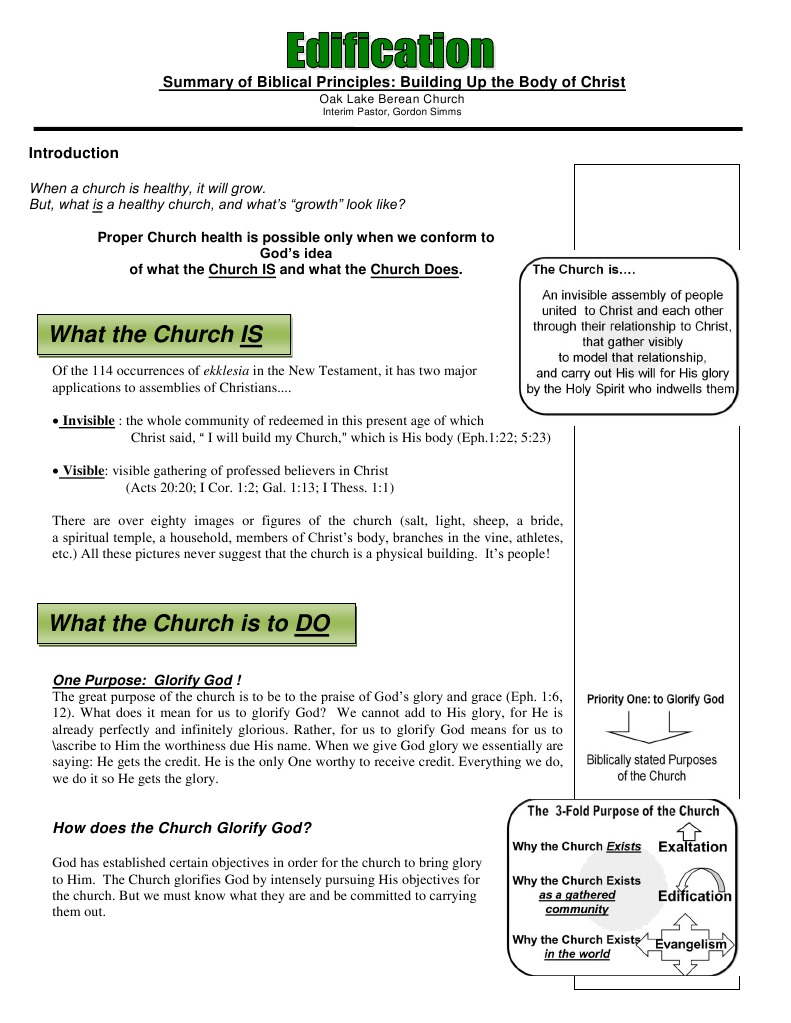
Edification, a term that resonates deeply within spiritual discourse, embodies the essence of building oneself up in faith and understanding. In the context of the Bible, edification transcends mere education; it represents a transformative process through which individuals cultivate their character and strengthen their spiritual foundation. As one delves into the scriptures, it becomes evident that edification is pivotal not only for personal growth but also for the broader community of believers. This article aims to illuminate the multifaceted nature of edification, exploring its biblical origins, practical applications, and its significance in fostering spiritual maturity.
The Biblical Foundation of Edification
To comprehend the full scope of edification, one must first explore its biblical roots. The term “edification” derives from the Latin word “aedificare,” meaning “to build.” In a biblical sense, edification implies constructing a robust spiritual edifice through prayer, study, and communal support. Several key scriptures elucidate this concept:
- 1 Thessalonians 5:11 encourages believers to “encourage one another and build one another up.” This call to community emphasizes that edification is not solely an individual endeavor; rather, it flourishes within relationships.
- Ephesians 4:11-12 states that Christ gave leaders to the church “to equip the saints for the work of ministry, for building up the body of Christ.” Here, edification is linked intricately to ministry, affirming that spiritual growth is a collective mission.
Through these passages, it is apparent that edification is inextricably woven into the very fabric of Christian fellowship—an ongoing process both initiated and sustained through engagement with the Scriptures and one another.
The Role of Scripture in Edification
Central to the journey of edification is the engagement with biblical texts. Scripture serves as the ultimate guide, providing wisdom, correction, and encouragement. The Word Acts as a catalyst for spiritual growth, inspiring individuals to cultivate virtues such as patience, kindness, and faithfulness. Meditating on and memorizing Scripture fosters a deeper understanding of God’s character and His will for humanity.
Moreover, the act of studying the Bible in a communal context amplifies the effectiveness of edification. Small groups and study circles facilitate discussions that can unveil different interpretations and insights. This collaborative approach allows believers to glean knowledge from each other, enriching their own spiritual journey. Consequently, the Bible is not merely a textbook for knowledge; rather, it serves as a living document that transforms hearts and minds.
Prayer and Edification
Alongside Scripture, prayer is another cornerstone of edification. Engaging in prayer cultivates a personal relationship with God, providing a conduit through which believers can express their hopes, doubts, and gratitude. It is in these moments of communion that believers often find clarity, strength, and redirection for their lives.
Moreover, communal prayer uplifts the body of Christ. When congregations come together to pray for one another, they reinforce bonds of unity and support. As individuals share their struggles and victories, they foster an environment of vulnerability and accountability—essential components for authentic edification.
Spiritual Gifts and Their Contribution to Edification
The New Testament emphasizes the diversity of spiritual gifts, each playing a pivotal role in the edification of the church. The Apostle Paul, in 1 Corinthians 12, eloquently articulates that while there are varieties of gifts, the same Spirit empowers them all. Each believer is endowed with unique abilities—whether it be teaching, encouraging, leading, or administering—contributing to the collective growth of the faith community.
Understanding and utilizing these gifts not only enhances individual spiritual development but also fosters an environment ripe for communal edification. Believers are encouraged to discover their gifts and employ them for the benefit of others, thereby reflecting the body of Christ in action.
Encouragement and Edification
Encouragement is another integral component of edification. The act of lifting others in their spiritual journeys requires intentionality and sensitivity. Genuine encouragement can manifest through words of affirmation, acts of service, or simple presence. It serves to inspire perseverance, especially during seasons of doubt or hardship.
This nurturing environment allows believers to flourish, cultivating a spirit of resilience rooted in faith. The significant impact that one person’s encouragement can have on another’s journey is profound, demonstrating the power of human connection within the edifying process.
Challenges to Edification
Despite its importance, the path of edification is not always linear. Various challenges can hinder spiritual growth, ranging from personal struggles to societal pressures. Individuals may grapple with doubts, moral dilemmas, or even feelings of inadequacy. Additionally, distractions and worldly commitments can overshadow spiritual priorities, leading to stagnation in one’s faith.
Acknowledging these obstacles is the first step toward overcoming them. Through prayer, accountability relationships, and a commitment to engage with Scripture, believers can navigate these challenges effectively. It fosters resilience and determination, symbolizing the transformative power of edification in action.
The Fruits of Edification
The culmination of edification is evident in the fruits it bears. As individuals grow in their faith and understanding, they exhibit greater love, joy, peace, and self-control—qualities that reflect the character of Christ. Ultimately, edification is not an end in itself but a conduit through which believers can impact the world.
Furthermore, the edified believer becomes a beacon of hope and an agent of change within their community. The lessons learned and the victories experienced are shared with others, perpetuating the cycle of encouragement and upliftment. Thus, edification stands as a vital process not only for individual transformation but for the collective mission of the church.
In conclusion, edification is an intricate tapestry woven from prayer, Scripture, communal support, and the exercise of spiritual gifts. It serves as the foundation for spiritual growth, fostering resilience and hope within believers. As individuals pursue edification, they contribute to a vibrant faith community that can collectively navigate the challenges of life, inspire one another, and ultimately reflect the love and grace of God in the world.











