
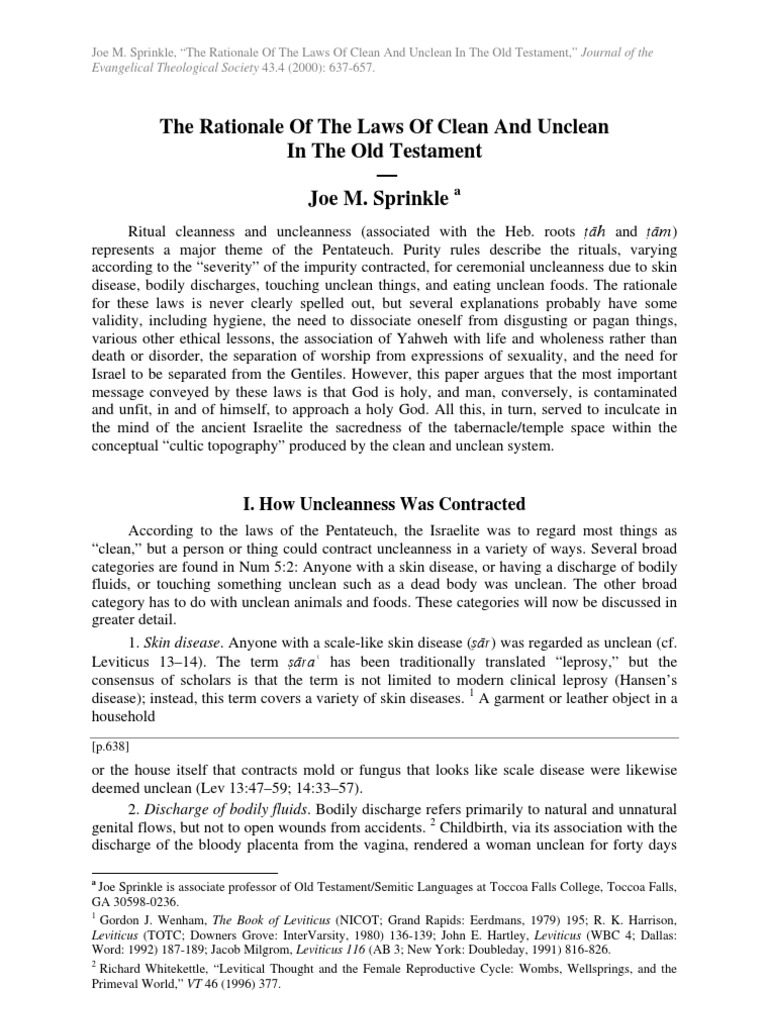
In both ancient and modern contexts, the concept of uncleanness in the Bible evokes a multitude of interpretations and understandings. It extends beyond mere physical impurities to encompass spiritual and moral dimensions that intricately weave into the fabric of faith, community, and divine interaction. Delving into the biblical assertions regarding uncleanness reveals a nuanced panorama of meaning, rich with implications for personal and communal living.
At its core, biblical uncleanness was often tied to physical states, such as illness, contact with dead bodies, or specific bodily functions. The Book of Leviticus, for instance, delineates a plethora of regulations geared towards maintaining purity within the Israelite community. But what does it signify when the text stipulates that certain actions or conditions render an individual “unclean”? This inquiry invites us to explore the profound significance of purity and impurity inherent to the Old Testament.
One might wonder why such extensive laws were ordained. In the ancient Near Eastern context, distinguishing between clean and unclean was not merely about hygiene; rather, it served as a spiritual delineation integral to worship and everyday life. The Israelites believed that physical uncleanness could lead to spiritual ramifications. Thus, to touch something considered unclean was tantamount to risking one’s standing within the covenant community and one’s relationship with God. This perspective underscores a fundamental belief: that what is seen as externally impure can also affect the internal spiritual state.
Consider the leper described in Leviticus 13, whose affliction rendered them unfit for community life. They were mandated to announce their condition aloud, effectively isolating them from society. Loneliness and stigma accompanied their physical ailment, illustrating the profound implications of physical uncleanness. Yet, Jesus’s healing of lepers in the New Testament transforms this notion. He extends his compassion towards those society casts aside, emphasizing that true purity arises from the heart rather than mere adherence to ritualistic law.
Transitioning from Old Testament rigor to New Testament grace, one observes a paradigm shift. While the Mosaic Law outlined the criteria for uncleanness, Jesus reframed these concepts. In Matthew 15:10-20, He proclaims that it is not what enters the mouth that defiles a person, but what comes out. This provocative statement challenges the prevailing understanding of purity and calls for introspection regarding one’s inner moral and ethical compass. Suddenly, the emphasis is less on ritual observance and more on the state of one’s heart and intentions.
Moreover, the notion of spiritual uncleanness extends into the realm of sin, which introduces a weightier aspect of biblical teaching. Sin serves as a profound barrier to communion with God, and the awareness of one’s sinful state can lead to feelings of uncleanness. Understanding sin not merely as an action but as a condition impacting one’s entire being reinforces the imperative for redemption and restoration. The sin offerings described in Leviticus, meant to atone for these conditions of uncleanness, foreshadow the ultimate atonement found in Christ’s sacrifice.
What might initially appear as an archaic requirement evolves into a lens through which to understand God’s redemptive purpose for humanity. The genealogies and purity laws present in the text serve not just to delineate heritage but also to highlight God’s meticulous care for community cohesion and spiritual integrity. The journey from uncleanness to cleanness constitutes a metaphorical arc of transformation, one that resonates with the human experience across various epochs.
Furthermore, the dilemmas of uncleanness are echoed in contemporary discussions surrounding moral and ethical dilemmas faced within modern society. Questions arise concerning societal norms and the implications of uncleanness today. What does it mean to be deemed ‘unclean’ in our current cultural conversation? The stigmas relating to failure, moral transgressions, or social injustices resonate with the biblical narrative—calling society to introspect and re-evaluate its values. In a world increasingly marked by fragmentation, the biblical exhortation towards introspection and purification becomes particularly compelling.
In closing, understanding what the Bible means by uncleanness invites a deeper, richer exploration of spirituality and community dynamics. It articulates a stark contrast between ritualistic adherence and the transformative power of grace. One learns that while laws guide behavior, they are incapable of changing the heart. This internal metamorphosis, characterized by reflection, repentance, and restoration, reveals a divine promise: that we may rise from the ashes of our uncleanness into a state of renewed purpose and community belonging. By engaging with these themes, individuals are beckoned to a transformative journey, igniting curiosity and inspiring a profound shift in their understanding of purity, both in ancient and contemporary contexts.












