
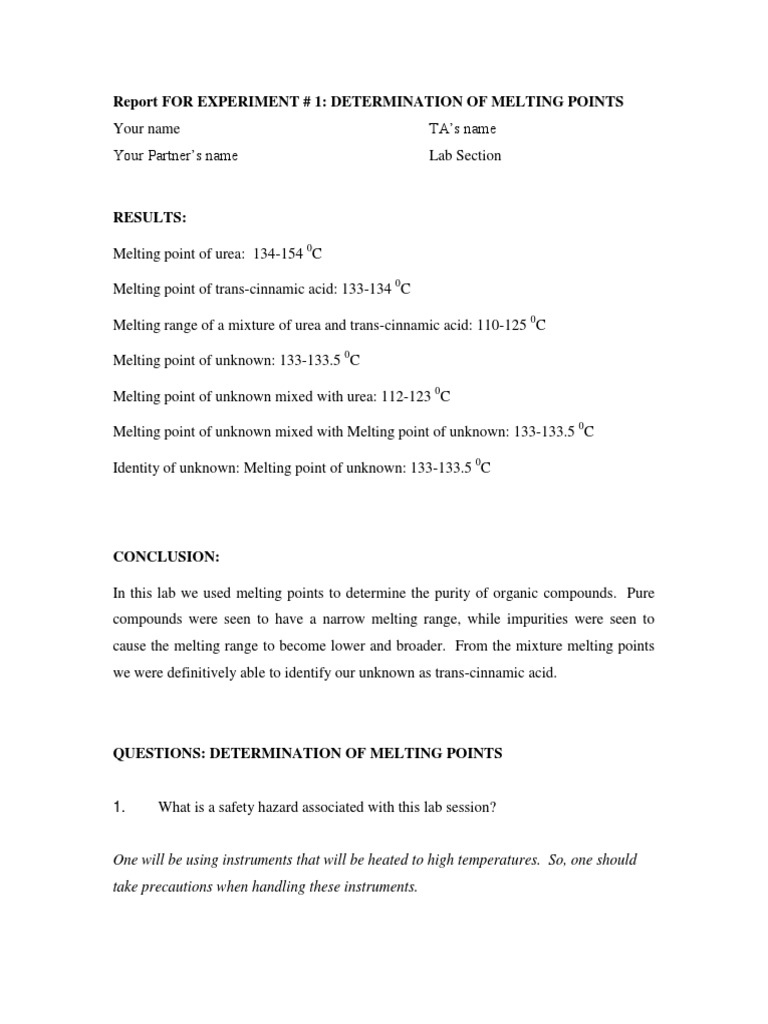
In the realm of scientific inquiry, chemistry stands as a pivotal lens through which we examine the intricate complexities of matter and its multifarious interactions. A chemistry lab report serves as a meticulous documentation of experimental processes, outcomes, and analyses, providing both a window into the observed phenomena and a stepping stone toward understanding the underlying principles that govern chemical reactions. This article delves into a classic example of a chemistry lab report, unpacking its components, methodologies, and implications.
Understanding the Purpose of a Chemistry Lab Report
The primary objective of a chemistry lab report is to communicate the findings of a significant experiment clearly and effectively. This document assists students in consolidating their learning experiences while also preparing them for the rigors of scientific communication in academia and industry. By engaging in this exercise, the student does not merely record outcomes; they practice critical thinking and analytical reasoning, essential skills in any scientific discipline.
Components of a Chemistry Lab Report
A comprehensive chemistry lab report typically comprises several key sections, each designed to elucidate different facets of the experiment. These entail:
- Title: A concise statement reflecting the essence of the experiment.
- Abstract: A brief summary of the purpose, methodology, results, and conclusions; it may only be a paragraph long but encapsulates the crux of the report.
- Introduction: This section outlines the theoretical background of the experiment, targeting specific questions or hypotheses that the research seeks to address.
- Materials and Methods: Here, a detailed account of the experimental setup, including all materials used and protocols followed, is presented. Precision in this section is paramount for reproducibility.
- Results: Data obtained during the experiment are organized and presented in an accessible format, often including tables, graphs, and figures.
- Discussion: This crucial section interprets the results, examining their significance and how they align with theoretical predictions. It articulates potential implications, sources of error, and areas for further study.
- Conclusion: A succinct wrap-up of the findings, reiterating the experimental purpose and summarizing the key results.
- References: Any literature or prior research consulted during the experiment should be cited in accordance with appropriate academic conventions.
Each part plays a vital role in weaving a cohesive narrative that showcases not only the results but the journey of discovery that led to these outcomes.
Example Experiment: The Reaction of Baking Soda and Vinegar
For illustrative purposes, consider an experiment investigating the reaction between sodium bicarbonate (baking soda) and acetic acid (vinegar). This experiment is not only a staple in introductory chemistry classes due to its simplicity but also an excellent avenue to explore broader chemical principles.
Hypothesis: When baking soda reacts with vinegar, a gas (carbon dioxide) will be produced, resulting in effervescence.
The Materials and Methods section would detail the ingredients (baking soda and vinegar), equipment such as measuring cups, test tubes, and a balloon for capturing the gas, along with the procedure for combining the reactants and observing the reaction.
As the experiment unfolds, students would document the observable changes in the Results section: the fizzing, bubbling, and inflation of the balloon indicative of gas production. Data might be quantified through measurements like the volume of gas collected over a set period.
When diving into the Discussion, one would analyze why the reaction occurs—exploring concepts such as acid-base reactions and the release of carbon dioxide. This analysis opens up avenues for a deeper understanding of how chemical changes relate to the laws of thermodynamics, the conservation of mass, and the role of catalysts in chemical reactions.
Scientific Interpretations and Broader Implications
Beyond the experimental observations, the fascination with this reaction lies in its accessibility and the fundamental principles it unveils. This simple experiment exemplifies crucial concepts such as chemical equilibrium and reaction kinetics, stimulating curiosity about the myriad of reactions that govern everyday processes. Why do certain substances react more vigorously than others? How can we manipulate conditions to yield desired results? Such queries propel students deeper into the intellectual explorations that chemistry offers, stimulating long-term academic and professional pursuits in the sciences.
Conclusion
A well-structured chemistry lab report encapsulates the essence of scientific inquiry, emphasizing the importance of clarity, precision, and critical thinking in the realm of experimental sciences. By engaging with an example such as the baking soda and vinegar reaction, students not only garner hands-on experience but also appreciate the broader implications of their findings. In a world saturated with complexity, the pursuit of answers through systematic experimentation remains a profound endeavor, unveiling the subtleties of chemical processes and igniting a lifelong fascination with the wonders of science.













