When delving into the world of linguistics, particularly the intricacies of sentence structure, one embarks on a fascinating journey that reveals the power of language to convey nuanced meaning. Among the various sentence types, compound-complex sentences stand out for their ability to interweave multiple thoughts and ideas with clarity and sophistication. These sentences comprise at least two independent clauses and one or more dependent clauses, creating a rich tapestry of information that invites readers to explore multifaceted relationships and scenarios.
To appreciate the beauty and complexity of compound-complex sentences, it is essential to first dissect their structure. An independent clause can stand alone as a complete thought, whereas a dependent clause cannot. By combining these elements, writers can construct sentences that reflect elaborate ideas or narratives, thereby encouraging a shift in perspective that captivates the audience.
Understanding the Structure
Consider the foundational components of a compound-complex sentence:
- Independent Clauses: These clauses express a complete thought and can function independently. For instance, “The sun set over the horizon” and “The stars appeared one by one.”
- Dependent Clauses: Incomplete thoughts that require an independent clause to provide full context. An example is, “As the sun dipped below the horizon” or “Although the stars illuminated the night.”
When combined, the result is a richly layered sentence that can express complex ideas and relationships. For instance: “As the sun dipped below the horizon, the stars appeared one by one, and the night transformed into a celestial masterpiece.” This type of sentence encapsulates actions happening concurrently while emphasizing a profound shift in time and space, ultimately piquing curiosity about the night that unfolds.
Examples that Exemplify
Now let us explore some compelling examples of compound-complex sentences that illustrate their potential:
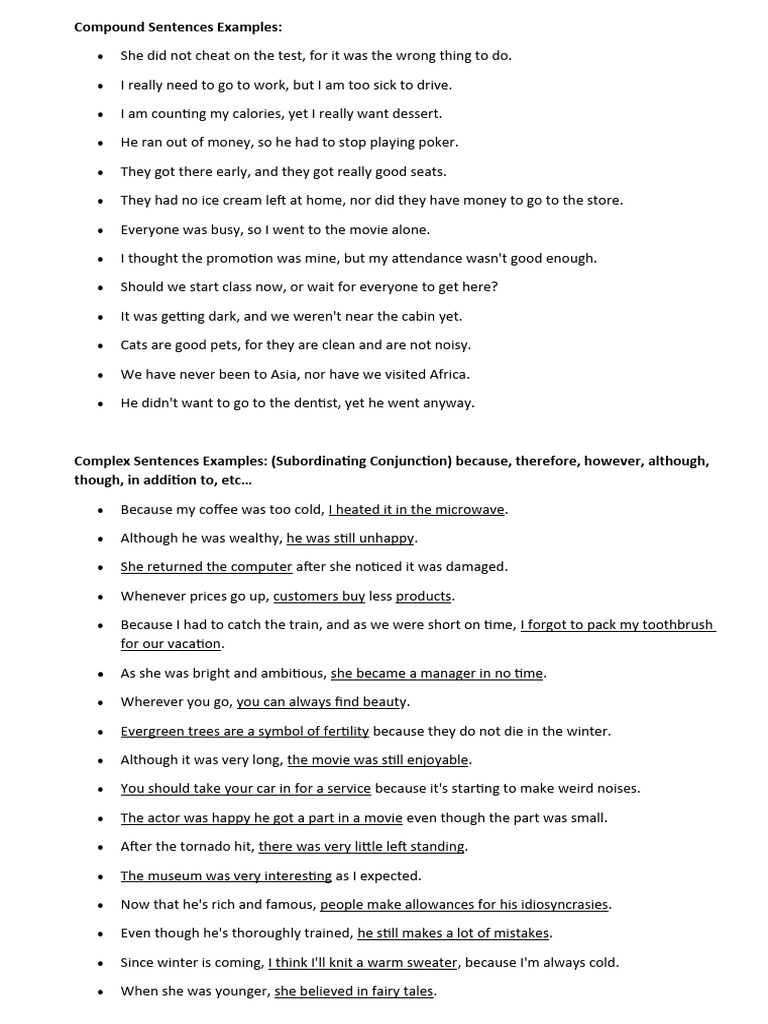
- “Although she was tired from a long day at work, Maria decided to go for a run, and her energy increased with each stride.”
- “The novel captivated readers for its intricate plot, which included unexpected twists, and the eloquence of its prose held their attention.”
- “Even though he had rehearsed diligently, the actor felt nervous before the performance, yet he delivered his lines flawlessly.”
Here, the richness of each sentence lies in their ability to convey contrasting emotions, complex events, or intricate details, prompting the reader to ponder deeper themes and broader implications.
The Significance of Compound-Complex Sentences
Why, then, should we embrace compound-complex sentences in our writing? The answer lies in their unparalleled capacity to enhance narrative depth. By judiciously weaving dependent and independent clauses, writers can:
- Convey Nuanced Meanings: A compound-complex sentence allows for the simultaneous expression of disparate ideas, encouraging readers to reconcile various perspectives and emotions.
- Create Rhythm and Flow: The interplay between different clauses can foster a lyrical quality, enhancing the reading experience and maintaining reader interest.
- Encourage Critical Thinking: Such sentences challenge readers to engage more actively with the text, making connections and deriving meaning from the interplay of ideas.
Exploring Promises and Consequences
Each compound-complex sentence carries a promise: a promise of complexity, of beauty, and of invitation into the labyrinth of thoughts. For instance, consider this sentence: “Though the storm raged outside, the children remained unfazed, and they crafted their own adventure with imaginative tales.” Here, the promise is multifaceted—while a storm typically connotes chaos and fear, in their imaginative world, it morphs into a backdrop for creativity and resilience.
This interplay between setting, emotion, and action piques curiosity, compelling the reader to contemplate the transformative power of perspective. Could it be that in moments of turmoil, creativity flourishes instead of falters? Such philosophical inquiries highlight the richness embedded within compound-complex sentences, encouraging deeper reflection and engagement.
Crafting Your Own Compelling Examples
If you find yourself drawn to the potential of compound-complex sentences, consider experimenting with their construction. Begin by identifying a series of related thoughts or a narrative that you wish to convey. Then, construct simple independent clauses, layering them with dependent clauses to add depth.
For example, take the foundational idea, “I enjoy photography.” This can be expanded to a compound-complex sentence: “While I enjoy photography, the technical aspects often confuse me, yet I am determined to improve my skills.” In this sentence, the interplay between enjoyment and confusion underscores a common struggle, inviting readers to empathize with the journey of learning.
Conclusion: A Tapestry of Language
As we conclude our exploration of compound-complex sentences, it becomes evident that their intricate structures possess the power to convey rich narratives and evoke profound reflections. Embracing this complexity allows writers to weave a tapestry of language that is not only informative but also deeply engaging.
Ultimately, the allure of compound-complex sentences lies in their ability to challenge perceptions, drive curiosity, and elaborate on the myriad dimensions of human experience. In mastering this sentence structure, writers can unlock new realms of expression, crafting prose that resonates and endures.