
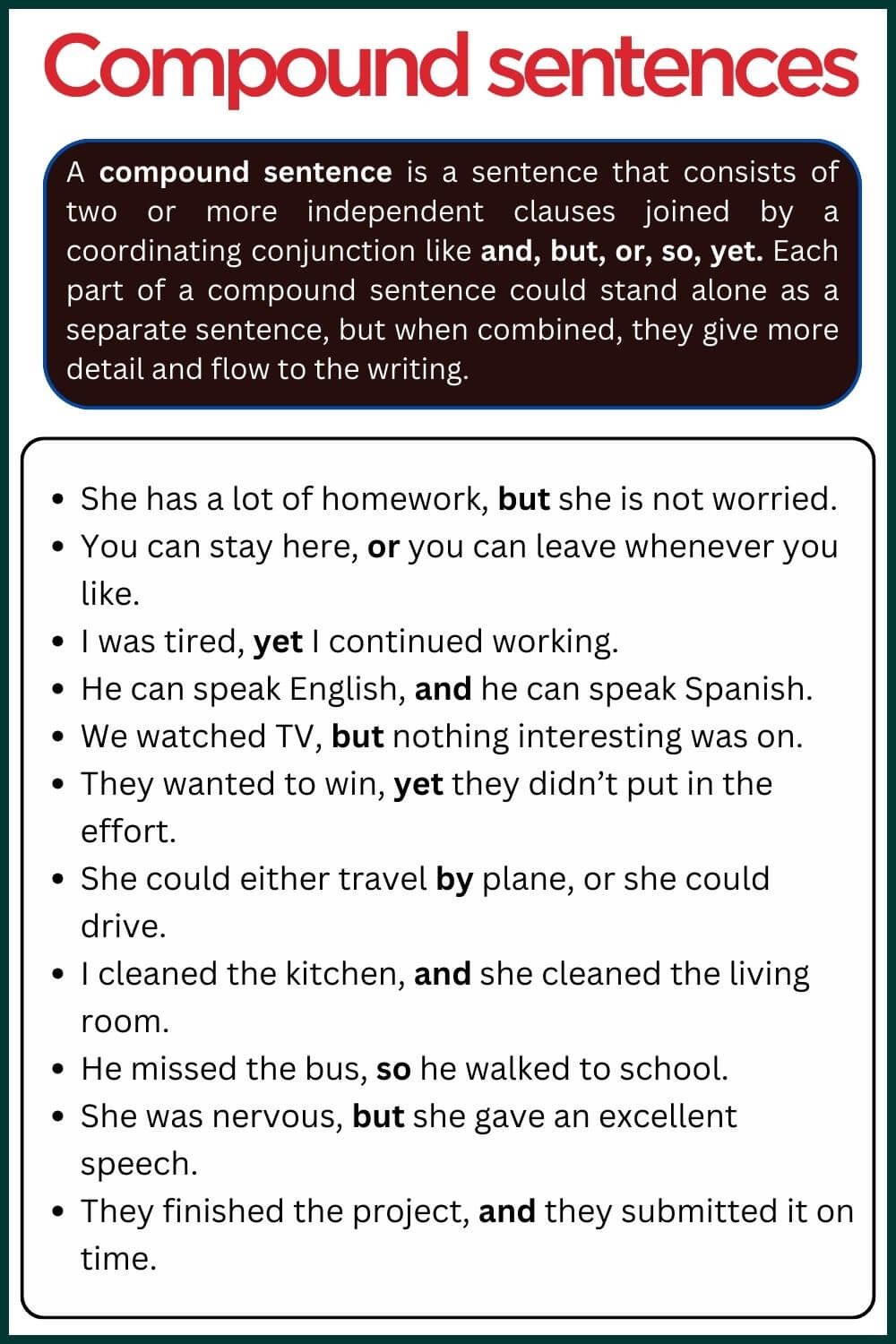
In the realm of language, sentences serve as the building blocks of communication, akin to how bricks form the foundations of a sturdy edifice. Among the various types of sentences, compound sentences occupy a unique niche, gracefully intertwining multiple independent clauses, much like a symphony harmonizes diverse musical notes into a beautiful composition. This article delves into the nuances of compound sentences, exploring their structure, significance, and the artistry they bring to everyday language.
A compound sentence is essentially a marriage of two or more independent clauses, joined together by a coordinating conjunction. This structure allows for the expression of interconnected ideas, thereby enhancing the complexity and richness of a statement. Consider, for instance, the simple declaration: “The sun set.” When combined with another independent clause, such as “the stars appeared,” it transforms into a compound sentence: “The sun set, and the stars appeared.” This union not only conveys more information but also creates a vivid mental image, evoking the beauty of a tranquil evening sky.
The connective elements employed in compound sentences—commonly referred to as coordinating conjunctions—include “and,” “but,” “or,” “nor,” “for,” “so,” and “yet.” Each conjunction carries its own connotation, impacting the relationship between the clauses it links. The conjunction “and” often suggests addition, whereas “but” introduces a contrast. The careful selection of these conjunctions allows the writer to craft sentences that resonate with emotion and clarity.
Exploring the structural elements of a compound sentence reveals its multifaceted nature. At its core, the sentence contains two independent clauses that can stand alone yet possess the potential to interlink. For example, “I wanted to go for a walk” can stand independently, but when melded with “it started to rain,” it evolves into: “I wanted to go for a walk, but it started to rain.” This structure offers an exquisite interplay of ideas, providing not just a statement but a narrative infused with tension and anticipation.
Venturing deeper into the significance of compound sentences uncovers their pivotal role in storytelling and effective communication. Writers utilize this sentence structure to convey complexity, mirroring the intricate tapestry of thoughts that characterize human experience. Compound sentences are indispensable in literary works, where authors often employ them to reflect the ebb and flow of character emotions, plot developments, and thematic elements. They serve as the brushstrokes of a painter, adding depth and dimension to the written word.
Moreover, compound sentences invite readers into a world enriched with nuance. Take the illustrative example: “He studied for hours, yet he felt unprepared for the exam.” Here, the juxtaposition of diligence and apprehension illustrates the complexities of life, enticing readers to reflect on their own experiences. Such sentences engage the audience, fostering a connection that transcends the mere exchange of information.
The unique appeal of compound sentences lies in their versatility. They can accommodate a multitude of subjects and verbs, allowing for dynamic expression. Whether discussing simple daily routines or profound philosophical debates, compound sentences can elevate the discourse. For instance, “The children played in the park, and their laughter echoed through the air” encapsulates a scene, painting a picture that resonates with anyone who cherishes the innocence of youth.
In crafting compound sentences, writers must be cautious about punctuation. The incorporation of a comma before the coordinating conjunction is crucial when linking two independent clauses. This small yet significant mark signals to the reader where one thought concludes and another commences, ensuring clarity and coherence. Failure to adhere to this convention can lead to what is known as a comma splice—an unintended grammatical error that can muddle the intended meaning.
Beyond merely showcasing grammatical prowess, compound sentences offer a lens through which one can explore the intricacies of relationship dynamics within language. They mirror interpersonal connections, echoing how ideas often intermingle and clash in conversation. Just as people navigate their relationships, negotiating through agreement and disagreement, compound sentences navigate the terrain of ideas, bridging gaps and fostering understanding.
In the educational sphere, teaching compound sentences provides students with invaluable tools for effective writing. Comprehending their structure and application empowers learners to express themselves with greater sophistication. The journey of mastering compound sentences can be likened to learning to play a musical instrument, where repetition and practice culminate in a harmonious fluency that enhances one’s communicative abilities.
As one traverses the landscape of written expression, embracing the allure of compound sentences not only enriches one’s writing but also infuses it with a sense of rhythm and flow. They serve to remind us that language is not merely a utilitarian tool; it is an art form that can evoke emotion and inspire thought. In the words of the poet, language is a garden where words bloom in resplendent phrases, and compound sentences are some of the most vibrant florals in that garden.
Ultimately, the exploration of compound sentences is an enchanting journey into the heart of language. They stand as a testament to the beauty of interwoven ideas, reminding us that communication is an intricate dance of thoughts and feelings. As we wield this powerful tool, let us embrace the majestic complexity of compound sentences, allowing our expressions to flourish and resonate in the tapestry of human experience.













